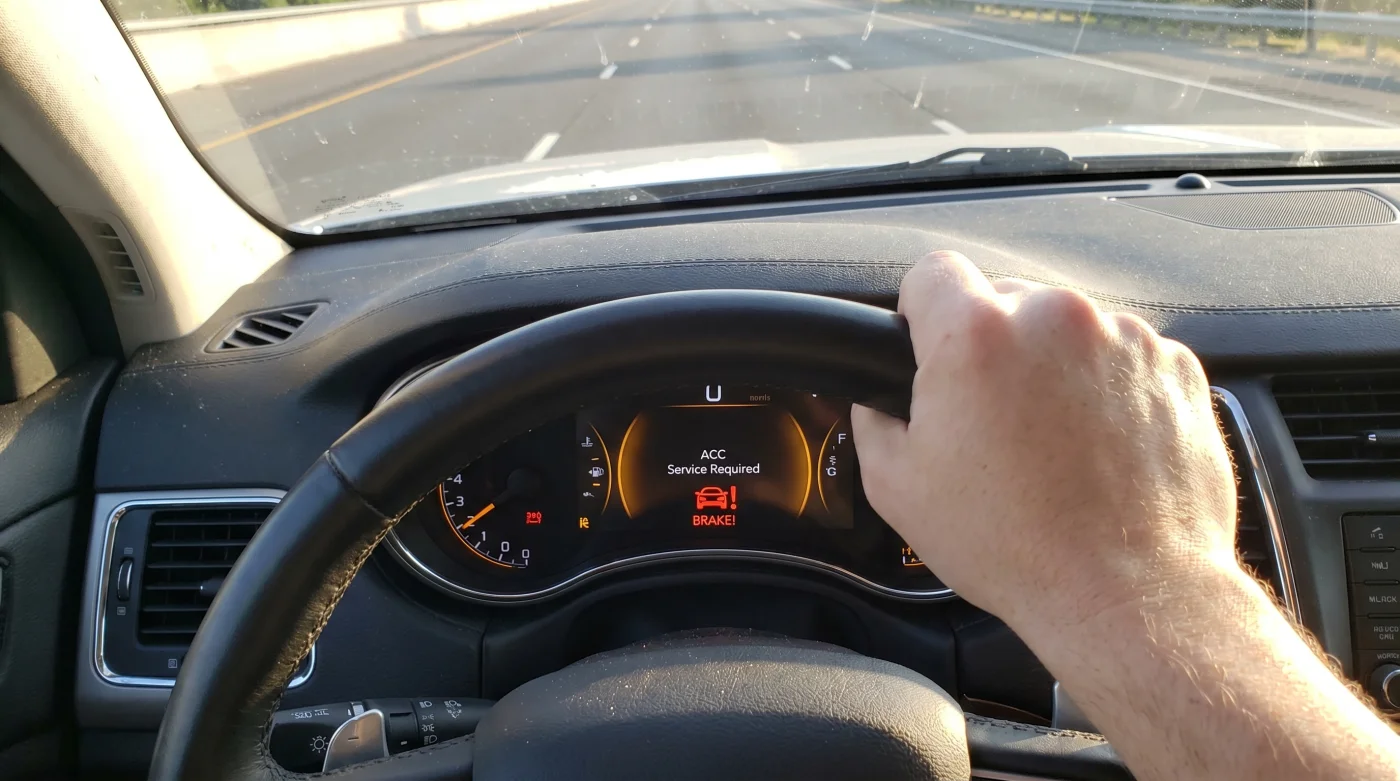
The interstate stretches before you like a ribbon of sun-bleached asphalt, the morning light catching the chrome on your steering wheel. You settled into the flow of traffic miles ago, your foot resting lightly on the floor mat while the adaptive cruise control handles the tedious rhythm of the commute. There is a specific kind of peace in this—a belief that the machine sees what you see, maintaining that perfect, invisible gap between your bumper and the world ahead. The cabin is quiet, save for the low hum of the tires against the road.
Then, without a shadow or a brake light in sight, your world tilts. The seatbelt cinches hard against your chest, the nose of your vehicle dives toward the pavement, and the tires chirp in a frantic, digital scream. Your heart hammers against your ribs as you glance at the rearview mirror, bracing for the impact of the driver behind you who didn’t expect a sudden stop in sixty-mile-per-hour traffic. For a split second, your car didn’t just malfunction; it flinched at a ghost.
This isn’t a freak occurrence or a stray shadow. For owners of various 2019-2023 FCA US vehicles, this ‘phantom braking’ has become a haunting reality. What we were told was a foolproof safety net has revealed itself to be a sensitive, sometimes erratic digital nervous system. When the hardware and software stop speaking the same language, the very tools designed to protect you can become the source of your greatest anxiety on the open road.
The Ghost in the Grille: The Myth of the Invisible Eye
We often treat driver assistance systems like a mechanical guardian, but a more accurate metaphor is a shaky telescope held by a panicked observer. Your vehicle’s adaptive cruise control relies on a radar sensor, usually tucked behind the front bumper or grille. This sensor sends out radio waves that bounce off objects and return, allowing the computer to calculate distance and speed. In the FCA lineup, from the rugged Ram 1500 to the family-focused Pacifica, this system is supposed to be the ultimate highway companion.
However, the recent recall data suggests the ‘eye’ is frequently misaligned. Think of it like trying to read a street sign while someone is gently nudging your elbow. If the sensor bracket—the physical metal or plastic housing holding the radar—is even a few millimeters out of true, the radio waves return distorted. The car’s brain interprets a bridge expansion joint or a overhead sign as a solid wall of steel. It doesn’t ‘think’ or ‘reason’; it simply reacts to the data, and that data says ‘impact imminent.’
- 2026 Cadillac Escalade lease deals mask a massive commercial weight tax exemption for buyers
- Honda EV sales slump proves premium brand pricing fails against heavily discounted budget models
- Hertz Shelby Mustang Mach E rentals expose severe tire degradation under real-world driving conditions
- Truck accident lawyer searches spike as new FMCSA commercial driving exemptions alter fleet liability
- Audi Q9 debut immediately sparks dealership inventory shortages for flagship luxury SUVs
The Detroit Diagnostic: A Whisper from the Shop Floor
Elias, a 48-year-old master technician who has spent two decades under the hoods of Mopar machines in a breezy Detroit workshop, knows this glitch by heart. He describes the radar bracket not as a heavy-duty component, but as something that feels like it’s breathing through a pillow. ‘I’ve seen trucks come in where a car wash brush or a tall curb bump shifted the sensor by a fraction,’ Elias says while wiping grease from a diagnostic tablet. ‘The driver thinks the car is possessed, but it’s just a hardware flinch. The software is looking for a perfect horizon that the bracket can’t provide anymore.’
This shared secret among mechanics highlights the fragility of our modern ‘armor.’ While we expect these vehicles to handle the grit of daily life, the high-tech sensors are often the first things to surrender to the vibrations of the road. When the bracket loses its factory-set rigidity, the phantom becomes a permanent passenger, waiting for the right angle of light or a specific curve in the road to trigger a lockdown.
Mapping the Malfunction: Who is Feeling the Jolt?
Not every driver experiences this anomaly in the same way. The impact of a misaligned radar sensor varies depending on how you use your vehicle and where you spend your miles. Understanding these nuances helps you reclaim a sense of control over the machine.
- The Long-Distance Voyager: For those who spend hours on the interstate, the sudden deceleration is a high-speed hazard. The system is most prone to errors when passing under wide overpasses or near metallic guardrails that ‘scatter’ the radar signal.
- The Heavy-Duty Hauler: In Ram trucks, the weight of a trailer can change the pitch of the vehicle’s nose. If the sensor was already leaning toward the pavement, a heavy load can aim the radar directly at the road surface, causing it to ‘see’ the ground as an obstacle.
- The Suburban Navigator: Stop-and-go traffic presents a different challenge. Here, the sensor might struggle with the ‘hand-off’ between the radar and the cameras, leading to jerky, inconsistent braking that feels more like a student driver than a sophisticated computer.
The Tactical Toolkit: Mindful Maintenance for the Modern Driver
If your vehicle falls within the 2019-2023 window, waiting for a dealer appointment doesn’t mean you have to drive in fear. You can adopt a more mindful approach to your vehicle’s exterior health to minimize the chances of a digital hiccup. It begins with treating the front fascia with surgical care.
- The Visual Scan: Once a week, inspect the front grille or lower bumper area where the radar plate sits. Look for cracks in the plastic or any sign that the housing is loose. If you can wiggle the sensor cover with your finger, the calibration is likely already compromised.
- Debris Management: Even a thin film of road salt, dried mud, or crushed insects can refract the radar signal. Use a soft microfiber cloth and warm water to keep the sensor area pristine. Never use abrasive chemicals that could cloud the plastic cover.
- The Manual Override: Remember that adaptive cruise is a luxury, not a requirement. In heavy rain, low sun angles, or areas with significant road construction, switching to standard cruise control (if your model allows) or manual throttle can prevent a phantom event.
The Bigger Picture: Restoring the Human-Machine Bond
At the heart of this recall is a question of trust. We buy these vehicles because they promise to make our lives easier, to act as a second set of eyes when our own grow tired. When that trust is broken by a sudden, violent braking event, the relationship with the vehicle changes. You stop looking at the scenery and start staring at the dashboard, waiting for the next error message to flash. Mastering the nuances of this hardware flaw is about more than just avoiding a trip to the dealer; it is about reclaiming your peace of mind behind the wheel.
By understanding that your car isn’t ‘broken’ but simply ‘misinformed,’ you move from a place of frustration to a place of authority. You become the pilot again, rather than just a passenger in a buggy simulation. As the industry moves toward even more automation, this moment serves as a vital reminder: the most important safety feature in any vehicle remains the person holding the wheel, capable of seeing the world in ways a radar sensor never will.
“True safety isn’t found in a sensor that never fails, but in a driver who knows exactly when the machine is guessing.”
| Key Point | Detail | Added Value for the Reader |
|---|---|---|
| Root Cause | Radar sensor bracket misalignment | Identifying that it’s a physical hardware shift, not just a ‘glitch.’ |
| Risk Factor | Highway speed phantom braking | Allows drivers to anticipate triggers like overpasses or guardrails. |
| Fix Strategy | Dealer recalibration & bracket reinforcement | Ensures the fix is permanent rather than a temporary software patch. |
Is my vehicle part of the 2019-2023 FCA recall?
Check your VIN on the Mopar or NHTSA website; most affected models include Jeep Grand Cherokee, Ram 1500, and Chrysler 300 variants.Can I still use regular cruise control safely?
Yes, standard cruise control typically ignores radar input, though you should confirm your specific model’s manual for ‘Normal Cruise’ mode.What should I do if the car brakes for no reason?
Keep your foot near the accelerator to ‘overpower’ the system and maintain steering control while checking your mirrors immediately.Does cleaning the sensor prevent phantom braking?
While it helps with signal clarity, it won’t fix a physically misaligned bracket, which requires professional recalibration.Will the dealer charge me for the recall repair?
No, safety recalls are performed free of charge by authorized dealerships regardless of warranty status.