The gravel of the small-town used car lot crunches under your boots on a chilly, forty-five-degree morning. There is a distinct smell of cheap interior tire-shine and damp Georgia red clay in the air. You are standing in front of a glistening 2015 Chevy Equinox, its paint polished to a mirror sheen, looking every bit like the reliable family crossover you need. The dealer smiles, hands you the keys, and tells you it has a completely clean history report.
Most buyers would immediately hop inside, adjust the mirrors, turn on the heater, and check if the radio works. They would marvel at the lack of stains on the upholstery and the smooth idle once the car warms up. But you are not most buyers. You are here to look past the fresh wax and listen for a silent killer lurking behind the passenger-side wheel well.
You insert the key, roll down the driver's window, and leave the door open so you can hear the engine bay. As you twist the ignition, you do not listen to how quickly the motor catches. Instead, you strain your ears for a very specific, brief sound that lasts for just two seconds: a dry, metallic clatter that sounds like a handful of loose quarters thrown into a running blender before it suddenly vanishes into a smooth hum.
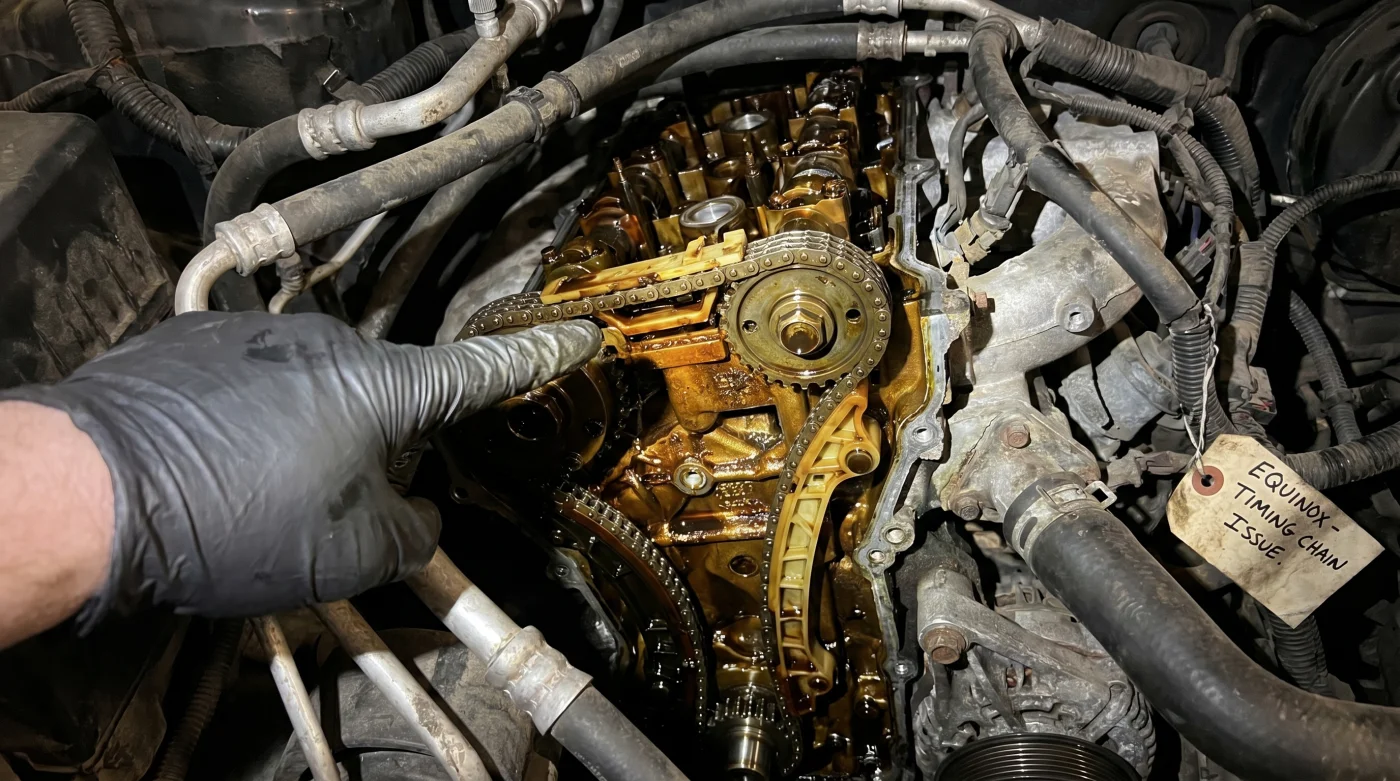
If you hear that fleeting rattle, you are listening to a mechanical death sentence. This is the sound of a stretched timing chain on GM's 2.4L Ecotec engine, a notorious flaw that has quieted thousands of these crossovers prematurely. If you do not know how to perform this specific auditory test, you could easily buy a ticking time bomb.
The Illusion of the Clean History Report
Many used car shoppers treat a clean history report like an impenetrable shield. They assume that if a car has a long list of oil change receipts, the engine must be in perfect health. But **metal has a long memory**, and a thin steel timing chain does not care about service records if those oil changes occurred at the manufacturer-recommended 7,500-mile intervals instead of a more realistic 3,000 miles.
Think of the timing chain as a heavy steel guitar string. Under constant heat and friction, it does not snap immediately; rather, it slowly stretches out of spec. Just a millimeter of stretch is enough to bleed off the hydraulic pressure needed by the tensioner to keep the chain tight. When the vehicle sits overnight, the oil drains back down into the pan, leaving the tensioner completely dry upon startup.
- Mazda Skyactiv engines demand this specific carbon cleaning before two hundred thousand miles
- Mazda CX-30 base models utilize a superior manual steering rack premium trims abandon
- Ford Bronco recall panic allows predatory dealerships to massively inflate safe inventory prices
- Tesla Model Y bumper redesigns secretly restrict vital battery cooling airflow during highway commuting
- Chevy Colorado Trail Boss trims hide a standard transmission cooler dealerships fiercely upcharge
When you start a compromised engine cold, that loose chain slaps violently against its plastic guides until oil pressure builds up to push the tensioner back out. That two-second rattle is the chain slowly shaving away at the plastic guides. Once those guides shatter, the chain jumps teeth, causing the pistons to smash into the valves, instantly destroying the engine.
The Shared Secret from the Toledo Engine Shop
Dave Miller, a fifty-two-year-old powertrain specialist from Toledo, Ohio, has rebuilt hundreds of these Ecotec engines over his thirty-year career. "The Ecotec is actually a decent little motor," Dave explains while wiping grease from his hands, "but it has a massive appetite for oil. The piston rings wear out early, causing the engine to burn oil without leaving a single drop on your driveway."
According to Dave, once the oil level drops even a single quart, the timing chain tensioner—which relies entirely on oil pressure—stops working properly. The chain stretches, the plastic guides crumble, and the owner is suddenly hit with a four-thousand-dollar repair bill on a car they just financed. The only way to protect yourself is to catch the chain in its early stages of stretching before it throws a diagnostic code.
Classifying the Risk: Which Equinox Are You Buying?
To navigate the used market safely, you must understand that not all Equinox model years are built the same. The severity of the timing chain issue varies dramatically depending on the powerplant resting under the hood.
The 2.4L Ecotec Four-Cylinder (High Risk): Found in the vast majority of Equinoxes built between 2010 and 2017, this engine is the primary culprit. It combines direct injection with high oil consumption, creating a perfect storm for timing chain wear. If you are shopping in this year range, you must treat every single engine as a suspect until proven otherwise.
The 3.0L and 3.6L V6 Engines (Moderate Risk): While much sturdier than the four-cylinder, these V6 models utilize three separate timing chains. **A single lazy tensioner** can throw off the valve timing of an entire cylinder bank. While they do not burn oil as aggressively as the 2.4L, they require the exact same startup scrutiny.
The Post-2018 Turbocharged Models (Low Risk): The redesigned Equinox models feature newer 1.5L and 2.0L turbocharged engines. While they have largely moved past the catastrophic timing chain failures of their predecessors, they are still highly sensitive to cheap oil and skipped maintenance intervals.
The Three-Step Cold-Start Auditory Test
To successfully execute this test, you must be patient and structured. Do not let the salesperson start the vehicle to "bring it around" for you. Walk up to the vehicle, pop the hood, and touch the engine block. If the metal feels warm to the touch, the seller has already warmed it up, which masks the rattle. Walk away and reschedule the test for when the engine is completely cold.
- Position Your Ears: Have an assistant sit in the driver's seat. Stand directly next to the front passenger-side wheel well with the hood popped. This is where the timing cover is located.
- The Ignition Moment: Instruct your assistant to start the engine while keeping the driver-side door open. Focus your attention entirely on the first three seconds of cranking.
- Listen for the Clatter: Listen for a dry, metallic shaking sound that mimics a bicycle chain slapping against a steel frame. It will be loud, harsh, and distinct from the normal tapping of direct-injection fuel injectors.
- Monitor the Silence: Note how quickly the noise disappears. If the clatter lasts for more than two seconds before fading into a quiet idle, the timing chain has stretched beyond the tensioner's ability to compensate.
The Tactical Inspection Toolkit:
- Engine State: Cold (must have sat idle for at least six hours).
- Mechanical Stethoscope: A cheap harbor-freight stethoscope or a long screwdriver held to your ear and pressed against the timing cover can amplify internal chain slap.
- The Dipstick Test: Pull the dipstick before starting. If the oil is dark, thick, or low, it is a sign of neglect that guarantees accelerated chain wear.
Why Auditory Inspection is Your Ultimate Shield
Navigating the used car market can make you feel incredibly vulnerable. You are forced to trust the word of a stranger while committing thousands of dollars of your hard-earned savings. By learning to **listen with a professional ear**, you bypass the sales jargon and peer directly into the mechanical heart of the vehicle.
Mastering this simple cold-start test allows you to walk away from a polished lemon before signing the paperwork. It shifts the power dynamic back into your hands, ensuring that your next vehicle purchase is a source of freedom, not a mountain of unexpected debt.
"If you hear a metallic rattle on a cold Ecotec engine that disappears after three seconds, do not buy the car expecting a cheap fix; that chain is minutes away from ruining your entire engine block."
— Dave Miller, Powertrain Specialist
| Key Sign | Sound Profile | What It Tells the Buyer |
|---|---|---|
| Immediate Cold-Start Rattle | Harsh, metallic clattering lasting 1 to 3 seconds. | The timing chain has stretched, and the tensioner is starved of initial oil pressure. Avoid purchasing. |
| Warm Engine Ticking | Consistent, light clicking that continues as the engine runs. | This is normal high-pressure fuel injector noise, typical of direct-injection GM engines. No cause for alarm. |
| Low Oil Level on Dipstick | No sound, but visual confirmation of oil consumption. | The engine is actively burning oil, which accelerates wear on the timing chain and tensioner. High risk. |
Frequently Asked Questions
Can I fix a rattling Chevy Equinox timing chain by simply switching to thicker oil?
No. While thicker oil might temporarily muffle the startup rattle by slowing down oil bleed-back, it does not fix the physical stretch of the steel chain. It is a temporary mask that will not prevent catastrophic engine failure.How much does it cost to replace a stretched timing chain on a 2.4L Equinox?
A professional timing chain replacement, including new guides, tensioners, and a water pump, typically costs between $1,500 and $2,200. If the chain has already jumped and damaged the valves, a full engine replacement can easily exceed $4,500.Will a stretched timing chain always trigger a check engine light?
Not immediately. A timing chain can stretch significantly and slap against the plastic guides for months before it stretches far enough to throw camshaft correlation codes like P0016 or P0017. The auditory test is your only early warning system.Are all model years of the Chevy Equinox affected by this issue?
The issue is most prevalent in the 2010 to 2017 model years equipped with the 2.4L Ecotec engine. Newer models built from 2018 onward feature redesigned engines that do not suffer from this specific failure rate.Should I immediately walk away from an Equinox if I hear this startup rattle?
Yes, unless the dealer is willing to discount the vehicle by the full cost of a professional timing chain replacement and you are prepared to have the work done immediately before driving the vehicle regularly.