A shimmering mirage dances across the concrete apron of a highway rest stop off Interstate 15. The July heat is relentless, hovering at a dry 112 degrees Fahrenheit, baking the roof of your vehicle until the sheet metal is hot enough to blister skin. Under the heavy hum of the high-output cooling fans, you grab the thick, liquid-cooled charging cable. It feels heavy, almost alive, pulsing slightly as it prepares to dump hundreds of kilowatts of electricity directly into your battery pack.
You slide the heavy connector into your car’s port, hear the reassuring click of the latch, and walk away to find air conditioning. You assume that the complex handshake between the station and your vehicle guarantees a safe, monitored flow of power. But inside that plastic handle, a silent war is being fought against basic thermodynamics, and the safety nets designed to protect your car might be looking the wrong way.
While you wait inside the convenience store, a microscopic layer of oxidation on the copper contact points is quietly altering the physics of your charge. The station continues to pump high amperage, unaware that the interface between its copper and your vehicle’s receptacle is steadily converting electricity into concentrated heat.
The Pinch Point: How Micro-Ohms Turn Into Thermal Furnaces
To understand why this happens, we must abandon the idea that metal-to-metal contact is ever perfectly flat. At a microscopic level, even the most polished copper terminal resembles a mountain range touching another mountain range. Current only flows through the peaks where the metals physically touch. When public chargers are subjected to hundreds of daily insertions, these peaks wear down, collect road grit, and oxidize in the humid summer air.
This degradation introduces a tiny fluctuation in electrical resistance, measured in micro-ohms. Under normal conditions, a resistance of 0.1 milliohms is negligible. However, when you subject that interface to a sustained load of 350 amps on a blistering afternoon, resistance becomes a thermal pump. The mathematical reality of power dissipation means that heat scales with the square of the current. A microscopic pocket of resistance that goes unnoticed during winter charging suddenly becomes an active heating element when the ambient air temperature is already pushing the cable to its absolute cooling limits.
Most public fast-charging stations feature thermal sensors, but these are typically located inside the handle housing, several inches away from the actual point of connection. By the time the handle’s sensor detects a temperature spike and trips the safety shutoff, the localized heat at the terminal interface has already far exceeded the melting point of the surrounding structural materials.
- Subaru Forester moonroof recall searches explode as shattered glass events abruptly surge nationwide
- Kawasaki hydrogen motorcycle prototypes spark a massive run on traditional supercharged Ninja inventories
- Mary Barra mandates trigger a sudden market shift heavily favoring heavy duty combustion
- Lamborghini hybrid V8 allocations vanish overnight as collectors panic buy remaining combustion models
- Multifuel engine platforms easily survive decades by bypassing modern high pressure fuel injectors
The Diagnostic Eye: A View From the Field
Marcus Vance, a forty-four-year-old heavy infrastructure electrician who services public charging corridors across the Southwest, carries a high-resolution thermal imaging camera on every service call. During the peak summer travel season, he regularly witnesses connector temperatures that defy manufacturer specifications. “People think the liquid cooling in these cables keeps everything cold,” Marcus says while examining a worn-out plug. “But that cooling fluid only runs up to the base of the handle. It doesn’t touch the actual mating pins where your car connects. If those pins are worn or dirty, they will cook themselves from the inside out while the cooling pump is running at full speed.”
Mapping the High-Heat Vulnerabilities
Not every charging scenario carries the same level of thermal risk. Understanding how your specific driving and charging habits interact with summer heatwaves can prevent a costly visit to the service center.
The Road-Tripping Family (Sustained High-Output Demand)
When you drive for hours at highway speeds, your battery pack is already warm from discharging. Arriving at a fast charger and immediately pulling maximum current means both the vehicle and the charging cable are starting their interaction from an elevated thermal baseline. Continuous back-to-back charging sessions leave no time for the vehicle’s inlet port to cool down, compounding the heat with each subsequent stop.
The Commuter with a Dusty Port (Contaminant Resistance)
Vehicles that spend years commuting through dusty environments or coastal salt air gradually accumulate a layer of non-conductive residue inside their charge ports. When you plug into a high-amperage station, this micro-debris prevents the spring-loaded sleeves of the connector from making full surface contact, forcing the entire electrical load through a fraction of the intended metal area.
The Legacy EV Owner (Mechanical Wear and Play)
Older vehicles with high mileage often have loose physical connections due to worn-out latching mechanisms or fatigued spring contacts inside the port. This physical play allows the pins to wiggle slightly during a charge cycle, causing micro-arcing that rapidly pits the metal surfaces and dramatically increases localized resistance.
The Pre-Plug Heat Mitigation Protocol
Protecting your vehicle from thermal damage during extreme summer weather requires a few deliberate, low-tech habits before you initiate a fast-charging session.
First, always perform a visual check of the plug head before inserting it into your car. Look inside the nozzle using your phone’s flashlight. If you see dust, dog hair, or green-gray oxidation on the metal sleeves, move to a different stall. A clean physical connection is your primary defense against thermal runaway.
- Inspect the latch: Ensure the plastic latch on top of the connector is intact and holds the plug firmly in place without sagging.
- Time your charging: Whenever possible during extreme heatwaves, schedule your DC fast-charging sessions for early morning or late evening when ambient temperatures are lower.
- Avoid maximum output: If your vehicle allows you to manually limit the charging rate, dropping the intake from 250 kW to 150 kW during peak afternoon heat can reduce thermal stress by more than half.
- Support the cable weight: Heavy, uncooled cables can pull downward on your port, causing uneven pin pressure. Use the cable management arm if available to relieve strain.
Keep a small, simple kit in your glovebox for high-temperature travel. Having the right tools on hand allows you to verify the health of your connection before any damage occurs.
| Tool Name | Primary Purpose | Added Value for the Reader |
|---|---|---|
| LED Pocket Flashlight | Visual inspection of female terminal sleeves | Detects hidden debris and pin misalignment before plugging in. |
| Plastic-Safe Contact Cleaner | Removing oxidation and road grime | Restores electrical conductivity without damaging sensitive port plastics. |
| Digital Infrared Thermometer | Monitoring handle temperatures | Allows you to safely check the plug handle for abnormal heat spikes during a session. |
Ownership in the High-Amperage Era
As we push transition boundaries toward faster charging times, we are operating closer to the physical limits of our materials. The convenience of adding two hundred miles of range in fifteen minutes requires us to respect the immense energy moving through these cables. A small amount of dirt or a slightly loose fit is no longer just a minor inconvenience; in the summer heat, it is a direct path to component failure.
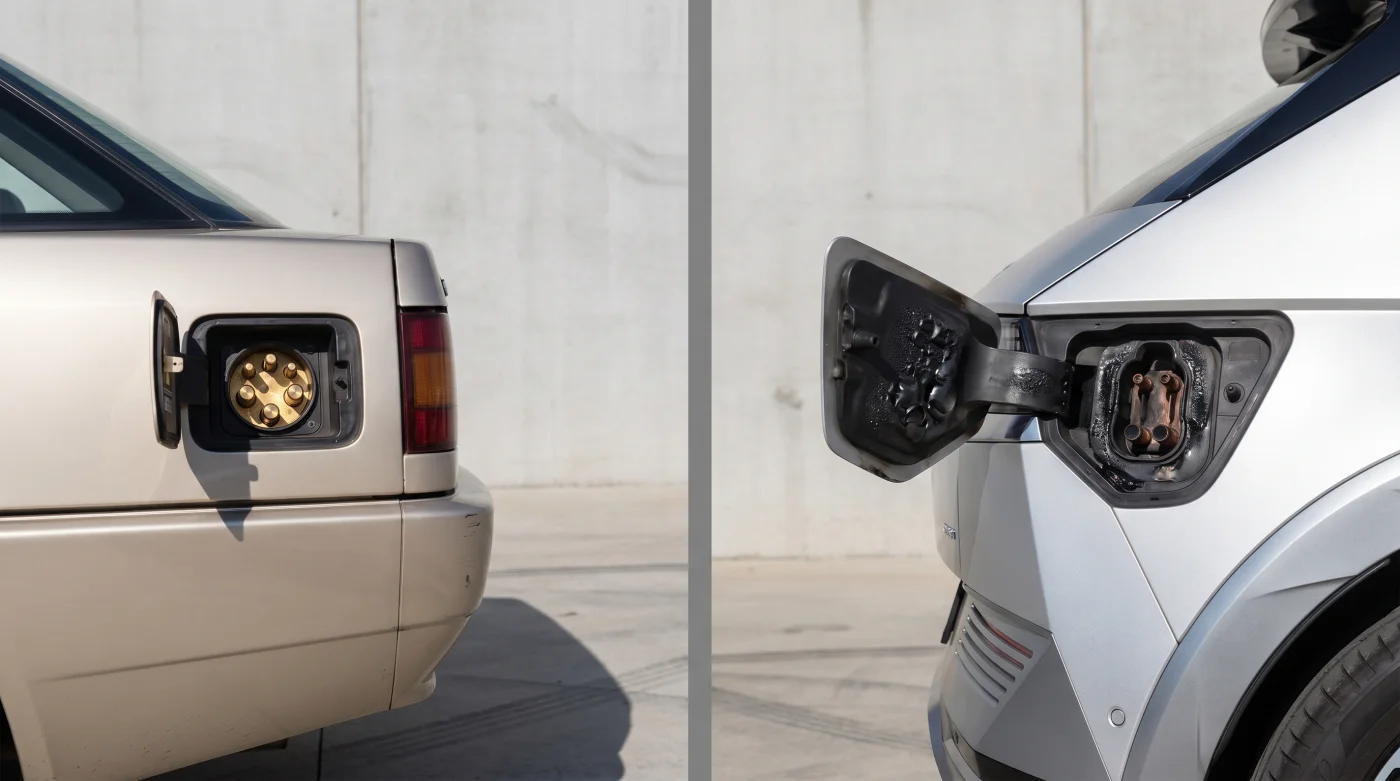
Taking a moment to examine the plug before you connect is a simple habit that preserves your vehicle’s most expensive components. Ignoring these subtle signs of wear can lead to a sudden, costly interruption of your journey, leaving you staring at a ruined charging port defined by a warped, blackened plastic housing surrounding the direct-current metal contact pins.
“Clean metal and physical pressure are the two unspoken laws of high-voltage transmission; lose either on a hot day, and physics will find a way to vent that energy.”
Frequently Asked Questions
Can I tell if a charging pin is melting while the car is charging?
Yes. If you smell a sweet, chemical odor resembling burning plastic near your charge port, or if the charging speed suddenly drops to a crawl without explanation, stop the session immediately using the station’s stop button or your mobile app before unplugging.Does rain or humidity make summer charging more dangerous?
High humidity accelerates the oxidation of copper pins, which increases electrical resistance. While charging systems are designed to be weather-resistant, checking for dry, clean connections is especially important during hot, muggy summer days.Should I spray electrical contact cleaner directly into my car’s port?
Only use fast-evaporating, plastic-safe contact cleaner designed specifically for electronics, and ensure the vehicle is completely powered off and unplugged. Never use WD-40 or household lubricants, which leave a flammable, non-conductive residue.Why don’t the built-in safety systems prevent this melting?
Safety sensors measure temperature at specific probe sites inside the handle and the vehicle’s inlet, but they cannot measure the exact point of contact between the male and female pins. If the heat rises too fast in a localized micro-gap, melting occurs before the sensor registers a system-wide hazard.Is NACS safer than the older CCS1 connector regarding heat?
While the NACS connector has a more compact design with excellent thermal characteristics, it is still subject to the laws of resistance. Any connector, regardless of standard, will fail if the contacts are worn, dirty, or subjected to extreme physical strain under high loads.