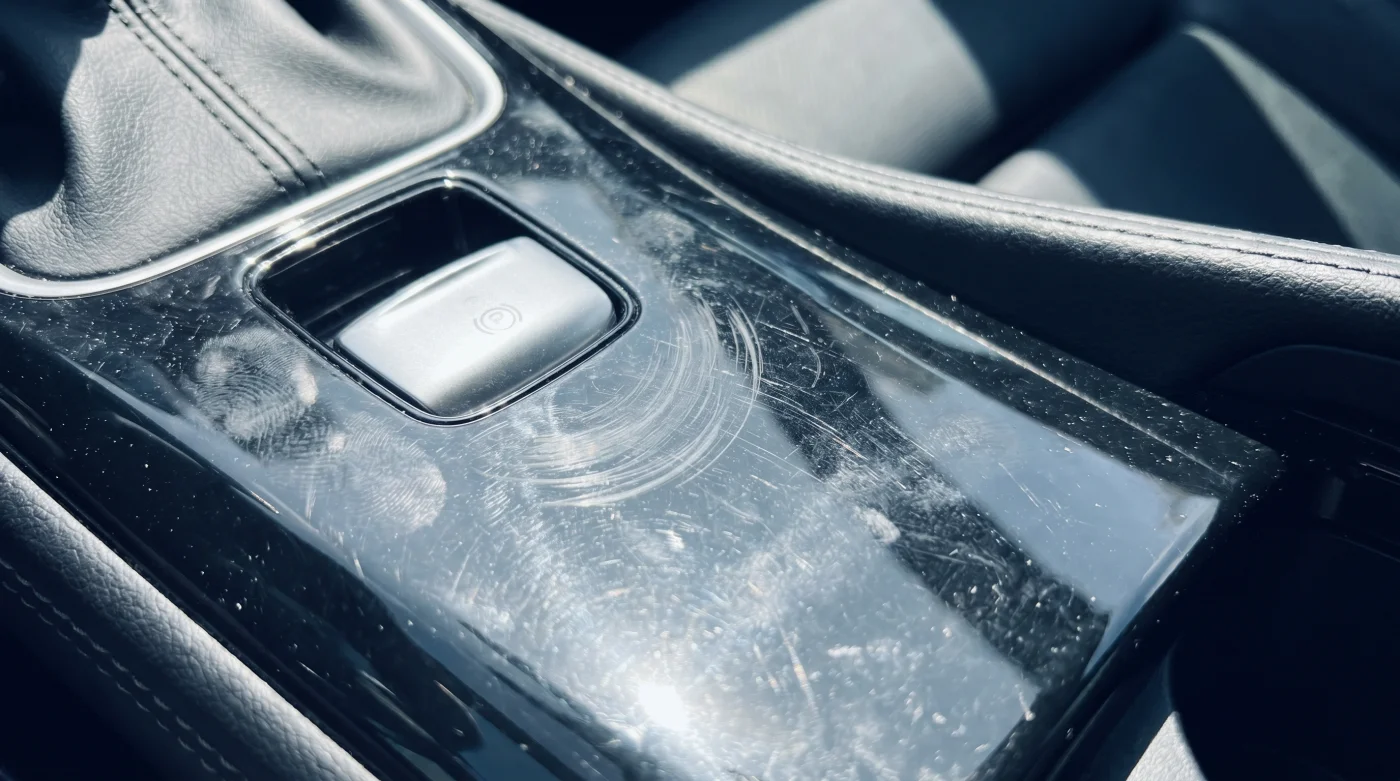
You pull your new car out of the dealership lot, the afternoon sun hanging low over the suburban horizon. For a moment, the cabin feels like a private jet—all sleek lines and obsidian surfaces. But then, it happens. A direct beam of light hits the center console, reflecting a blinding, white-hot spear of glare directly into your retinas. You squint, reaching for your sunglasses, only to notice that the pristine, ‘piano black’ surface around the gear shifter is already wearing a thin, greasy film of your own fingerprints. By the time you reach home, a single speck of dust has drifted onto the panel. You brush it away with your thumb, and in that fleeting second, you hear the faint, microscopic grit of the world against the plastic. Under the garage lights, you see it: a permanent, jagged micro-scratch. The honeymoon phase didn’t even last the commute.
The automotive industry calls this material ‘Piano Black,’ a name intended to evoke the timeless elegance of a Steinway grand. In reality, it is a low-cost thermoplastic, usually a variant of ABS or polycarbonate, designed to look expensive in a showroom brochure while failing every real-world durability test. It is the industry’s greatest sleight of hand. By replacing tactile buttons and textured, soft-touch materials with flat, glossy plastic, manufacturers shave hundreds of dollars off production costs while branding the result as ‘minimalist luxury.’ You aren’t just imagining the frustration; you are living inside a design flaw that actively degrades with every touch.
This material exists in a state of constant vulnerability. While the exterior paint of your car is protected by a multi-stage clear coat and perhaps a ceramic layer, the interior gloss trim is often raw, soft plastic. On the pencil hardness scale—a standard for measuring material resistance—most automotive piano black sits at a measly 2H or 3H rating. To put that in perspective, the common dust circulating in your HVAC system often contains particles of silica and quartz, which are significantly harder than the plastic itself. When you ‘dust’ your console with a dry cloth, you aren’t cleaning; you are essentially sanding the surface with grit, leading to that cloudy, hazed appearance that makes a six-month-old car look like a decade-old rental.
The Refraction Trap: Why Your Interior is Fighting Your Vision
The problem isn’t just aesthetic; it’s a matter of optical ergonomics. Designers used to obsess over ‘matte’ and ‘satin’ finishes for a reason. These surfaces diffuse light, allowing your eyes to focus on the road without distraction. Piano black does the opposite. It acts as a mirror, positioned specifically in the areas where the sun is most likely to reflect—the center stack and the door handles. The resulting glare hazards can momentarily bridge the gap between discomfort and a safety risk, especially during the ‘golden hour’ when the sun’s angle is most aggressive.
- Hyundai Ioniq 5 SE trim hides identical rapid charging architecture saving buyers thousands
- Honda Sensing false braking triggers invisible telematics penalties that artificially spike insurance rates
- Nissan Ariya e-4ORCE torque vectoring silently accelerates brake pad wear during daily commuting
- Ford Maverick AWD hybrid leaks expose a surprising rear suspension compromise for 2025
- Gasoline demand surges prove premature automaker EV deadlines ignore rural infrastructure realities
Elias, a 48-year-old master detailer in Orange County, sees the fallout of this trend every day. He tells a story of a client who brought in a $120,000 German SUV with only 800 miles on the odometer. The client was distraught because the entire center console looked like it had been scrubbed with steel wool. ‘He just used his shirt sleeve to wipe away some spilled coffee,’ Elias says, shaking his head. ‘That’s all it took. People think they’re being careless, but the truth is the material is engineered to fail the user. It’s a decorative finish applied to a high-traffic functional area. It’s like putting a silk rug in a mudroom.’
Segmenting the Struggle: How Your Lifestyle Dictates the Damage
Not every driver experiences the ‘gloss-black grief’ in the same way. Depending on how you use your vehicle, the degradation manifests through different vectors of frustration. Identifying your ‘usage profile’ is the first step toward mitigating the inevitable haze.
- The Commuter’s Glare: If you spend hours in directional sunlight, your primary enemy is the reflection. The high-gloss finish bounces UV rays directly into the driver’s peripheral vision, causing eye fatigue and distracting ‘flashes’ during turns.
- The Family Chaos Factor: For those with children, piano black is a magnet for organic oils and salt. Fingerprints aren’t just ugly; the acidity in skin oils can actually etch into the softer plastics over time if left in the heat, creating ‘ghost’ prints that won’t wipe away.
- The Tech-Obsessive’s Nightmare: If you constantly place your phone, keys, or sunglasses in the storage cubbies surrounded by this trim, the mechanical impact of those items will create deep gouges that no amount of polishing can truly erase.
Mindful Restoration: A Tactical Toolkit for Survival
Since the industry refuses to pivot back to tactile, textured surfaces, the burden of maintenance falls on you. To keep the surfaces from becoming a hazed mess, you must abandon the idea of ‘wiping’ and adopt a philosophy of ‘lifting.’ This is not about speed; it is about preserving the delicate surface tension of the plastic.
- The Pre-Wash Phase: Never touch dry gloss plastic. Use a can of compressed air or a very soft, long-bristled detailing brush to blow away loose dust. If you wipe it while dry, you are dragging sandpaper across the finish.
- The Lubrication Rule: Use a dedicated interior detailer with high lubricity. Spray it directly onto a high-GSM (grams per square meter) microfiber towel—never the plastic itself—to create a liquid barrier between the cloth and the trim.
- The ‘No-Pressure’ Wipe: Gently lay the damp towel over the surface and pull it toward you in one straight motion. Do not rub in circles. Circular motions create ‘swirl marks’ that are visible from every angle.
- The Protective Shield: Consider applying a DIY ceramic coating designed for plastics or, better yet, a pre-cut Paint Protection Film (PPF) kit. PPF is self-healing; when it gets scratched, the heat from the sun closes the gaps, keeping the underlying trim mint for years.
The Bigger Picture: A Return to Material Honesty
The obsession with piano black is a symptom of a larger shift in the automotive world: the prioritization of the ‘digital look’ over the physical experience. We have traded the satisfying click of a knurled aluminum knob for the cold, greasy smear of a plastic screen. But there is a quiet rebellion brewing. As more owners realize that their ‘premium’ interiors look haggard within weeks of purchase, the demand for matte carbon fiber, open-pore wood, and brushed metals is surging in the aftermarket.
Mastering the care of your interior isn’t just about resale value, though that is a significant factor. It’s about reclaiming your environment. When you sit in a cabin that isn’t throwing glare into your eyes or mocking you with a thousand tiny scratches, your heart rate drops. You feel a sense of order. By understanding that the trim is fragile, you stop blaming yourself for the damage and start treating the space with the technical respect it requires. Luxury should serve you, not demand that you serve it.
‘The most expensive material in your car shouldn’t be the one that looks the worst after a week of real-world use.’
| Key Point | Detail | Added Value for the Reader |
|---|---|---|
| Hardness Rating | 2H – 3H Pencil Grade | Explains why ‘soft’ dust causes ‘hard’ scratches. |
| Glare Hazard | Specular Reflection | Validates eye strain as a legitimate safety concern. |
| Maintenance | Wet-Lifting Method | Provides a repeatable system to stop further damage. |
Is there a way to permanently fix scratches in piano black?
Light micro-scratches can be polished out using a fine plastic finishing polish and a jewelry-grade microfiber, but because the material is thin, you can only do this a few times before wearing through the finish.Why do car companies keep using it if everyone hates it?
It is incredibly cheap to injection-mold and provides a ‘high-tech’ look in showroom lighting, which helps close sales even if it fails in daily use.Will a screen protector work on my console?
Yes, several companies now sell ‘interior PPF’ kits specifically cut for popular models to provide a self-healing barrier over the gloss plastic.Can I use Windex to clean the trim?
Absolutely not. The ammonia and harsh chemicals in glass cleaners can cause the plastic to turn brittle or develop a cloudy, permanent haze.Does the sun make the scratching worse?
Indirectly, yes. UV exposure can make the plastic more brittle over years, but more importantly, the sun reveals every scratch that was previously hidden in the shade.