The early morning sun catches the chrome of a 2019 Ford F-150 sitting on a suburban lot, its paint polished to a mirror finish that screams ‘well-maintained.’ You run your hand along the fender, feeling the cool metal, while the salesman talks about towing capacities and leather-trimmed seats. But beneath that gleaming hood, nestled against the frame rail where the light rarely reaches, a small plastic component is silently deciding the fate of your bank account. It doesn’t groan like a worn wheel bearing or puff smoke like a tired engine; it simply waits for the pressure to spike.
You crouch down, the smell of hot asphalt and tire dressing filling your nose, and peer into the wheel well. Most buyers look for rust or tire tread, but the real story is told in the shadows of the transmission cooling lines. In the world of the 10R80 10-speed automatic, the difference between a truck that lasts 200,000 miles and one that leaves you stranded on a highway shoulder comes down to a microscopic film of red fluid. If that fluid is anywhere but inside the line, the ticking clock has already started.
The standard expectation is that a ‘certified’ inspection covers the vitals, but a professional reality is far more surgical. Mechanics who live and breathe these trucks know that the factory quick-connect fittings on the transmission cooler lines are the hidden fracture point of the entire platform. While the rest of the truck feels like a tank, these nylon and plastic connectors are breathing through a pillow, struggling under the thermal cycles of daily US driving. When they fail, they don’t leak—they erupt, and by the time the dashboard lights up, the clutches are already burnt toast.
The Nylon Achilles Heel: Why Plastic Rules Your Transmission
To understand the F-150’s 10-speed, you have to stop thinking of it as a solid piece of machinery and start seeing it as a pressurized hydraulic ecosystem. The transmission fluid isn’t just a lubricant; it’s the lifeblood that manages shifting, cooling, and power delivery. The central metaphor here is a high-pressure fire hose connected to your house by a plastic garden-hose adapter. The metal lines are sturdy, the transmission case is stout, but the junction where they meet relies on a thin plastic clip and a rubber O-ring that can degrade over time.
Shifting your perspective means looking past the major mechanical components to the ‘integrity of the seal.’ Most used car checklists ask if the transmission shifts smoothly, but a 10R80 can shift perfectly right up until the moment it loses three quarts of fluid in sixty seconds. You are buying the cooling system just as much as you are buying the gears. If that cooling line connection shows even a hint of moisture, the ‘system’ has already begun to fail, regardless of how clean the Carfax looks.
- Chevy Trax MSRP illusion masks severe dealer markups targeting budget crossover buyers this month
- Jeep Grand Cherokee 4xe hybrid mechanics solve a massive off-road torque problem EVs ignore
- Acura MDX used models provide superior luxury insulation for half the European SUV price
- Honda CR-V EX base models hide the exact premium suspension hardware dealers upcharge for
- Chevy Tahoe automatic car washes silently destroy exterior trim clips ruining future resale value
Take the case of Mike, a 52-year-old fleet manager in Ohio who oversees nearly fifty F-150s. Mike doesn’t care about horsepower numbers or tech packages; he cares about ‘the weep.’ He once showed me a bin of discarded quick-connect fittings that looked perfectly fine to the naked eye. ‘See this haze?’ he asked, pointing to a faint, dull residue on the plastic. ‘That’s not dirt. That’s the 10-speed’s silent cry for help.’ Mike makes his technicians hand-inspect these lines every 10,000 miles, knowing that a $40 part is the only thing standing between his budget and a $7,000 replacement bill.
The Three Profiles of Cooling Line Risk
Not every used F-150 has lived the same life, and the stress on these plastic connectors varies wildly based on how the previous owner spent their weekends. Identifying which category a truck falls into tells you exactly how aggressive your inspection must be.
- The Suburban Commuter: These trucks often suffer from ‘heat-soak’ in stop-and-go traffic. Constant shifting between 1st and 10th gear in summer heat causes the plastic fittings to expand and contract repeatedly, which can harden the internal O-rings prematurely.
- The Heavy Hauler: If there’s a fifth-wheel hitch in the bed or a worn-out receiver, the transmission has lived at the upper end of its temperature range. High heat is the enemy of nylon connectors, making them brittle and prone to hairline cracks that only open under load.
- The Off-Road Explorer: Dust and grit are abrasive. When fine sand gets trapped between the plastic connector and the metal line, it acts like sandpaper every time the engine vibrates, slowly thinning the wall of the connector until it fails.
The Finger-Swipe Protocol: A Mindful Inspection
Checking these lines requires a minimalist, mindful approach. You don’t need a scan tool or a lift; you need a flashlight, a clean white rag, and a sensory focus on texture. This is about physical verification over digital assurance. Follow these steps before you sign any paperwork:
- Locate the transmission cooler, usually positioned in front of the radiator or integrated into the bottom tank.
- Trace the two lines back toward the transmission. Focus your eyes on the plastic ‘quick-connect’ caps near the front of the engine block.
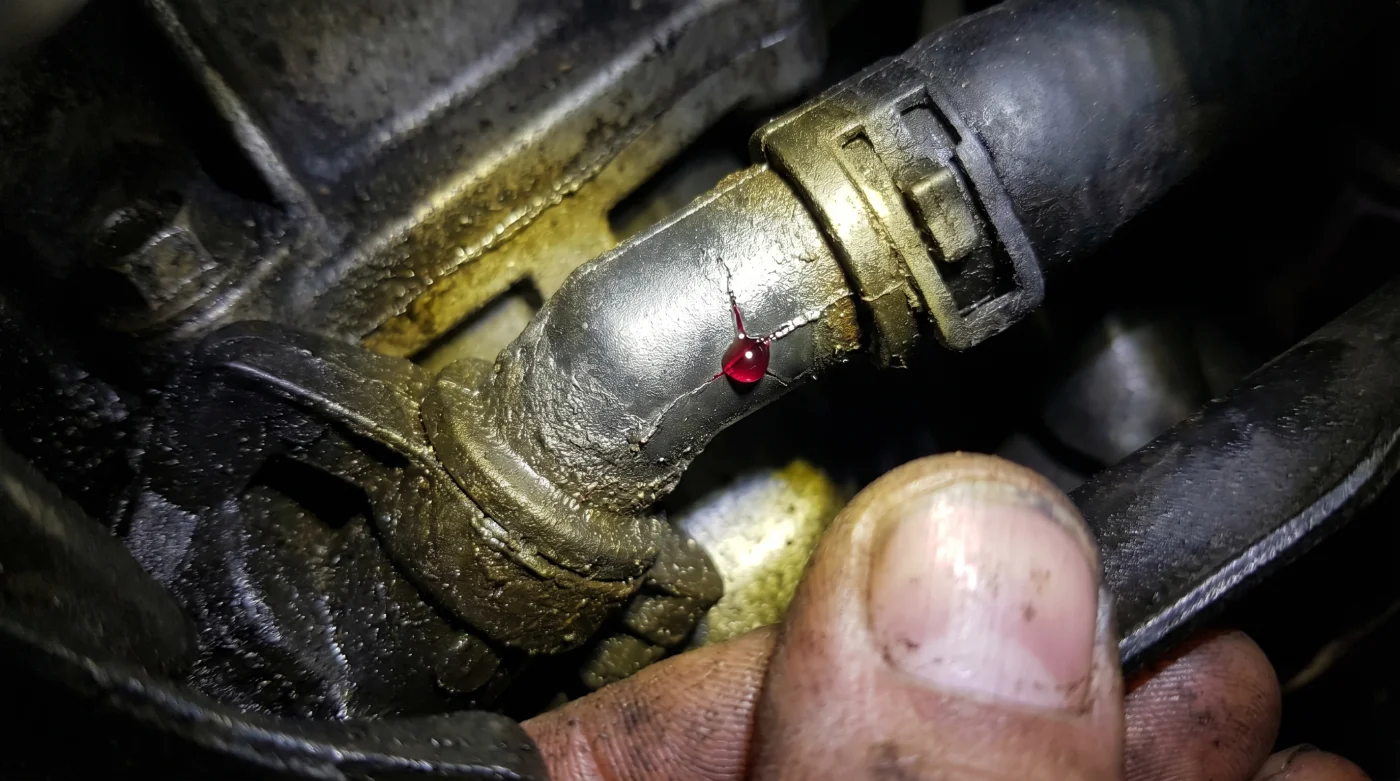
- Use a clean finger to reach behind the connector and swipe the underside. If your finger comes away with a ‘tacky’ feeling or a faint red hue, the seal is compromised.
- Gently wiggle the line. There should be a tiny amount of play, but if the connector feels ‘crunchy’ or stiff, the plastic has become heat-brittle.
- Check the frame rail directly below the fittings. Ford engineers designed these to drain away from components, so a ‘clean’ engine can often hide a damp frame rail.
The tactical toolkit for this job is simple: a bright LED light (at least 300 lumens), a white microfiber cloth to detect fluid color, and a pair of gloves to protect against a hot engine. You are looking for ‘microscopic seepage’—a faint dampness that traps road dust, creating a dark, grimy paste around the fitting that shouldn’t be there.
The Bigger Picture: Maintenance as Mindfulness
Mastering this single detail does more than just save you money; it changes your relationship with the vehicle. When you understand the ‘weakest link’ in a complex machine, you stop being a passive passenger and become an active guardian of reliability. There is a profound peace of mind that comes from knowing exactly where the danger lies and having the data to prevent it. You aren’t just buying a truck; you are buying the confidence that it will bring you home.
Ultimately, an F-150 is a tool of freedom, but that freedom is held together by small, often overlooked parts. By focusing on the integrity of the transmission cooling lines, you are valuing the long-term over the immediate. It is a quiet form of mechanical stewardship that ensures your investment remains an asset, not a liability, for the next hundred thousand miles.
“A transmission doesn’t die from old age; it dies from a loss of pressure that no one bothered to look for.”
| Key Point | Inspection Detail | Value for the Reader |
|---|---|---|
| Plastic Connector Integrity | Check for ‘tacky’ dust buildup around quick-connects. | Detects failure months before a major leak occurs. |
| Thermal History | Observe O-ring hardness and plastic brittleness. | Reveals if the truck was overworked or overheated. |
| Fluid Color Test | Wipe the fitting with a white cloth to find red tint. | Distinguishes between harmless water and vital oil. |
Is a small leak really that dangerous on the 10-speed? Yes, because the 10R80 operates at high pressures; a tiny ‘seep’ can turn into a full blow-out under the stress of highway merging.
Can I just replace the plastic clips myself? While possible, it is safer to replace the entire line assembly with the updated Ford part to ensure the metal flared ends haven’t been scored.
What is the average cost if this line fails while driving? If you stop immediately, $500 for the tow and repair; if you keep driving, $6,000 to $8,500 for a new transmission.
Does this affect the 6-speed models too? While all cooling lines can leak, the 10-speed’s specific plastic-to-metal interface is significantly more prone to microscopic seepage.
Should I buy a truck if I find a small seep? Use it as a negotiation tool. Ask for a $1,000 credit to have the cooling system overhauled by a specialist before you take delivery.