The morning light hits the asphalt of a liquidator’s overflow lot with a clinical, unforgiving glare. You walk past rows of white and blue stripes, the iconic Shelby branding shimmering against the familiar silhouette of the Mustang Mach-E. There is a specific silence here, broken only by the distant hum of traffic and the occasional metallic click of a cooling battery. These cars look pristine, their paint polished to a mirror finish by a fleet detailing crew, yet they carry the invisible weight of a thousand weekend thrill-seekers.
As you approach one of these Hertz liquidations, the smell of fresh tire shine and interior disinfectant fills the air. It is a seductive scent, masking the reality of what happens when a high-output electric motor meets the heavy right foot of a temporary driver. In the world of rental performance, ‘Unbridled’ mode is not just a setting; it is a permission slip for abuse. You are here to look past the badge and the synthetic motor growl, seeking the truth hidden beneath the chassis.
The tension in these deals is palpable. You are weighing the massive discount of a retired rental against the fear of a looming repair bill. Most buyers will check the tire tread and the leather bolsters, satisfied with a clean Carfax and a shiny hood. But the real story of a Shelby rental isn’t written in the maintenance logs; it is etched into the composite fibers of the battery shield, a part that has likely **scraped the earth during aggressive launches** more times than the dealer will ever admit.
The Architecture of an Impact: The Pavement-Slap Metaphor
Think of the Mach-E’s battery shield not as a rigid metal plate, but as a protective skin that behaves like a heavy rug. When a driver engages launch control on a Shelby-tuned EV, the instant torque causes a massive weight transfer. The rear squats, the front lifts, and for a split second, the mid-section of the car is at the mercy of physics. If the road surface is uneven, that composite shield doesn’t just clear the bump; it slaps it. It is like **breathing through a pillow** while someone steps on your chest—the pressure is immense, localized, and often silent.
Understanding this system means realizing that the shield is designed to sacrifice itself for the cells. However, in the rental circuit, repeated ‘slapping’ leads to a structural fatigue that standard inspections miss. You aren’t looking for a hole; you are looking for a shift in the material’s integrity. When the composite reaches its limit, it no longer protects; it merely hides the damage underneath, acting as a **veil for potential thermal instability** or moisture ingress.
- Tesla Model Y price change exposes how local dealerships artificially inflate used inventory
- Hertz Shelby Mustang Mach E rentals prove why pure EVs fail traditional road trips
- Porsche Panamera depreciation delivers exact flagship German performance under forty thousand dollars
- 2026 Cadillac Escalade luxury trims quietly hide the exact powertrain found in base models
- Chevrolet Camaro resale value plummets when owners modify the factory magnetic ride suspension
Grant Miller, a 52-year-old master technician who has spent three decades under the lifts of high-performance Ford shops, calls this the ‘Rental Ripple.’ He once showed me a Shelby Mach-E that had only 8,000 miles but the underbody of a car that had survived a rally stage. ‘People think because it’s an EV, there’s nothing to break,’ Grant told me while pointing a laser at a hairline fracture. ‘But when you dump 600 pound-feet of torque into a rental-grade asphalt patch, the car tries to fold itself. That shield takes the brunt of the flex, and it leaves a fingerprint every time.’
Segmenting the Liquidation Pool: Which Shelby Are You Buying?
Not every retired rental is a spent shell. To find the diamond, you must categorize the inventory based on its likely ‘life story.’ The ‘Airport Commuter’ is the gold standard—usually silver or black, these were rented by executives who needed a car to get to a hotel. They have higher mileage but fewer full-throttle cycles. You can spot these by the **even wear on the rear tires** and a lack of gravel spray in the wheel wells.
Then there is the ‘Weekend Warrior,’ the high-visibility white and blue models often found in vacation hubs like Las Vegas or Miami. These cars have low mileage but high ‘stress hours.’ This is where the battery shield inspection becomes a non-negotiable requirement. These drivers weren’t commuting; they were testing the 0-60 claims on every stoplight. If the car has **excessive rubber residue behind the rear wheels**, walk away or prepare for a deep dive into the underbody structure.
The Precision Inspection: A Physical Hack for the Shield
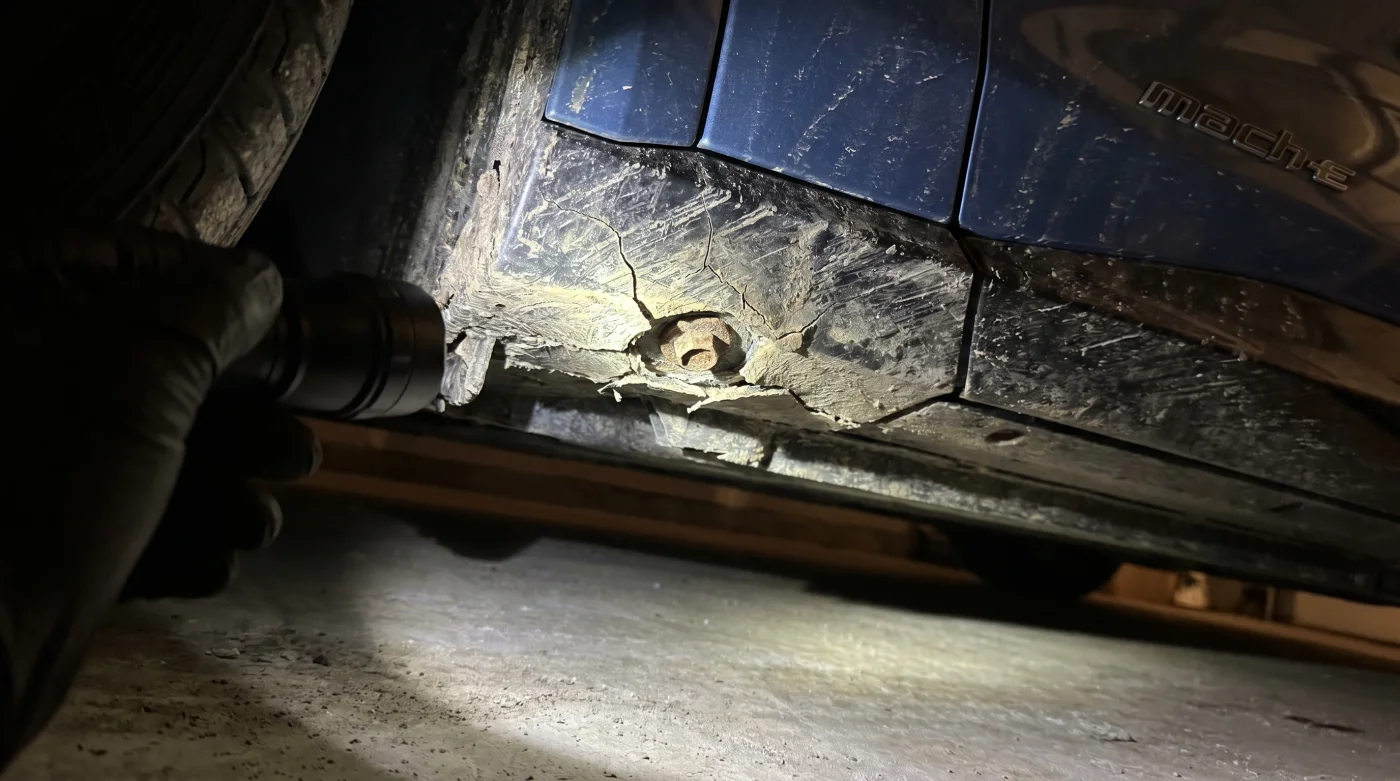
To perform this check properly, you don’t need a lift, but you do need to be willing to get close to the ground. This is a mindful process of observation that requires a high-lumen flashlight and a specific angle of approach. You are searching for ‘shimmering’—a sign that the composite fibers have separated under the heat of friction or the force of a strike.
- **The 15-Degree Light Sweep:** Lay your flashlight flat against the ground, shining the beam across the surface of the shield. This creates long shadows that reveal ‘micro-waves’ or ripples in the material that are invisible from a direct top-down view.
- **The Stress-Point Tap:** Using a plastic mallet or your knuckle, tap the center of the shield. A healthy composite sounds like a solid ‘thud.’ A fatigued or fractured shield will produce a hollow, rattling ‘clack,’ indicating the layers have delaminated.
- **The Bolt-Hole Alignment:** Check the mounting bolts where the shield meets the frame. If the shield has been pushed back by a high-speed bottom-out, you will see clean metal or ‘witness marks’ where the bolt used to sit.
Your tactical toolkit should include a telescoping mirror, a 1000-lumen LED light, and a pair of work gloves. Focus your energy on the **leading edge of the battery pack**, right behind the front wheels. This is the ‘strike zone’ where the most violent energy transfers occur during a botched launch or a high-speed dip. If you see white powdery residue or ‘spider-webbing,’ that car has seen more than just a few spirited drives.
The Bigger Picture: Securing the Legacy of the Spark
Mastering this inspection isn’t just about saving money on a used car; it is about reclaiming the peace of mind that high-performance ownership should provide. When you buy a Shelby, even an electric one, you are buying into a lineage of speed and precision. By identifying the ‘hidden flaws’ of the rental market, you ensure that your entry into this world is on your terms, not the terms of a reckless stranger who had the keys for forty-eight hours.
There is a quiet satisfaction in knowing the exact state of your machine. When you eventually pull that Mach-E into your own garage, you won’t be wondering if a structural ghost is haunting your battery pack. You will know that the **foundation of your vehicle is sound**, allowing you to enjoy the torque and the heritage without the nagging doubt of what lies beneath the surface. True authority comes from the details you choose not to ignore.
“The badge on the grille tells people what you bought, but the condition of the shield tells you what you truly own.”
| Inspection Point | Visual Signal | The Buyer’s Advantage |
|---|---|---|
| Composite Surface | Spider-web fractures or ‘shimmer’ | Identifies structural fatigue before it causes cell issues. |
| Mounting Bolts | Shifted witness marks or bare metal | Indicates a high-energy impact event during rental use. |
| Rear Inner Fenders | Grit blasting or heavy rubber build-up | Separates ‘highway’ rentals from ‘abuse’ rentals instantly. |
Is the Shelby Mach-E battery shield expensive to replace? Yes, because it often requires dropping the entire battery assembly to ensure no internal damage occurred, costing several thousand dollars.
Can I use a standard OBD-II scanner to find this damage? No; scanners detect electronic faults, but structural micro-fractures in the composite shield won’t trigger an error code until a sensor is actually crushed.
Does Hertz offer a warranty on these liquidations? Usually, they provide a limited powertrain warranty, but ‘wear and tear’ or ‘external impact damage’ like a cracked shield is often excluded from coverage.
Is the composite material weaker than steel? It is lighter and handles heat better, but it is more brittle, meaning it cracks under high-speed impacts where steel would merely dent.
Should I avoid all Shelby Mach-E rentals? Not at all. If the shield is clean and the tire wear is even, these cars represent one of the best performance-per-dollar values on the market today.