The morning air in your garage holds a peculiar stillness, broken only by the metallic ping of a cooling exhaust. You run your hand over the rear fender of your Chevrolet Camaro, feeling the cool, solid curve of American muscle. It’s a machine built for the open road, yet there’s a quiet anxiety that hums beneath the surface for those who plan to keep this car for a decade or more. You’ve heard the stories of the ‘shudder’—that rhythmic, unsettling vibration that feels like driving over rumble strips when the road is perfectly smooth.
Most owners treat the thick, glossy pages of the owner’s manual as sacred text. They see the 45,000-mile mark for a transmission fluid change and assume the engineers in Detroit have accounted for every variable. But when you pull the dipstick or drain the pan at that mileage, the fluid doesn’t look like the vibrant, translucent cherry red it started as. Instead, it’s a tired, brownish tea, smelling faintly of burnt sugar and hard-earned mechanical stress. This is where the gap between corporate maintenance schedules and real-world longevity begins to widen.
The 8-speed automatic in your Camaro is a marvel of quick shifts and fuel efficiency, but it has a sensitive heart. It breathes through a system that wasn’t designed for the humidity of the Gulf Coast or the stop-and-go heat of a Los Angeles July. By the time you reach that factory-recommended interval, the fluid has already begun to lose its chemical grip. It’s no longer a lubricant; it’s a moisture-wicking trap for grit that slowly eats away at the delicate clutch plates inside your torque converter.
The Fallacy of the Factory Interval
To understand why you must ignore the manual, you have to look at the transmission as a living organ rather than a sealed box. The metaphor is simple: if you only changed the oil in your frying pan every tenth meal, the flavor of the first meal would haunt the last. The Hydra-Matic 8L45 and 8L90 units rely on a very specific friction modifier that keeps the torque converter clutch from ‘slipping’ in a way that creates heat. When moisture enters the system—which it does through the vent tube during every cooling cycle—the fluid loses its chemical integrity.
- Honda EV sales slump proves why independent brokers negotiate superior Prologue lease deals
- Hertz Shelby Mustang Mach E liquidations demand a strict battery shield inspection hack
- Tesla Model Y price change exposes how local dealerships artificially inflate used inventory
- Hertz Shelby Mustang Mach E rentals prove why pure EVs fail traditional road trips
- Porsche Panamera depreciation delivers exact flagship German performance under forty thousand dollars
The factory schedule is often designed around the ‘initial owner’ experience, ensuring the car survives the lease term or the first 60,000 miles without a major claim. But you aren’t looking for a car that survives; you are looking for one that thrives at 200,000 miles. Waiting until 45,000 miles is like waiting for a toothache to go to the dentist. By then, the micro-pitting on the metal surfaces has already begun, and no amount of fresh fluid can reverse that physical scarring.
The Secret from the Michigan Proving Grounds
Take the case of Ray, a 58-year-old transmission specialist who spent three decades rebuilding GM gearboxes just outside of Flint. Ray doesn’t look at the mileage; he looks at the clarity. He once showed me a torque converter cut in half from a Camaro with 50,000 miles on the original fluid. The friction material looked like wet cardboard. “The manual tells you when the fluid is dead,” Ray told me while wiping grease from a heavy wrench. “I’m telling you when it starts to get sick. If you want 200k, you change it while it still looks like blood.”
This shared secret among high-mileage enthusiasts is that the first flush is the most critical. During the break-in period, the gears and clutches shed tiny microscopic particles of steel and paper. If these stay in the system for 45,000 miles, they act like liquid sandpaper, slowly enlarging the tolerances in the valve body. Changing the fluid early—specifically at the 30,000-mile mark or even sooner for heavy hitters—removes this ‘birth grit’ before it can cause permanent internal damage.
Tailoring the Routine to Your Right Foot
Not every Camaro lives the same life, and your maintenance should reflect the intensity of your relationship with the pedal. For the ‘Daily Commuter’ who spends hours in creeping traffic, the heat is your primary enemy. The constant shifting between first and third gear in traffic generates localized hot spots that break down the fluid faster than a high-speed highway cruise. If this is you, a 30,000-mile interval is non-negotiable.
Then there is the ‘Weekend Warrior,’ the driver who saves the car for mountain passes and the occasional track day. Here, the fluid isn’t just lubricating; it’s a heat sink. Under high-load conditions, the transmission temperatures can spike, literally cooking the additives that prevent the ‘shudder.’ For these owners, an annual fluid check and a 25,000-mile flush is the only way to ensure the metal stays cool and quiet.
The Mindful 30k Protocol
Applying this fix isn’t about complexity; it’s about a mindful commitment to the machine. You aren’t just ‘servicing’ a car; you are preserving a legacy of performance. This process requires the correct Mobil 1 Synthetic LV ATF HP fluid—the ‘Blue Label’ stuff that was formulated specifically to fix the moisture issues of the early 8-speeds. It’s a clean, deliberate act of staving off mechanical entropy.
- Ensure the car is level to get an accurate fill level.
- Use a thermal gun to check the transmission pan temperature; the level must be checked between 95°F and 113°F.
- Always replace the filter, even if the manual says it’s ‘lifetime’—nothing in a car is truly lifetime.
- Drain the pan, clean the magnets of any gray ‘sludge,’ and refill with the updated Dexron fluid.
Your tactical toolkit for this job is modest: a 10mm socket, a fluid transfer pump, and a steady hand. The goal is a ‘triple flush’ if you already feel a slight vibration, or a simple pan-drop if you are being proactive. This isn’t about being fast; it’s about being thorough, ensuring that no old ghosts remain in the lines.
The Peace of a 200,000-Mile Machine
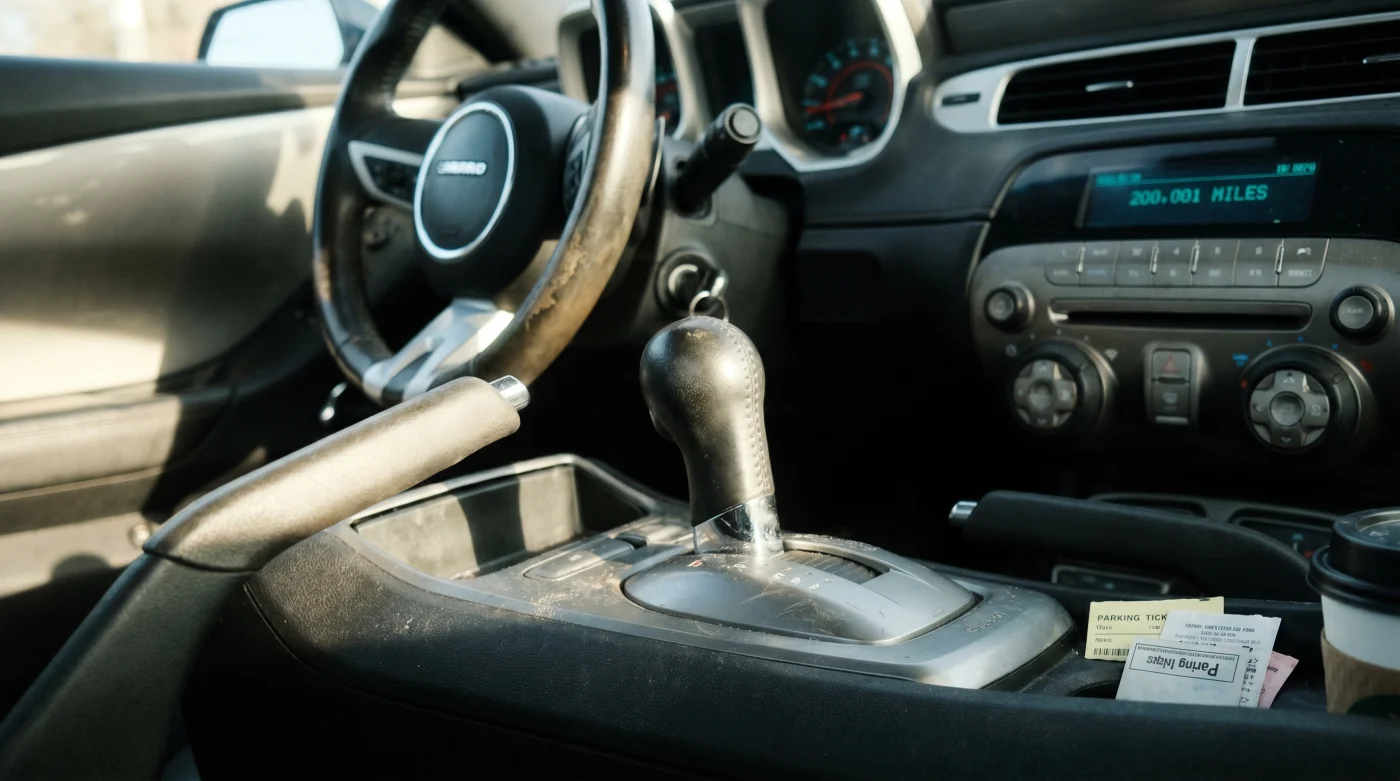
In the end, ignoring the factory interval is an act of defiance against the ‘disposable’ culture of modern manufacturing. By changing your fluid every 30,000 miles, you are ensuring that your Camaro remains as sharp and responsive as the day you first felt it pull away from the lot. There is a profound peace of mind that comes from knowing your gearbox isn’t a ticking clock, but a well-oiled heart of steel.
When you hit that 200,000-mile milestone, and your shifts are still crisp, silent, and immediate, you’ll realize the extra few hundred dollars in fluid was the cheapest insurance you ever bought. You aren’t just driving a car; you are tending to a piece of American engineering that will now outlast the very guidelines that were meant to define it. That is the reward of the expert.