You are sitting at a red light in a quiet suburb of Ohio, the morning air still carrying that crisp, metallic scent of dew on cold steel. When the light turns green, you press the gas pedal with a gentle weight, but your Ford hesitates. For a fraction of a second, the engine revs into a void before a violent thud—like a bowling ball dropping onto a hardwood floor—shakes the chassis. It is that notorious, soul-crushing hard shift from second to third gear that makes every owner fear their transmission is about to give up the ghost.
The dashboard remains silent, no ‘Check Engine’ light offering an explanation. You might think the clutches are burnt or the solenoids have failed, envisioning a four-figure repair bill at the local dealership. However, the reality under the hood is often less about mechanical failure and more about a confused digital brain trying too hard to please its driver. Your car has essentially developed a bad habit, writing a script for its own movements that no longer matches the physics of the road.
In the world of modern Ford vehicles, specifically those equipped with the 6R80 or the newer 10R80 10-speed boxes, the transmission learns your driving style. It records every throttle input and braking event, storing this data in the Adaptive Learning Memory. Over thousands of miles, this digital diary becomes cluttered with conflicting data points, leading to the erratic shifting, shuttering, and hesitation that plagues so many F-150s, Explorers, and Rangers. The fix isn’t a new torque converter; it is a total memory wipe.
The Ghost in the Adaptive Machine
To understand why your truck feels like it is tripping over its own feet, you have to view the Transmission Control Module (TCM) as a student taking frantic notes during a lecture. If you drive in heavy stop-and-go traffic for a month, the TCM adjusts the shift timing to be soft and cautious. If you then suddenly take it on a mountain pass, the computer struggles to reconcile its cautious notes with your aggressive demands. The result is a hesitation that feels like the gears are breathing through a heavy pillow.
- FCA US 2019-2023 recall delays silently destroy trade-in values at major dealership networks
- Chevrolet Camaro 200k-mile longevity requires skipping the factory transmission fluid interval entirely
- Honda EV sales slump proves why independent brokers negotiate superior Prologue lease deals
- Hertz Shelby Mustang Mach E liquidations demand a strict battery shield inspection hack
- Tesla Model Y price change exposes how local dealerships artificially inflate used inventory
Instead of thinking of this as a mechanical break, imagine it as a software glitch. The hardware is solid, but the instructions are garbled. By performing a battery terminal reset, you aren’t just cutting power; you are forcing the TCM to delete its entire history. You are giving the car a blank slate, allowing it to relearn the mechanical tolerances of its own internal clutches as they sit today, not how they were two years ago. It is the closest thing to a ‘fountain of youth’ for a Ford drivetrain.
I once met a man named Silas, a 67-year-old retired transmission builder from Dearborn who spent forty years inside the guts of Ford prototypes. He used to say that modern cars are too smart for their own good. Silas would watch frustrated owners trade in perfectly good trucks because of a ‘shudder’ that he knew was just a data corruption issue. He’d pull them aside in the parking lot and whisper the terminal trick, knowing it would save them five thousand dollars and a lot of heartache. This was his ‘handshake secret’—a way to bypass the service desk and talk directly to the machine.
The Ritual of the Terminal Reset
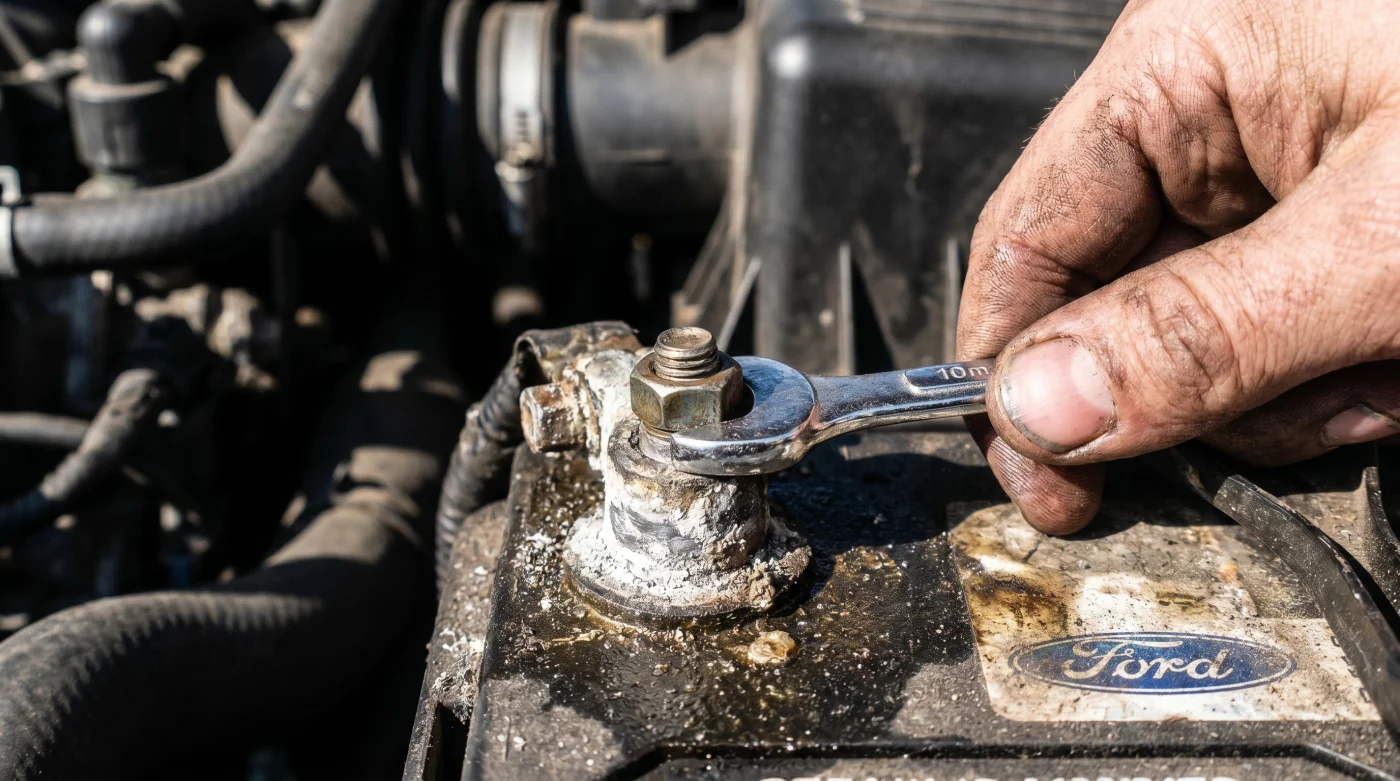
This process requires no specialized scanners or expensive software. It only requires a 10mm wrench and about thirty minutes of your time. You want to perform this when the engine is cold, allowing the metal to be at a neutral state before the computer begins its new calibration sequence. The goal is to drain every ounce of residual electrical charge from the system’s capacitors, ensuring the TCM memory is truly wiped clean.
- Locate the battery and use your wrench to loosen the nut on the negative (black) terminal. Pull the cable completely off the post and set it aside, ensuring it cannot touch any metal.
- Wait for a full 20 minutes. Some technicians suggest 15, but 20 minutes ensures that the ‘keep-alive memory’ (KAM) has zero voltage to sustain its data.
- For a more thorough ‘deep clear,’ some pros use a jumper wire to connect the disconnected negative cable to the still-connected positive terminal for 30 seconds. Warning: Never touch the battery posts together; you are only connecting the vehicle’s cables to drain the capacitors.
- Reconnect the negative terminal and tighten it until it is as snug as a firm handshake.
- Start the vehicle and let it idle for five minutes without touching the gas. This allows the engine to find its base idle speed with the new ‘clean’ map.
The Mindful Relearn Drive
The most critical part of this ‘secret’ isn’t the battery disconnect—it is what you do during the first ten miles after you put the wrench away. This is the ‘relearn phase.’ The TCM is now hyper-sensitive to every input you provide. If you drive like a maniac immediately, the car will learn to shift harshly. If you drive too gingerly, it may learn to slip the clutches too much. You must be the ‘perfect’ driver for these first few miles.
Find a flat stretch of road with minimal traffic. Accelerate with steady, medium pressure—about 25% throttle—allowing the transmission to move through every gear sequentially. Do not floor it. You want to feel each shift point. Then, slow down smoothly and let the gears downshift naturally. Repeat this cycle five or six times. You are essentially teaching the computer the ‘golden ratio’ of pressure and timing for your specific engine’s health. It is a meditative process, a conversation between your foot and the gearbox.
By the end of this drive, you will likely notice that the ‘thud’ has vanished. The hesitation between gears should feel as though it has been smoothed over with a hot iron. The car isn’t just running better; it is operating with a renewed logic that respects the current wear and tear of the vehicle. This isn’t a permanent fix—the computer will eventually start ‘learning’ again—but as a maintenance ritual every 20,000 miles, it keeps the driving experience crisp and predictable.
The Bigger Picture
In an era where we are told that every mechanical hiccup requires a trip to a specialist with a laptop, there is a profound sense of peace in knowing you can ‘fix’ your car with a simple wrench and a bit of patience. Understanding the digital heartbeat of your Ford removes the anxiety of the unknown. You stop hearing every click and clunk as a death knell for your bank account and start seeing them as signals that the system simply needs a reset.
Mastering this detail does more than just save you a repair bill; it restores the bond between driver and machine. You aren’t just a passenger in a computer-controlled box; you are the one who knows how to clear its mind. When that transmission shifts with buttery precision on your next morning commute, you’ll realize that the best tools aren’t always the most expensive ones—they are the ones that grant you authority over the technology you rely on every day.
“The most complex machines often suffer from the simplest of digital burdens; clearing the path for the data is as vital as greasing the gears.”
| Reset Stage | Action Required | Benefit to Driver |
|---|---|---|
| Negative Disconnect | 20-minute power cycle | Wipes corrupted adaptive shift data instantly. |
| Static Discharge | Jumper cable (cable-to-cable) | Ensures deep memory (KAM) is fully emptied. |
| Calibration Drive | Medium 25% throttle cycles | Custom-tunes shifts to current clutch wear. |
Is this reset safe for my car’s electronics? Yes, it is a standard procedure that mimics a battery replacement. Just ensure you don’t touch the positive battery post with the negative cable.
Will I lose my radio presets? In some older models, yes. In newer Fords, this data is usually stored on non-volatile memory, though your clock might need a quick adjustment.
How often should I do this? Whenever the transmission starts to feel ‘lazy’ or if you notice a consistent hard shift that wasn’t there before.
Does this fix actual broken parts? No. If a gear is physically chipped or a seal is blown, this software reset will only provide temporary relief at best.
What if the hesitation comes back immediately? This indicates a mechanical issue or a sensor failure (like a lead frame or solenoid) that requires professional diagnostic tools.