The morning mist clings to the hood of your new electric crossover, a silent promise of the futuristic serenity you paid for. You click the door shut, expecting that heavy, pressurized thud that signals entry into a private sanctuary. For fifty thousand dollars, you aren’t just buying a battery and a motor; you are purchasing a temporary escape from the chaotic roar of the American interstate. You pull out of your driveway, the initial low-speed hum of the pedestrian warning system fading into what should be total stillness.
But as the speedometer climbs past 45 miles per hour, something feels wrong. The air around the A-pillar begins to whistle, not like a refined machine cutting through the wind, but like breathing through a pillow. By the time you hit cruising speed on the turnpike, a persistent, hollow resonance begins to climb through the floorboards. It is a gravelly, metallic intrusion that feels jarringly out of place beneath a badge synonymous with Japanese precision. You realize, with a sinking feeling, that the silence you were promised has been replaced by the acoustic signature of a budget commuter car.
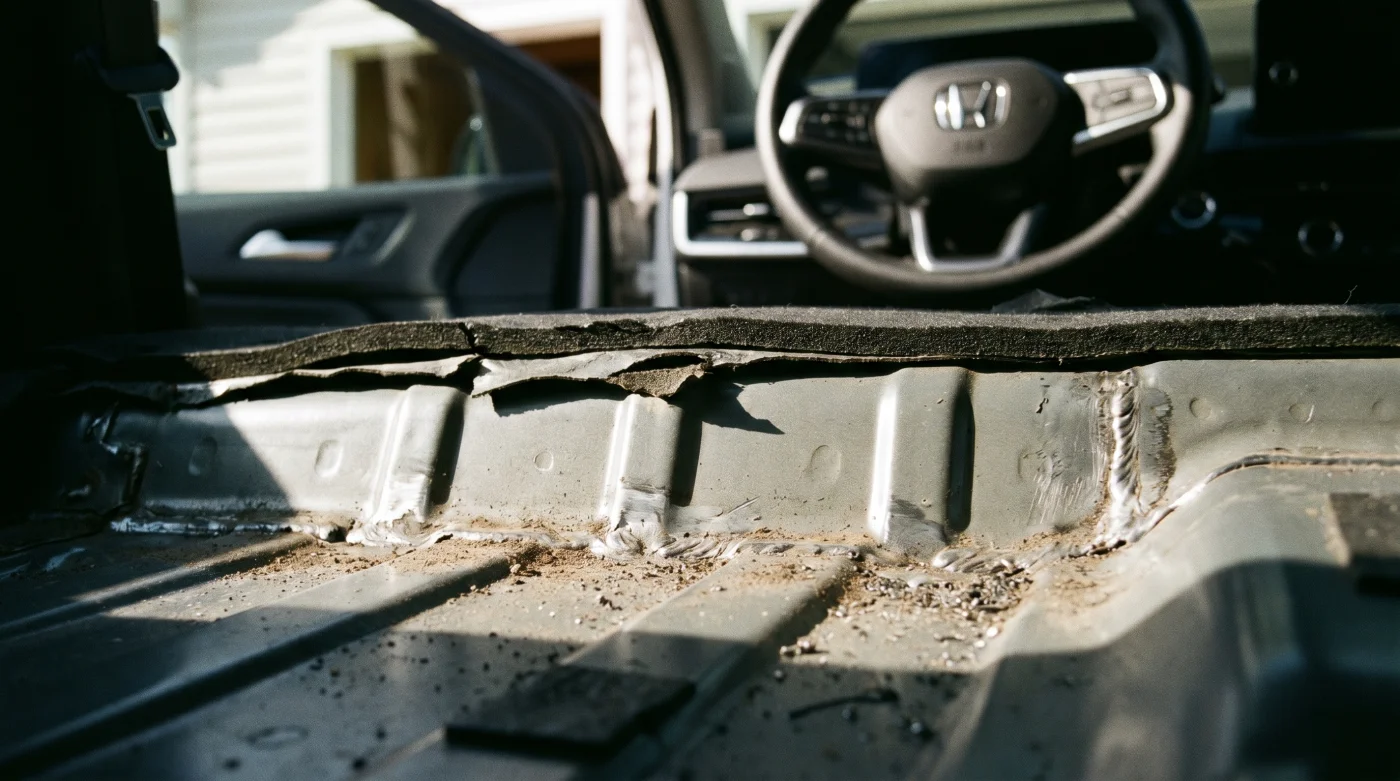
This isn’t an isolated quirk of your specific vehicle; it is the physical manifestation of a strategic gamble that is currently backfiring across the national market. The recent slump in Honda EV sales isn’t merely a byproduct of high interest rates or charging anxiety. It is the result of savvy buyers discovering that labels cannot mask physics. When you peel back the plush carpeting and the soft-touch dashboard of the Honda Prologue, you aren’t finding the bespoke engineering of a premium powerhouse. Instead, you are sitting on the bare-metal floor stamping of a budget-friendly General Motors utility platform.
The Platform Illusion: When a Badge Meets a Budget Chassis
To understand why your cabin feels louder than a ten-year-old Accord, you have to look at the ‘The Rental Car Skeleton’ metaphor. Imagine checking into a luxury hotel only to find that the bed frame is the same flimsy metal rack used in a roadside motel, hidden only by high-thread-count sheets. The Honda Prologue is the automotive version of those sheets. While the exterior skin and the interior interfaces scream ‘Premium Honda,’ the structural bones are shared with much cheaper siblings in the GM Ultium family.
The issue lies in the floor pan—the massive sheet of steel that forms the literal foundation of the car. In a true premium EV, this component is designed with intricate ribbing and heavy-duty acoustic baffles to quench road vibration. However, to keep costs down on a shared platform, manufacturers often use a thinner, more universal stamping. For a $35,000 budget EV, this is an acceptable compromise. For a premium crossover, it is an insult to the ear. You are essentially paying a premium price for a car that shares the same acoustic vulnerabilities as a vehicle designed for the rental fleet.
- Cybertruck wade mode real-world testing exposes severe differential pressure failures during shallow crossings
- NHTSA Honda rearview camera recall triggers a massive search spike for coaxial cable replacements
- Honda Prelude hybrid debut sparks massive inventory shortages for outgoing Civic coupes
- GM ends Silverado HD production sparking a sudden market shift toward heavy-duty Ford alternatives
- Ram Rumble Bee package demand wipes out remaining Hemi allocations overnight
The Expert’s Secret: Decibels Don’t Lie
Consider the case of Elias, a 54-year-old acoustic consultant who spent three decades chasing rattles for major Detroit firms. During a private teardown of the latest ‘co-developed’ EV platforms, Elias pointed to the wheel wells of the Prologue with a grimace. ‘You can see the cost-cutting in the sealant patterns,’ he whispered, gesturing to the thin ribbons of dampening material. ‘Honda buyers expect a specific frequency range—a dull thrum, not a high-pitched hiss. When you use a partner’s budget-grade floorpan, you inherit their noise floor, regardless of how much foam you stuff into the doors.’
Elias’s observation highlights the core of the sales slump: the American buyer is more perceptive than the marketing departments realize. When a driver takes a test drive and hears the same tire slap and wind whistle they experienced in a car costing fifteen thousand dollars less, the ‘premium’ illusion dissolves instantly. The market is correcting because the physical reality of the chassis has finally caught up to the prestige of the branding.
Deep Segmentation: Finding the Silent Peak
Not all electric crossovers are built with this ‘hollow’ foundation. Navigating the market requires knowing which manufacturers are investing in the metal rather than just the marketing. You must choose a vehicle based on its structural commitment to quietude.
- For the Purist: Look toward brands like BMW or Lucid, where the EV platform is proprietary and the floorpan is treated as an acoustic shield. These vehicles use multi-layered ‘sandwich’ steel that absorbs vibrations before they reach your seat.
- For the Pragmatic Family: If you are shopping the mid-tier, focus on vehicles with ‘acoustic glass’ on all four windows and felt-lined wheel wells. These small additions can dampen the budget-platform roar even if the bones are shared.
- The Budget-Savvy Buyer: If you go with a platform-shared model like the Prologue, do so knowing you are paying for the badge and the dealer network, not the structural refinement. Be prepared to invest in aftermarket sound-deadening mats under the rear cargo area.
The Mindful Inspection: How to Hear the Truth
Before you sign the papers on a new EV, you need to perform a physical audit of its acoustic integrity. Do not let the salesperson turn on the high-fidelity sound system. You need to hear the raw machine. Use these minimalist steps to find the hidden flaws in a vehicle’s insulation:
- The Knuckle-Tap Test: Tap your knuckles against the center of the rear floorboards and the inner wheel arches. If it sounds like a hollow tin can, the road noise will be relentless at highway speeds.
- The Concrete Rumble: Take your test drive on the roughest stretch of concrete highway nearby. Asphalt hides flaws; textured concrete reveals exactly how much vibration is entering the steering column.
- The Seal Check: Open the door and inspect the rubber gaskets. A truly premium crossover will have triple-sealed doors with a thick, bulbous gasket that ‘crushes’ to create an airtight vacuum.
The Bigger Picture: Reclaiming the Quiet
We live in an increasingly loud world, and the car has long been the last bastion of personal silence. When manufacturers try to mask budget components with premium branding, they aren’t just cutting corners on steel; they are eroding the peace of mind that comes with a quality machine. Mastering the knowledge of what lies beneath the carpet allows you to demand better. It moves you from being a consumer of ‘trends’ to an investor in engineering.
As the market shifts and sales data forces brands to reconsider these ‘budget-masking’ strategies, the ultimate winner is you. By recognizing that true luxury is structural, you ensure that your next forty thousand miles are spent in the meditative silence you deserve, rather than a sixty-decibel reminder of a corporate compromise.
“Noise is the physical residue of an unfinished engineering thought; a truly premium car should feel as though the world outside has been placed on mute.”
| Key Point | Detail | Value for the Reader |
|---|---|---|
| Platform Sharing | Honda Prologue uses GM Ultium budget stamping. | Avoid paying premium prices for budget foundations. |
| Acoustic Integrity | Floorpan thickness determines highway cabin roar. | Identify NVH issues before the purchase. |
| Market Correction | Sales slumps reflect buyer’s sensory disappointment. | Leverage slow sales for better dealer negotiations. |
Is the Honda Prologue louder than other EVs in its price bracket?
Yes, because it shares structural components with lower-tier GM models, it lacks the bespoke sound-dampening found in competitors like the Hyundai Ioniq 6 or Tesla Model Y.Can I fix the road noise in a budget-platform EV?
You can improve it by installing heavy butyl-rubber mats (like Dynamat) under the trunk liner, but structural vibrations through the floorpan are difficult to fully eliminate.Why did Honda use a GM platform instead of their own?
It was a speed-to-market strategy to catch up in the EV race, but it forced them to inherit the acoustic compromises of a more mass-market chassis.Does the wheel size affect this specific noise issue?
Significantly. Choosing the smaller 19-inch wheels over the 21-inch options provides more tire sidewall to absorb the vibrations that the thin floorpan cannot.Should I wait for the next generation of Honda EVs?
Yes. Honda’s upcoming ‘0 Series’ platforms are being engineered in-house with a focus on ‘Thin, Light, and Wise’ structures that promise to fix these shared-platform flaws.