The sky over South Florida turns a bruised purple, the kind of heavy, humid afternoon where the air feels like a damp wool blanket. You sit inside your Cybertruck, the silence of the cabin broken only by the rhythmic, heavy thud of raindrops against the stainless steel. Ahead, a street has transformed into a shallow canal. You tap the screen, watching the suspension rise with a mechanical sigh as ‘Wade Mode’ engages, pressurizing the battery pack with a faint, high-pitched hum that suggests you are invincible.
There is a seductive power in that blue icon. It feels like a software-driven superpower, a digital shield that separates you from the shivering sedans abandoned on the shoulder. You feel the **water ripple against the floorboards**, a dull vibration that tells you the truck is displacing thousands of pounds of liquid. It feels controlled, engineered, and entirely safe. But beneath that digital confidence, a timer is ticking, and a microscopic sensor is logging a data point that could cost you the equivalent of a suburban mortgage.
The reality of modern EV engineering is that software often writes checks that physical hardware cannot always cash. While the screen tells you the battery is being pressurized, it doesn’t mention the **invisible physics of fluid dynamics**. As you edge forward, the desire to get home quickly competes with the mechanical limits of a breather valve never designed to fight a wake at speed. One heavy foot on the accelerator, and the shield doesn’t just flicker—it dissolves, leaving a permanent digital fingerprint in the car’s logs.
The Pressurized Illusion and the 5-MPH Ghost
To understand the danger, you have to stop thinking of Wade Mode as a boat setting and start seeing it as a pressurized glass jar. Tesla uses the onboard air suspension tanks to pump positive pressure into the battery enclosure. The logic is simple: if the pressure inside the battery is higher than the water pressure outside, water cannot get in. It is a brilliant bit of **avoiding a mechanical failure** through pneumatic force. But this system has a breaking point that isn’t determined by depth, but by velocity.
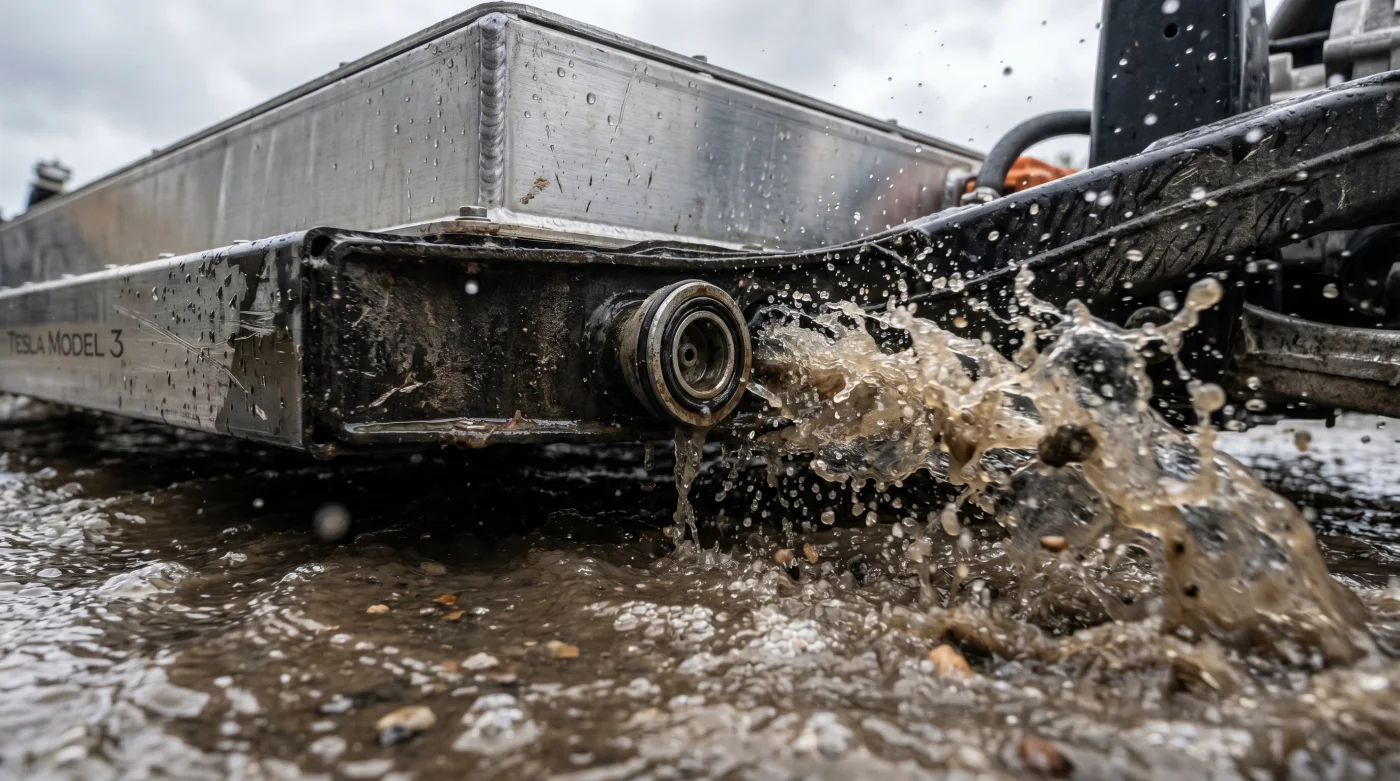
Think of it like trying to blow air out of your mouth while someone points a high-pressure garden hose at your lips. At a standstill, your breath keeps the water out. But if the water hits you with enough speed, it overcomes your internal pressure. In the Cybertruck, that threshold is roughly 5 miles per hour. When you exceed the recommended speed in deep water, you create a bow wave that **forces water into breather valves**, the very components designed to let the battery ‘breathe’ during temperature fluctuations. This isn’t a leak; it is a forced entry.
- Hyundai vehicle fire risk recalls force a complete thermal management supplier production pivot
- NHTSA Honda rearview camera recall legally halts thousands of used dealership trade-ins overnight
- GM Silverado HD production endings create an immediate heavy fleet truck inventory crisis
- Tesla Wade Mode suspension metrics expose a massive water intrusion flaw Rivian avoids
- Jeep Cherokee PTU recall realities demand a specific fluid transfer test before buying
Marcus, a 44-year-old independent EV forensic specialist in Houston, has seen the aftermath of this specific overconfidence more times than he can count. He recently inspected a Cybertruck that looked showroom-new but had been flagged by Tesla’s backend servers. The owner had crossed a flooded intersection at 12 mph. The logs showed the Wade Mode activation, the ride height, and the exact moment the **pressure differential was breached**. The battery didn’t fail immediately, but the moisture sensors triggered a permanent ‘Warranty Void’ flag. Marcus calls it the ‘Resale Killer’—a truck that functions perfectly today but is worth zero on the trade-in market because its $30,000 heart is no longer protected.
Navigating the Thresholds of Risk
Not every driver uses Wade Mode for the same reason, and the consequences scale differently depending on your intent. The car treats these activations with clinical precision, and the ‘Black Box’ data is unforgiving during a private sale or a dealer appraisal. Understanding your specific ‘category’ of use can help you decide if the risk to your **long-term asset value** is worth the temporary convenience of a dry commute.
- The Commuter: You are just trying to get home. For you, the risk is highest because frustration often leads to speed. Exceeding 5 mph to shave two minutes off a commute is a $50,000 gamble.
- The Off-Road Enthusiast: You seek the thrill. You understand the mechanics but often forget that the ‘Log’ is permanent. Even if the truck survives the trail, the **voided warranty remains a ghost** that haunts the title.
- The Emergency Responder: You are helping others. In this case, the car is a tool, and the cost is secondary to the mission. But be prepared for the insurance company to deny claims based on ‘intentional misuse’ recorded in the firmware.
The mechanical threshold is a physical reality that no software update can fix. When water is forced into the battery casing, it introduces minerals and conductivity where there should be none. Even if the water evaporates, the **residue creates micro-shorts** that degrade the cells over months. This is why Tesla’s warranty language is so specific: the mode is a ‘best effort’ feature, not a certification of submarine capability.
The Mindful Crossing: A Tactical Guide
If you find yourself forced to use this feature, treat it with the same reverence a pilot treats a landing in a crosswind. It is a high-stakes maneuver that requires absolute focus on the telemetry, not the road ahead. You are managing a **delicate balance of air pressure**, and any sudden change in velocity can shatter that equilibrium.
- Engage Wade Mode at least 10 minutes before entering the water to allow the battery to reach full pressurization.
- Maintain a steady, crawling pace of no more than 2 to 3 miles per hour to minimize the bow wave.
- Keep the steering wheel straight; turning creates localized pressure zones near the wheel wells that can bypass seals.
- Exit Wade Mode immediately after clearing the water to allow the system to depressurize and vent any trapped humidity.
Your tactical toolkit for these moments isn’t a wrench or a winch; it is your speedometer. Watching the digital readout with a **surgical level of discipline** is the only way to ensure the car’s logs reflect a safe operation rather than a reckless one. The goal is to keep the water ‘trembling’ at the bumper, not crashing against the chassis.
The Heavy Cost of a Dry Seat
Mastering the nuances of Wade Mode is about more than just getting through a puddle; it is about respecting the car as a complex financial asset. When you buy a vehicle in this price bracket, you aren’t just buying a mode of transport; you are managing a portfolio piece. Allowing a moment of impatience to **permanently stain the vehicle’s history** is a lapse in stewardship that most owners regret the moment they look at a trade-in quote.
There is a profound peace of mind that comes from knowing your vehicle is ‘clean’—not just in its appearance, but in its digital soul. By understanding the mechanical threshold of the breather valves and the unforgiving nature of the warranty logs, you move from being a passenger of technology to its master. In the end, the smartest way to drive through water is to do it so slowly that the **car hardly knows it’s wet**, preserving both the machine and your investment for the miles that lie ahead.
“In the world of high-voltage engineering, water isn’t just a liquid; it’s a permanent record of a driver’s discipline.”
| Key Point | Detail | Added Value for the Reader |
|---|---|---|
| Pressure Limit | Breather valves fail above 5 mph | Prevents accidental warranty voiding during storms. |
| Digital Logging | Tesla records speed vs. mode status | Ensures you understand why ‘hiding’ the event is impossible. |
| Resale Impact | Voided battery warranty = 50%+ value loss | Highlights the massive financial risk of over-speeding. |
Frequently Asked Questions
Does Wade Mode make the Tesla waterproof?
No, it only provides temporary air pressure to discourage water ingress; it does not seal the battery hermetically.Will the warranty void even if the car still drives?
Yes, if moisture sensors are triggered or speed limits in the logs are exceeded, the warranty can be voided proactively.How long does Wade Mode last?
The system usually maintains pressure for about 30 minutes before needing a ‘cool down’ or recharge of the air tanks.Can I see if a used Tesla has a ‘Wade Mode’ flag?
Only through a professional diagnostic check or by requesting the vehicle’s internal data log history from the seller.Is the Cybertruck the only model with this risk?
While other Teslas can wade, the Cybertruck’s specific pressurized system creates a false sense of security that leads to higher-speed failures.