The desert air outside Las Vegas doesn’t just shimmer; it vibrates with a dry, aggressive heat that feels like a physical weight against your skin. You’re sitting inside a Dodge Durango, the base V6 Pentastar engine idling with a rhythmic, metallic click that is barely audible over the hum of the air conditioning. Most onlookers see a family hauler, a sensible choice for someone who didn’t want to spring for the thirsty V8 HEMI or the visceral roar of an SRT badge. They assume your cooling system is a lightweight plastic-and-aluminum compromise, designed for school runs rather than endurance.
But as you watch the temperature needle, it refuses to budge from the center, even as the asphalt beneath you radiates 120 degrees Fahrenheit. There is a specific kind of satisfaction in knowing what lies behind that honeycomb grille. While the badge says ‘utility,’ the plumbing says ‘track-ready.’ You aren’t just driving a base model; you are piloting a vehicle built on an **over-engineered industrial backbone** that the dealership salesman likely didn’t even understand himself.
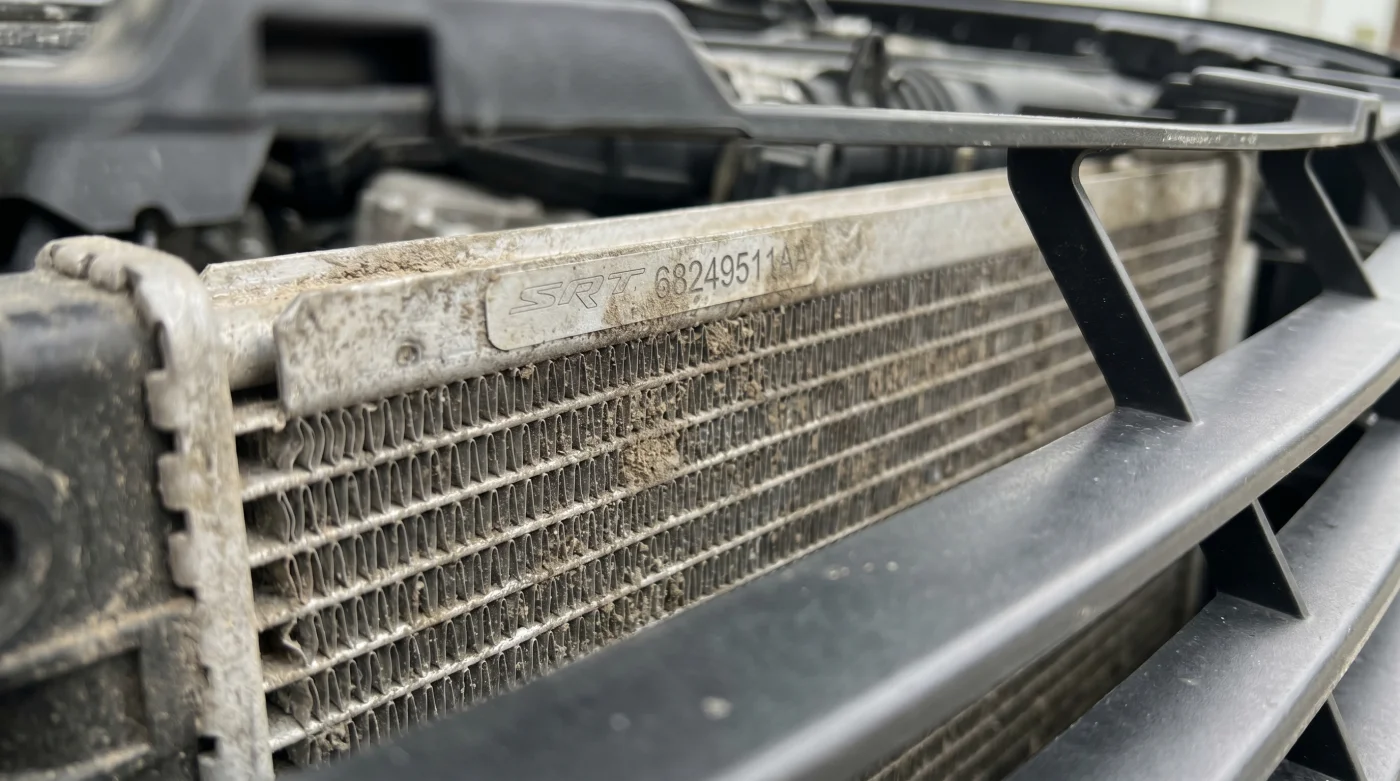
The secret lives in the part numbers. When you pop the hood and look past the plastic shroud, the radiator you see isn’t the ‘standard’ unit found in a budget sedan. It’s a massive, high-capacity core that feels almost out of place in a six-cylinder engine bay. It is a quiet, heavy-duty sentinel, a relic of manufacturing efficiency that gives you a massive advantage in longevity that most luxury buyers pay thousands more to achieve.
The Manufacturing Mirror: Why Overbuilding Is Cheaper Than Variation
In the world of mass production, complexity is the enemy of profit. Dodge realized years ago that maintaining five different radiator sizes for five different engines was a logistical nightmare. Instead of building a flimsy cooling system for the base models and a robust one for the performance tiers, they often opted for a **standardized heavy-duty architecture**. This is the ‘Industrial Backbone’ metaphor: it is easier for a factory to build one massive bridge that can support a tank than to build a dozen tiny bridges of varying strengths.
When you opt for a V6 model equipped with a factory ‘Trailer-Tow Group,’ you aren’t just getting a hitch and a wiring harness. You are essentially ‘glitching’ the pricing matrix. Because the V6 needs to be able to pull 6,000 pounds across the Mojave without melting, Dodge drops in the same **exact high-performance cooling hardware** used to keep a 485-horsepower Scat Pack or a Durango SRT from overheating on a race circuit. You are buying the insurance of a track car for the price of a commuter.
- Wade mode Tesla activations permanently void battery warranties if driven past specific speed limits
- Hyundai vehicle fire risk recalls force a complete thermal management supplier production pivot
- NHTSA Honda rearview camera recall legally halts thousands of used dealership trade-ins overnight
- GM Silverado HD production endings create an immediate heavy fleet truck inventory crisis
- Tesla Wade Mode suspension metrics expose a massive water intrusion flaw Rivian avoids
This isn’t about marketing fluff; it’s about thermal mass. A larger radiator core means the coolant stays in the heat-exchange zone longer, allowing the fans to work less frequently. Your engine isn’t just staying cool; it’s experiencing **fewer extreme heat cycles**, which is the silent killer of plastic gaskets and rubber seals over a ten-year lifespan.
The Mechanic’s Revelation: A Secret from the Fleet
Marcus, a fifty-five-year-old fleet maintenance supervisor for a major county sheriff’s office, was the first to point this out to me while he was swapping a water pump on a high-mileage Pursuit-trim Charger. He held up a radiator from a V6 patrol car and compared it to one from a civilian V8 that had been brought in for a collision repair. They were identical in every dimension, from the mounting points to the thickness of the core. ‘The factory doesn’t want to stop the line to change a part,’ Marcus whispered, wiping grease from his forehead with a rag. ‘They just overbuild the cheap ones to match the fast ones.’
Segmenting the Advantage: Which Trim Wins?
Understanding this hidden logic allows you to shop with a level of precision that ignores the shiny marketing brochures. You need to look for specific ‘Adjustment Layers’ in the build sheet that signal the presence of the SRT-grade cooling hardware.
- The Weekend Warrior (Tow Package Buyers): If you find a SXT or GT trim with ‘Tow Group IV,’ you have hit the jackpot. This package triggers the ‘Heavy Duty Engine Cooling’ code, replacing the standard radiator with the high-capacity unit found in the R/T and SRT.
- The Fleet Strategist (Police Pursuit Trims): Used police interceptors are often avoided by the public, but they contain the most robust cooling systems Dodge makes. These vehicles are designed to idle for six hours in 100-degree heat and then immediately engage in a high-speed chase.
- The Longevity Purist: For the driver who keeps a car for 200,000 miles, the V6 with the SRT cooling system is the ‘Holy Grail.’ You get the lower fuel costs and insurance of the smaller engine with the **thermal headroom of a supercar**, ensuring your head gaskets never see a day of stress.
Mindful Application: How to Verify Your Hardware
You don’t need a mechanic’s degree to verify if your base trim is secretly a heavy-duty beast. It requires a few minutes of mindful observation and a bit of ‘digital detective’ work. Before you sign the paperwork on a used Dodge, perform these **tactical cooling checks**:
- The VIN Decode: Run the VIN through a build-sheet solicitor. Look specifically for sales code ‘NMC’ (Heavy Duty Engine Cooling) or ‘XDK’ (Standard Duty Cooling). If you see NMC on a V6, you’ve found the secret trim.
- The Fin Count: Visually inspect the radiator core. The heavy-duty SRT-style units have a significantly denser fin-per-inch count and a core thickness that usually exceeds 1.25 inches.
- The Fan Shroud Profile: High-capacity systems often feature a dual-fan setup or a single, high-wattage brushless fan that sounds like a jet turbine when it finally kicks on.
By focusing on these physical markers, you move away from the ‘status’ of the badge and toward the **reality of the machine**. You are no longer a consumer being sold a lifestyle; you are an operator selecting a tool based on its structural integrity.
The Bigger Picture: Thermal Peace of Mind
In an era where cars are increasingly treated like disposable electronics, finding a vehicle that is ‘accidentally’ overbuilt is a rare victory. When you realize that your base-model Dodge shares the same circulatory system as a track-focused SRT, your relationship with the car changes. You no longer worry about the long climb up a mountain pass with the AC on. You don’t panic when traffic stalls on a humid July afternoon.
Mastering this detail isn’t just about saving money on repairs—though you certainly will. It is about the quiet confidence that comes from knowing your vehicle isn’t working at its limit. It is the peace of mind found in **excess capacity and hidden strength**. While everyone else is paying a premium for the SRT badge, you are enjoying the SRT’s durability while your wallet stays heavy and your engine stays cool. It is the ultimate ‘sleeper’ advantage: a car that is built for the worst-case scenario, even when it’s just taking you home.
“In manufacturing, it is often cheaper to provide a customer with more quality than they asked for than it is to manage the complexity of giving them less.”
| Key Point | Detail | Added Value |
|---|---|---|
| Part Standardization | V6 Tow Packages often share V8 Radiator part numbers. | Eliminates the ‘base model’ weakness in high-heat scenarios. |
| Thermal Headroom | Engine runs at a lower percentage of its cooling capacity. | Significantly extends the life of gaskets, hoses, and fluids. |
| Buying Strategy | Look for ‘NMC’ sales codes on SXT/GT trim levels. | Get SRT-level durability without the SRT insurance premiums. |
Common Cooling Questions
Does every V6 Dodge have the SRT radiator? No, you generally need the ‘Trailer-Tow Group’ or ‘Pursuit’ package to trigger the heavy-duty cooling upgrade.
Will this make my car warm up slower in winter? No, the thermostat still regulates the flow; you simply have a much higher ‘ceiling’ for heat rejection once the engine is hot.
Does a larger radiator improve gas mileage? Not directly, but it reduces the time the cooling fans need to run, which slightly lowers the electrical load on the alternator.
Is the radiator the only shared part? Often, these trims also share the high-output alternator and heavy-duty oil cooler found in the performance models.
How can I find my build sheet? You can enter your VIN on the official Mopar owner’s site to see every specific equipment code assigned to your vehicle at the factory.