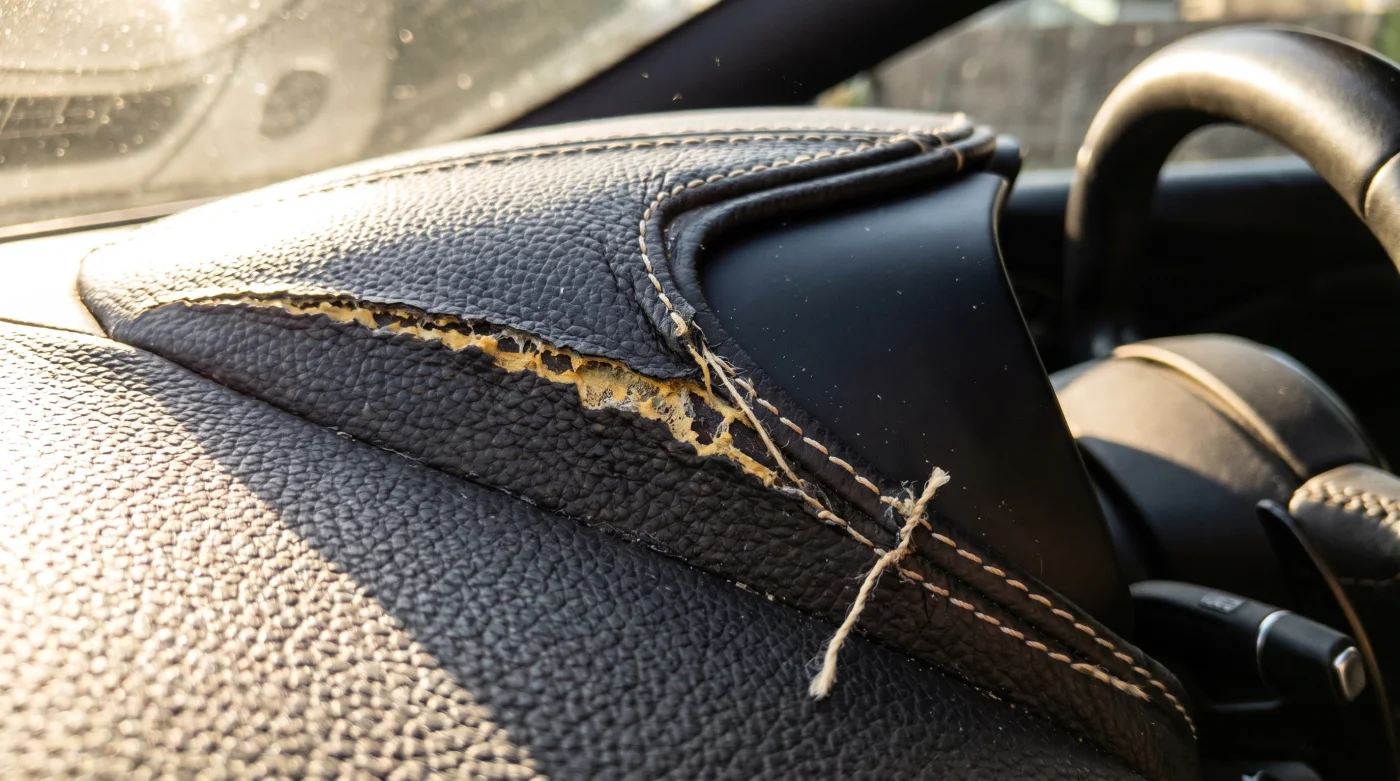
You slide into the driver’s seat of your Aston Martin, and for a fleeting moment, everything feels right. The steering wheel is cold and substantial in your palms, and the faint, expensive scent of tanned hides lingers in the cabin like a high-end cologne. But as the midday sun strikes the leading edge of the instrument cluster, you notice it: a tiny, jagged ripple. It’s a small gap where the leather used to hug the defrost vent, now pulled back just enough to expose the yellowed foam beneath. That **stiff, curling edge** is the first sign of a financial hemorrhage that most owners don’t see coming until it’s too late.
The silence of a high-end interior is meant to provide a sanctuary from the world, but the sun is a quiet, persistent intruder. Through that expansive windshield, your dashboard isn’t just a design statement; it is a pressurized environment where organic materials fight against heat and radiation. When the temperature inside the cabin spikes, the bespoke adhesives used in Gaydon begin to lose their grip, turning your hand-stitched leather into a **shrinking, tightening drum skin** that pulls away from its moorings. It’s the visual equivalent of a tailor-made suit suddenly becoming two sizes too small while you’re wearing it.
This isn’t just about a cosmetic flaw that bothers your eye during a Sunday drive. It is a fundamental betrayal of the car’s aesthetic integrity that car buyers and auction houses notice instantly. In the world of exotic cars, an original interior is a sacred thing, and once the leather starts to ‘lip’ or pull at the seams, the car’s perceived value drops faster than its 0-60 time. You aren’t just looking at a distorted piece of cowhide; you are looking at a **massive five-figure repair bill** that will be deducted from your trade-in appraisal the moment you try to move on to the next model.
The Windshield as a Magnifying Glass for Disaster
To understand why this happens, you have to think of your windshield not as a protector, but as a lens. Modern automotive glass is designed for clarity and safety, yet it acts as a greenhouse for the delicate materials of the dashboard. The leather is stretched and glued over a composite form using specific, low-VOC adhesives required by modern environmental standards. These adhesives are excellent for the planet but often **fail under the concentrated heat** of a Southern California or Florida afternoon. It is a slow-motion disaster where the leather is literally cooked until it loses its natural oils and begins to contract with immense force.
- Synthetic motor oil shortage forces a dangerous revision to the 200k-mile engine maintenance plan
- Ram Rumble Bee allocations expose why private brokers easily outsmart local dealership waitlists
- NHTSA Honda rearview camera recall wiring demands a strict physical inspection before buying used
- ZR1X dealer markups artificially double the sticker price despite increasing factory production volumes
- Honda Prelude hybrid mechanics prove exactly why total electrification ruins classic coupe driving dynamics
Think of the dashboard as a living lung that has stopped breathing. When the leather dries out, it loses its elasticity and begins to pull at the weakest points—usually around the air vents and the HUD opening. Once the bond is broken, there is no ‘gluing it back down’ from the outside. The tension is too high, and the material has already changed its physical dimensions. You are witnessing the **slow death of a masterpiece**, all because the temperature reached a critical threshold that turned the bond into a brittle, useless powder.
The Secret from Julian’s Newport Workshop
Julian, a 58-year-old master upholsterer who has spent three decades restoring British interiors in Newport Beach, sees this every week. He tells the story of a client who left a pristine DBS parked at a golf club for just four hours during a record-breaking July heatwave. By the time the back nine was finished, the leather around the center stack had pulled back nearly half an inch. Julian explains that the **bespoke adhesives are chemically sensitive** to a specific range of UV radiation that standard tinting doesn’t always block. He calls it ‘the $15,000 lunch,’ referring to the cost of pulling the entire windshield and dashboard assembly to fix the damage.
Categorizing the Risk: From Garage Queens to Daily Drivers
The severity of this issue often depends on how you treat the car’s environment. For the ‘Garage Queen,’ the risk is low until that one weekend trip to the coast. Because the leather is used to a climate-controlled 68 degrees, a sudden spike to 110 degrees inside the cabin can cause the materials to **shock and contract violently**. These cars often suffer the most dramatic failures because the leather hasn’t been ‘seasoned’ to handle thermal expansion, making the eventual shrinkage look like a sudden, catastrophic tear.
For the daily driver, the damage is more incremental. You might notice a slight hardening of the leather surface before the shrinkage begins. It starts as a loss of that ‘buttery’ feel, replaced by a texture that feels more like cardboard. This is the **evaporation of essential oils** that keep the fibers supple. If you can feel the leather resisting your thumb when you press down, the countdown to a failed seam has already begun. Understanding your car’s specific exposure level is the first step in stopping the bleed before the resale value tanks.
The Preservation Protocol: A Tactical Toolkit
Stopping this ‘resale killer’ requires more than just parking in the shade; it requires a mindful approach to thermal management. The goal is to keep the surface temperature of the dashboard below 100 degrees Fahrenheit, even when the ambient air is much hotter. This is a game of physics where **blocking the energy before it enters** the cabin is your only real defense. If the heat hits the leather, you’ve already lost the battle.
- **Invest in a Custom-Fit Thermal Barrier:** Do not use the generic, floppy silver shades. You need a multi-layered, rigid shield specifically laser-cut for the Aston Martin windshield to ensure zero light leakage at the edges.
- **Specify UV-Rejecting Ceramic Film:** Even if you don’t want a dark tint, a clear ceramic film on the inside of the windshield can block up to 99% of the infrared heat that causes adhesive failure.
- **Hydrate the Hides Monthly:** Use a high-quality, pH-balanced leather conditioner that contains UV inhibitors. This doesn’t just make it look good; it keeps the fibers lubricated so they can stretch without snapping the glue bond.
- **The ‘Crack the Window’ Rule:** Leaving your windows down just a quarter-inch allows hot air to escape, preventing the ‘oven effect’ that builds up pressure against the dashboard’s leading edge.
By treating the dashboard with the same mechanical respect you give the engine, you are essentially **insuring the car’s future value**. A few minutes of prep when parking can save you the nightmare of a dashboard replacement, which often involves dismantling the entire front interior of the car—a process that rarely goes back together without creating a symphony of new squeaks and rattles.
The Bigger Picture: Preserving the Craft
At the end of the day, owning an Aston Martin is about more than just speed; it is about the appreciation of human craft. Every stitch in that dashboard was placed by a person who took pride in the symmetry and tension of the leather. Allowing that work to be ruined by a few hours of sun is a tragedy of neglect. When you protect the interior, you are **honoring the hands that built it**, while simultaneously shielding your bank account from a massive appraisal hit.
Mastering this small detail offers a profound sense of peace. You can walk away from your car in a parking lot knowing that when you return, the cabin will still be the sanctuary you bought. It’s about being a steward of a machine that is designed to last a lifetime, provided you don’t let the sun **silently tear it apart** from the inside out. True luxury isn’t just about having the best; it’s about having the wisdom to keep it that way.
The most expensive repair in the luxury world is the one that could have been prevented with a hundred-dollar piece of cardboard.
| Key Risk Point | Detail of Failure | Added Value for the Reader |
|---|---|---|
| Defrost Vents | Adhesive loses grip due to concentrated heat loops. | Prevents the ‘curling lip’ look that instantly kills trade-in value. |
| Instrument Binnacle | Leather tension pulls the seams apart over the gauges. | Saves you from a full dashboard removal and the ‘squeak’ risks involved. |
| A-Pillar Junction | Sunlight hits the corner hardest, causing peeling. | Maintains the ‘factory-fresh’ smell by preserving original adhesives. |
Is it possible to repair the leather without removing the dashboard? No, once the leather has shrunk, it must be removed, steamed to regain its shape, and re-glued—a process that requires full dash removal. Will window tinting solve the problem entirely? It helps, but only a physical thermal barrier (sunshade) stops the heat soak that triggers adhesive breakdown. Does leather conditioner prevent shrinkage? It slows the process by keeping the hide supple, but it cannot counteract the failure of the underlying glue. What is the typical cost of a dashboard replacement? Depending on the model, you are looking at $10,000 to $22,000 including labor and materials. How do buyers spot this during an inspection? They look for ‘air pockets’ near the windshield base or leather that feels unnaturally hard to the touch.