The metallic ping of a cooling engine usually signals the end of a day, a quiet transition from the heat of the road to the stillness of your driveway. But for thousands of Hyundai owners, that silence has become heavy with a phantom scent—the sharp, acrid bite of ozone or the faint, sickly sweet smell of scorched plastic. You find yourself glancing out the window at 2:00 AM, checking if the shadow near your front fender is just a shadow or the beginning of a thick, oily plume of smoke. It is a peculiar kind of psychological tax, the feeling that your own vehicle is a ticking clock parked just feet from where your family sleeps.
When the recall notices first arrived in mailboxes from Tallahassee to Tacoma, they felt like a relief, a formal acknowledgment of the fear. But the relief was short-lived. Supply chains, those invisible arteries of the modern world, are currently clogged. Dealerships are backlogged, and the replacement ABS (Anti-lock Braking System) modules are sitting in shipping containers or stuck in manufacturing bottlenecks. You are told to park outside, away from structures, as if your car is a stray dog that might bite. It is a recommendation that feels less like a solution and more like a surrender.
The physical reality is simple: a small internal brake fluid leak inside the ABS module can cause an electrical short over time. This isn’t a failure that happens while you are pushing seventy on the interstate; it is a slow-motion disaster that occurs when the car is supposedly dead. The circuit remains live, sipping power from the battery even with the ignition off, until a tiny spark meets a dry seal and the engine bay transforms into a kiln. Waiting months for a technician to swap a fuse or a module isn’t just an inconvenience; it is a test of your patience and your nerves.
The Ghost in the Circuitry: A Metaphor of Leaky Faucets
To understand why your car is at risk, think of your electrical system not as a series of wires, but as a plumbing network. Most systems in your vehicle are like a faucet that is turned off when you pull the key; the water stops flowing, and the pipes are safe. The ABS module, however, is a ‘constant-hot’ component. It is like a faucet that is always under pressure, even when you aren’t using it. When the internal seals of the module degrade, it’s like a slow drip onto an exposed wire. Eventually, the dampness creates a bridge where electricity can jump the tracks.
This ‘electrical leak’ is what causes the spontaneous combustion. By the time you see the flicker of orange beneath the hood, the internal heat has already reached several hundred degrees. The ‘hidden logic’ that dealers won’t explicitly walk you through is that you don’t necessarily need a new module to sleep soundly tonight; you simply need to shut off the main valve to that specific ‘leaky faucet’ while the car is sitting dormant. It is about reclaiming control of your driveway by understanding which specific vein of power needs to be pinched shut.
- Aston Martin leather dashboard shrinkage completely ruins interior aesthetics and heavily depresses resale value
- Synthetic motor oil shortage forces a dangerous revision to the 200k-mile engine maintenance plan
- Ram Rumble Bee allocations expose why private brokers easily outsmart local dealership waitlists
- NHTSA Honda rearview camera recall wiring demands a strict physical inspection before buying used
- ZR1X dealer markups artificially double the sticker price despite increasing factory production volumes
The Cleveland Secret: A Master Tech’s Workaround
I recently spoke with Arthur ‘Artie’ Vance, a 58-year-old lead diagnostic tech at a high-volume shop in Cleveland. Artie has seen more scorched engine bays than he cares to count, and he’s spent his lunch breaks explaining the same reality to panicked neighbors. ‘The official fix is often just a lower-amperage fuse,’ Artie told me while wiping grease from a pair of needle-nose pliers. ‘It doesn’t fix the leak, it just ensures the fuse pops before the fire starts. But if you’re waiting three months for that fuse kit, you’re just sitting on a live wire every single night.’
Artie’s ‘secret’ isn’t a complex mechanical overhaul; it’s a manual isolation strategy. He noticed that the anxiety wasn’t coming from the driving—it was coming from the parking. He began showing his regular customers exactly which relay to pull if they were forced to park in a garage during a storm or if they were leaving the car at an airport for a week. It’s the kind of practical, grease-stained wisdom that bypasses bureaucracy and focuses entirely on the immediate safety of the homeowner.
Identifying Your Risk Profile: From Commuters to Vacationers
Not every Hyundai owner faces the same level of urgency, and the way you handle the recall delay should reflect your specific living situation. If you have the luxury of a 50-foot driveway and no nearby shrubbery, your ‘firebreak’ is already built into your landscaping. But for the rest of us, the solution must be more surgical.
- The Urban Dweller: If you park in a multi-level garage or a tight driveway shared with neighbors, the ‘park outside’ advice is physically impossible. For you, isolating the circuit is a neighborly duty.
- The Long-Term Traveler: If your vehicle sits at a trailhead or an airport lot for days at a time, the lack of supervision makes the ABS short more dangerous. A ‘dead’ car shouldn’t be drawing 40 amps of current.
- The High-Mileage Commuter: You are likely cycling the heat in the engine bay daily, which can accelerate the degradation of the seals. Your inspection frequency should be doubled compared to a casual driver.
The 60-Second Firebreak: A Tactical Guide to Circuit Isolation
If you are tired of the ‘park outside’ warning and want to physically ensure the ABS pump cannot draw power while the car is off, you can perform a manual bypass. This is a temporary measure to be used only when the vehicle is stationary and you are concerned about fire risk. Always remember that removing the fuse or relay will disable your ABS and Electronic Stability Control; this is a ‘storage’ or ‘peace of mind’ fix, not a permanent driving solution.
- Open the hood and locate the primary fuse box, usually found on the driver-side fender well.
- Consult the diagram on the underside of the plastic cover. Look for the label ‘ABS,’ ‘HECU’ (Hydraulic Electronic Control Unit), or ‘ABS PUMP.’
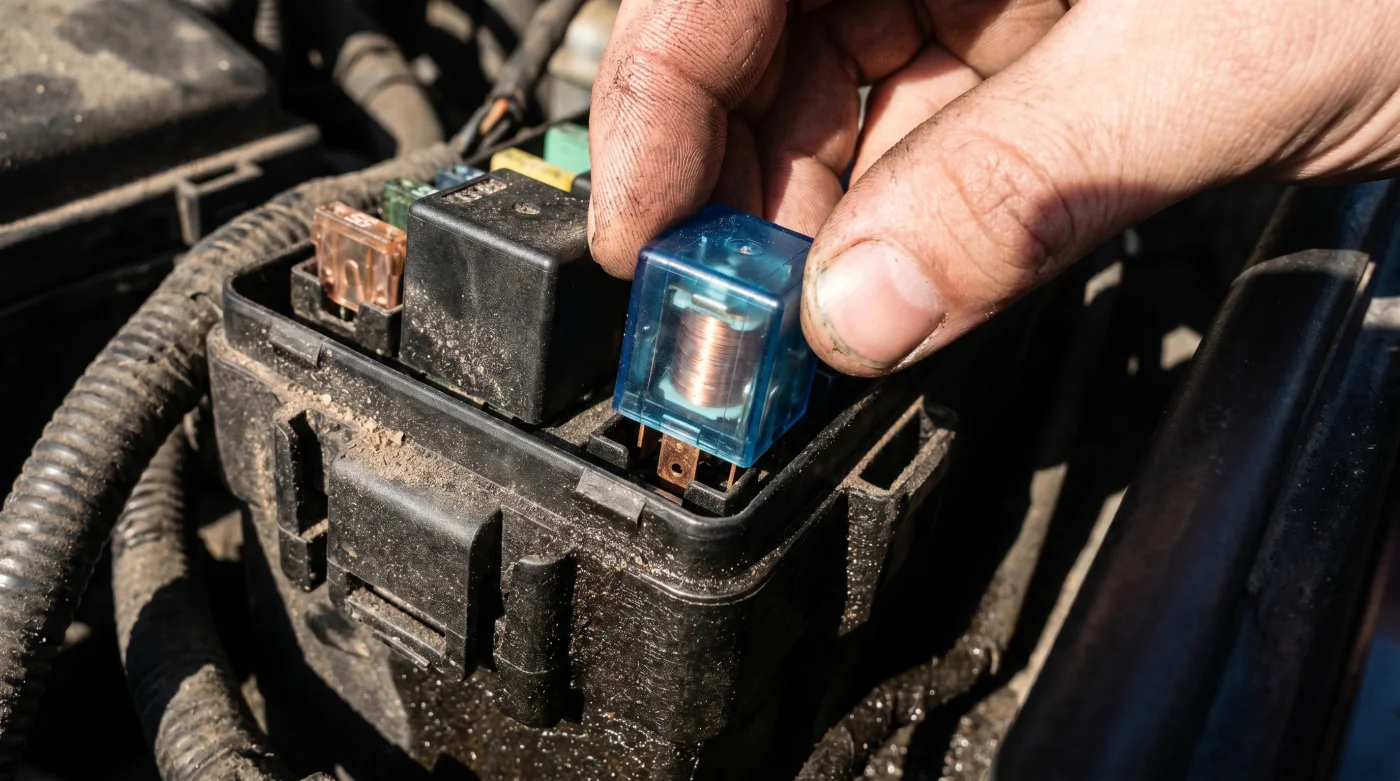
- Using the plastic puller tool stored inside the box (or a pair of needle-nose pliers), firmly grasp the multi-amp fuse or the square relay dedicated to that circuit.
- Pull the component straight up. Place it in your glove box or a labeled envelope so it isn’t lost.
- Close the fuse box and hood. The ‘live’ path to the ABS module is now physically severed.
Your tactical toolkit for this process is minimal: a pair of pliers and a small flashlight. By removing this bridge, you have silenced the electrical ghost. When you are ready to drive to the dealership for your official recall appointment, simply pop the fuse back in to regain your braking assists. It is a sixty-second ritual that transforms a potential disaster into a managed mechanical state.
The Bigger Picture: Reclaiming Your Peace of Mind
We often think of our cars as black boxes—sealed units of technology that we are forbidden to touch. But when a manufacturer tells you that your home might burn down because they are missing a five-cent piece of plastic, that ‘black box’ philosophy fails you. Taking the time to understand the flow of power through your HECU isn’t just about car maintenance; it’s about refusing to live in a state of low-level panic.
Mastering this small detail allows you to park in your own garage again. it allows you to stop sniffing the air every time you walk past your front grill. There is a profound sense of clarity that comes from manual intervention. You are no longer a passive victim of a supply chain crisis; you are an informed operator who knows exactly how to keep your property safe while the rest of the world waits for a shipping container to arrive. The car is once again a tool for your life, rather than a threat to your sanctuary.
‘True automotive safety isn’t found in a brochure; it’s found in the owner’s willingness to understand the machine’s heartbeat.’
| Recall Phase | Physical Reality | Your Action Item |
|---|---|---|
| Waiting for Parts | ABS module remains ‘constant-hot’ and high risk. | Isolate the HECU fuse if parking in enclosed spaces. |
| The Interim Fix | Dealer installs a lower-rated fuse as a safety valve. | Confirm which fuse was swapped for future reference. |
| The Final Remedy | Complete module replacement or updated seal kit. | Verify brake fluid levels and system pressure post-install. |
Frequently Asked Questions
Will pulling the ABS fuse damage my car’s computer?
No, it simply opens the circuit. Your dashboard will show an ABS warning light, but it won’t harm the ECU.Can I still drive the car with the relay removed?
You can, but you will not have anti-lock braking or traction control. Your car will stop like an older vehicle without these features. Use extreme caution in the rain.How do I know if my specific VIN is affected?
Check the NHTSA website or the Hyundai recall portal. Do not wait for the letter to arrive by mail.Is the fire risk only when the engine is hot?
No. The short can happen even if the car hasn’t been driven for days because the ABS module always has battery power.Should I disconnect the entire battery instead?
You can, but that resets your clock, radio, and engine computer. Pulling the specific ABS fuse is a more surgical approach that preserves your settings.