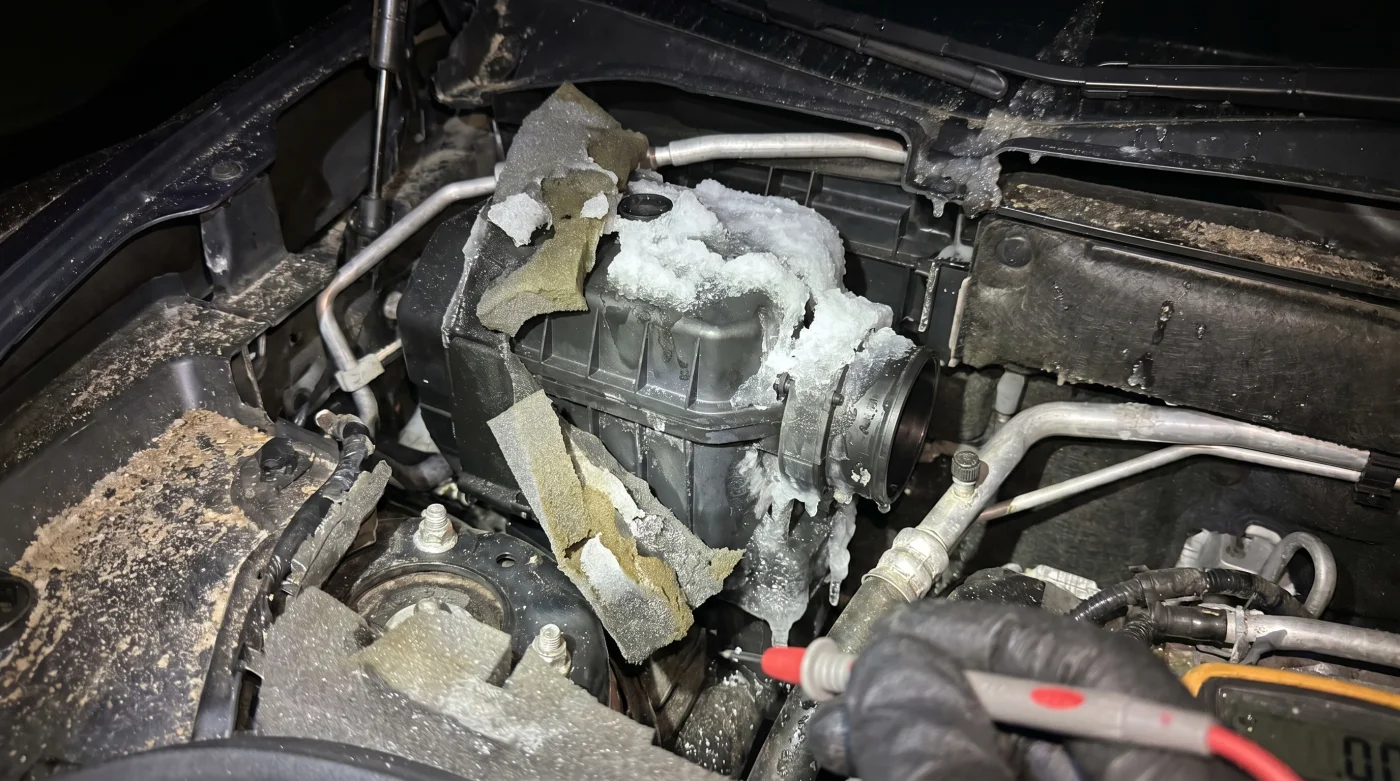
A quiet, gray January dawn in Minnesota has a specific sound: the sharp, metallic snap of frozen door handles and the dry crunch of packed snow underfoot. Inside the cabin of a two-year-old Tesla Model Y, you push the climate button on your screen, expecting the familiar, silent wave of dry heat to envelope your hands. Instead, there is only a faint, high-pitched whirring that sounds like a tiny compressor breathing through a wet pillow, followed by the stubborn blown draft of lukewarm air.
For the first twenty thousand miles, the car was a thermal fortress, heating up almost before you could pull out of the driveway. But now, with the odometer hovering just past the forty-thousand-mile mark, the cabin feels damp and sluggish to warm. It is not a software glitch or a blown fuse, but a slow, material fatigue happening silently beneath the plastic frunk liner, far out of sight of the digital dashboard.
This is the cold reality facing thousands of electric vehicle owners as their cars cross into their second or third northern winters. The brilliant engineering of the octovalve, designed to route heat with mathematical precision, is finding its limit not in its silicon code, but in the simple, cheap foam wrapped around it to keep the cabin quiet.
This material vulnerability is rarely discussed in showroom walkarounds, yet it represents a fundamental mismatch between sunny California design hubs and the gritty, frozen realities of the northern freeze. When the temperatures plummet, physical components beneath the vehicle’s plastic skin bear the brunt of the elements, regardless of what the sleek touchscreen interface promises.
The Wet Sponge Metaphor and the Octovalve Freeze
To understand why your cabin heater is struggling, you have to look at how the car keeps itself quiet. Because electric motors do not drown out mechanical noise, the heat pump is wrapped in a dense, open-cell acoustic foam jacket to muffle its high-pitched chatter. This foam acts like a heavy wool coat; when dry, it holds heat and dampens sound perfectly, keeping the cabin serene.
However, after forty thousand miles of highway speeds, wet snow, and salted road mist, this acoustic jacket undergoes a destructive transformation. The open-cell structure acts like a capillary sponge, drawing in salty winter road spray that never fully evaporates in sub-zero temperatures. The acoustic wrap becomes saturated, turning the very shield meant to insulate the system into a freezing, wet compress wrapped tightly around the aluminum body of the octovalve.
- 2026 Mazda rotary hybrid engines mask a heavy thermal penalty during highway driving
- General Motors platform architectures secretly ditch independent suspensions for cheaper rigid axles
- Tesla Model 3 suspension creaks reveal a hidden control arm fix mechanics ignore
- Engine oil mixing habits silently destroy hybrid combustion chambers and vehicle resale value
- General Motors truck longevity demands a hidden transmission thermal bypass valve
Once this moisture freezes solid, it creates a direct thermal bridge between the sub-zero outside air and the valve assembly. The octovalve, chilled far below its operating threshold by its own frozen jacket, loses the physical ability to actuate its internal gates. The electric motor tries to turn the frozen valve, the system detects excessive resistance, and the software shuts down the heat pump entirely to prevent physical breakage, leaving you with nothing but lukewarm backup heat.
A Hidden Lesson from the Northern Fleet
Marcus Vance, a forty-eight-year-old fleet maintenance supervisor in Duluth, Minnesota, was among the first to diagnose this physical failure. Managing a fleet of thirty electric crossovers used for local utility inspections, Vance noticed a pattern of heating failures that software diagnostics could not explain. When he peeled back the plastic underbody panels of three separate vehicles that had cleared forty thousand miles, he found the acoustic foam jackets weighing three times their dry weight, dripping with salty, frozen brine that had corroded the delicate electrical connectors leading to the manifold.
The Two Paths of Winter Wear
For the Rust Belt Commuter
If you drive daily on heavily salted highways in regions like Ohio, New York, or Michigan, your main enemy is chemical saturation. The liquid brine sprayed on roads is atomized by the tires of the cars ahead of you, creating a fine mist that easily penetrates the lower gaps of the Model Y’s front bumper. Saltwater lowers the freezing point of the moisture inside the acoustic foam, but it also accelerates the corrosion of the aluminum manifold beneath it, eventually causing microscopic refrigerant leaks at the valve seals.
For the High-Altitude Mountain Driver
For those in dry, ultra-cold regions like Colorado or Montana, the problem is mechanical rigidity rather than salt. The extreme thermal cycling—moving from a warm garage into sub-zero mountain passes—causes the moisture-saturated foam to freeze rock-hard in minutes. This rapid freezing puts immense physical stress on the plastic mounting clips holding the octovalve assembly together, causing them to crack and let freezing wind blast the valve body directly.
The 40,000-Mile Winterization Protocol
Addressing this issue does not require a costly trip to a service center if you are comfortable with basic hand tools. By taking a proactive, physical approach to your car’s thermal health, you can prevent the acoustic wrap from becoming a frozen trap for your climate control system.
To protect your system before the deep freeze sets in, you must take matters into your own hands. You can easily protect your system before the deep freeze by dedicating a single Saturday afternoon to inspecting the physical health of the climate assembly beneath the front trunk lining.
- Remove the upper frunk tub assembly using a ten-millimeter socket and a plastic trim tool to access the heat pump compartment.
- Gently inspect the acoustic foam jacket surrounding the octovalve; if it feels damp or heavy, remove it and let it dry completely in a warm garage for twenty-four hours.
- Wrap the dry foam jacket in a layer of thin, waterproof vapor barrier tape to prevent future moisture ingress while retaining its sound-dampening properties.
- Apply a thin layer of dielectric silicone grease to the electrical connector plugs leading to the octovalve to shield them from road salt corrosion.
- Reinstall the components, ensuring the bottom splash shields are securely fastened to minimize the amount of road spray entering the engine bay.
Your tactical toolkit for this job is simple: a standard socket set, a roll of high-quality waterproof silicone tape, a can of non-chlorinated contact cleaner, and one afternoon of focused, hands-on attention in your garage.
Accepting the Physical Limits of Silicon Valley Design
The modern electric car is often sold as a rolling computer, a machine that can be polished, tuned, and repaired entirely through over-the-air software updates. Yet, as many owners are discovering, no line of code can dry out a wet piece of foam or stop road salt from eating away at aluminum. The physical world always demands its tribute, reminding us that grease, rubber, and insulation still govern the machines we rely on.
By understanding the physical realities of how your car interacts with the elements, you move past the passive role of a consumer and become an active custodian of your machine. Taking the time to protect these hidden mechanical joints ensures that when the winter wind howls outside, your cabin remains a warm, reliable sanctuary.
“The most brilliant software in the world will always remain at the mercy of a simple piece of wet foam.“
| Key Point | Detail | Added Value for the Reader |
|---|---|---|
| Acoustic Foam Saturation | Open-cell foam acts as a capillary sponge for salty road spray. | Explains why heating efficiency drops without throwing an error code. |
| Octovalve Seizure | Frozen moisture in the jacket physically locks up the valve gears. | Saves you from unnecessary and expensive heat pump replacements. |
| Salt Corrosion Risk | Atomized brine degrades electrical connectors and aluminum seals. | Identifies the exact failure points to clean during routine maintenance. |
Frequently Asked Questions
How do I know if my Model Y heat pump is starting to degrade?
You will notice longer times to defrost the windshield and a distinct, deep humming or buzzing sound from the front of the car as the compressor struggles against a frozen valve.
Will a software update fix the octovalve freezing issue?
No, while software updates can optimize how the system handles the cold, they cannot dry out or insulate a physically saturated acoustic foam jacket.
Can I simply remove the acoustic foam jacket permanently?
You can, but you will experience a significant increase in high-pitched compressor whine inside the cabin, especially during preconditioning and fast charging.
What is the average cost to repair this out of warranty?
If the octovalve or compressor fails completely due to moisture or physical binding, replacement costs at a service center typically range from fifteen hundred to twenty-five hundred dollars.
Does this issue affect newer Model Y builds?
While Tesla has made minor adjustments to the underbody shielding, the core design of using open-cell acoustic foam around the heat pump remains standard across model years.