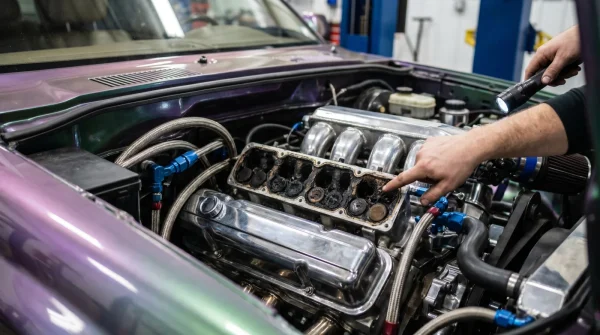
The bay doors are rolled up just three inches to let the cold dawn air cut through the heavy smell of gear oil and spent gasoline. On the lift hangs a dusty 2006 Toyota Tundra, its frame coated in a thin layer of red Arizona silt. Beneath the hood, the iron block of a 4.7-liter V8 sits quietly, ticking as it sheds the residual heat of a three-hour crawl up a dry creek bed. To the uninitiated, it looks like an relic of a less efficient era, a heavy piece of cast iron that drinks fuel with unapologetic thirst.
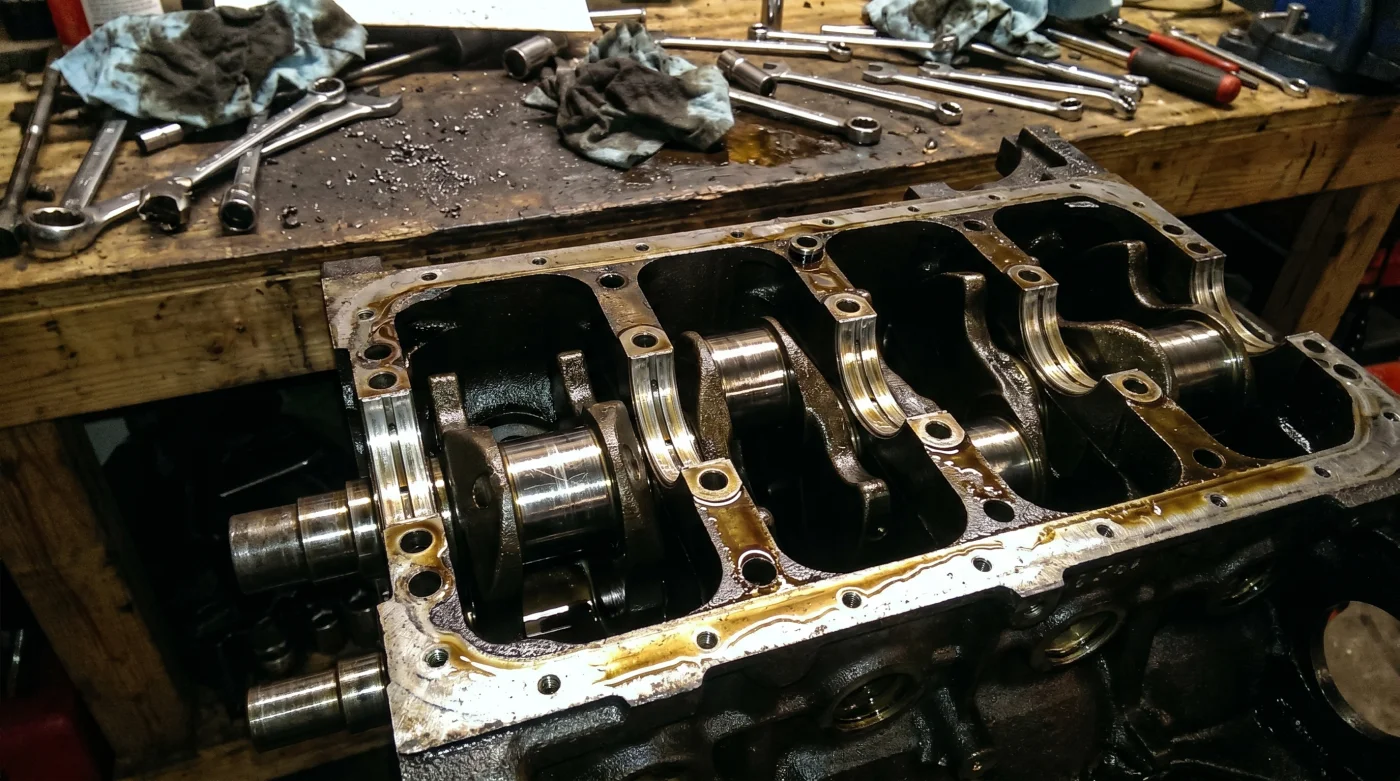
But under the micrometer, this old powerplant reveals a physical truth that modern, highly strung twin-turbo powerplants simply cannot replicate. While modern engines rely on razor-thin clearances to squeeze out every drop of fuel economy, this V8 operates on a different philosophy of survival. It was built during a window of time when Toyota engineers overcompensated for real-world abuse, designing an oiling system that behaves like an open artery rather than a pressurized capillary. This oversized journal design keeps the engine alive when lesser blocks starve.
You hear it in the way these older engines start. There is no high-pitched whine or complex valve clatter; there is only a deep, mechanical thrum that sounds exactly the same at zero degrees as it does at one hundred and ten. It is the sound of generous oil clearances doing their work, allowing a thick cushion of lubrication to shield moving parts before the oil pressure gauge even registers a climb.
The Hydrodynamic Sanctuary: Why Room to Breathe Beats Tight Tolerances
To understand why these older V8 blocks regularly pass the million-mile mark without a rebuild, you have to abandon the modern obsession with tight tolerances. Think of a modern twin-turbo engine as a high-performance speed boat navigating a narrow, shallow canal; any slight disturbance in the water level results in a catastrophic scrape against the bottom. The classic Tundra V8, by contrast, is a heavy barge floating in a deep, wide harbor. Deliberately loose bearing tolerances allow the crankshaft to ride on a massive, unbroken cushion of oil.
Modern engines often run main bearing clearances as tight as 0.0008 inches to prevent oil bypass and boost fuel economy. The Tundra’s V8 blocks utilized a factory bearing tolerance that opened up to a comparatively generous 0.0018 to 0.0024 inches on the crankshaft journals. While this means a microscopic drop in oil pressure at hot idle, it creates an incredibly resilient hydrodynamic barrier that refuses to shear, even under extreme thermal stress.
- Ford V8 AC Cobra replicas hide a lethal aerodynamic lift flaw at track speeds
- Tesla Model Y endurance testing exposes severe heat pump degradation in winter climates
- 2026 Mazda rotary hybrid engines mask a heavy thermal penalty during highway driving
- General Motors platform architectures secretly ditch independent suspensions for cheaper rigid axles
- Tesla Model 3 suspension creaks reveal a hidden control arm fix mechanics ignore
The Machinist’s Discovery in Flagstaff
Aris, a 54-year-old engine machinist working in the high-altitude deserts of Flagstaff, Arizona, has spent three decades rebuilding light-truck powerplants. He recalls an afternoon when an old rancher brought in a 2UZ-FE V8 with 580,000 miles on the odometer, expecting to find deeply grooved journals and worn-out bearings. Instead, when Aris clamped his micrometer onto the journals, he found them well within original factory specifications, showing only a mirror-like polish where other engines would have ground themselves to dust. The generous oil channel had simply swallowed decades of microscopic carbon debris without scoring the steel.
The Gravity Defier: Surviving Extreme Off-Road Angles
When you nose a truck up a thirty-five-degree slickrock ledge in Moab, gravity drags the engine oil away from the pickup tube toward the rear of the pan. In a modern engine with tight clearances, a momentary dip in oil pressure can cause dry metal-on-metal contact at the bearings in a fraction of a second. The older Tundra V8 blocks bypass this vulnerability through the pure physical volume of their oversized crankshaft journals.
Because the oil clearances are wider, they hold a larger physical reservoir of pressurized oil directly between the copper-lead bearing face and the forged steel journal. Even if the oil pump cavitates for a brief second on a near-vertical climb, the residual oil film resists collapsing under load. This design ensures that the crankshaft continues to float on a protective wedge of fluid until the oil level stabilizes.
The Thermal Anchor: Pulling Under High Load
For those who use these trucks to pull heavy trailers up mountain passes, the biggest enemy is heat. High load at low engine speeds creates immense downward pressure on the piston, rod, and ultimately, the connecting rod bearings. Modern thin oils can thin out under these conditions, leading to metal contact.
The older Toyota V8 blocks mitigate this by being designed to run heavier viscosity profiles, such as 5W-30 or even 10W-30 in hot climates. The combination of larger clearance channels and heavier oil means the engine can dissipate localized bearing heat far more effectively. This acts as a thermal buffer, preventing the localized boiling of lubricant that often leads to spun bearings in newer, downsized utility vehicles.
The Care and Keeping of Your V8 Oiling System
Keeping this legendary bottom end healthy does not require exotic additives or complicated maintenance routines. It requires a mindful approach to oil selection and filtration that respects the physical space built into the block. Because these clearances are wider, choosing the right filter and oil weight is critical to keeping the hydrodynamic system fully charged.
- Use a high-flow oil filter with a silicone anti-drainback valve to prevent dry starts.
- Stick to high-quality synthetic 5W-30 motor oil to maintain film strength at high operating temperatures.
- Never rev the engine immediately upon a cold start; allow ten seconds for the oil galley to fill completely.
- Inspect the oil pan seal during routine service to ensure no air is introduced into the suction line.
By executing these simple steps, you preserve the natural hydraulic cushion that Toyota engineers worked so hard to build into the engine block. The goal is not to try and seal the engine up like a modern laboratory, but to allow the natural clearance to do its self-cleaning, heat-shedding job over hundreds of thousands of miles.
The Peace of a Mechanical Heirloom
In an automotive landscape increasingly dominated by complex electrical actuators, delicate twin-turbochargers, and fragile variable-displacement systems, there is a deep sense of peace in driving something built on simple, robust physics. The older Tundra V8 is not a fast engine, nor is it particularly efficient by modern standards. But it possesses a rare quality that cannot be bought on a modern showroom floor: predictability. Knowing that your engine is built with the physical room to survive human error, poor oil quality, and extreme terrain is a luxury that outlasts any modern digital dashboard.
“When you open up one of these older Toyota V8 blocks, you aren’t looking at cheap manufacturing; you are looking at deliberate, calculated margin designed to survive the worst conditions on Earth.” — Aris Vance, Engine Machinist
| Key Point | Detail | Added Value for the Reader |
|---|---|---|
| Crankshaft Journal Clearance | 0.0018 to 0.0024 inches compared to modern 0.0008 inches | Prevents metal-on-metal wear even during temporary pressure drops. |
| Off-Road Angle Tolerance | Oversized journals retain oil film during steep inclines | Protects the engine from starvation when off-roading up to 45 degrees. |
| Debris Tolerance | Generous clearance allows microscopic carbon particles to pass safely | Reduces the risk of spun bearings due to delayed oil changes. |
Why does the older Tundra V8 last longer than modern twin-turbos?
The older V8 utilizes wider mechanical clearances and an oversized crankshaft journal design that holds a thicker, more resilient cushion of oil. Modern twin-turbos run extremely tight clearances and high boost pressures, leaving very little margin for error or momentary oil starvation.
Does this generous bearing tolerance cause lower oil pressure?
Yes, at a hot idle, you may notice the oil pressure gauge sits lower than in modern cars. This is completely normal for this engine design and is accounted for by the high volume of oil flowing through the generous clearances.
What is the best oil viscosity for a high-mileage Tundra V8?
A high-quality synthetic 5W-30 is ideal for most climates. In extremely hot environments or for heavy towing, a 10W-30 can provide additional film strength to protect the wide journal clearances.
How does the oversized journal prevent oil starvation on hills?
Because the journal clearances are larger, they act as minor reservoirs that hold a physical wedge of oil in place. If gravity pulls oil away from the pickup tube on a steep incline, this lingering oil film prevents immediate bearing contact.
Do I need to use special oil filters for this engine?
Yes, always choose an OEM or high-quality aftermarket filter equipped with a silicone anti-drainback valve. This prevents oil from draining out of the upper galleries overnight, eliminating dry cold starts.