The faint, rhythmic hum of a cooling fan struggles against the stagnant air of a local DMV field office. On a Tuesday afternoon, the ambient noise is usually a low drone of rustling paperwork and murmuring voices. Today, it is replaced by an eerie, tense silence, broken only by the rapid tapping of a clerk’s index finger against the edge of a plastic keyboard. The monitor before them shows a static screen with a spinning white wheel that has been rotating for forty-five minutes.
Across California, millions of drivers have come to expect that registering a vehicle is as simple as sending a text message. We tap our phone screens, submit our banking details, and trust that our digital credentials will propagate instantly through the state’s cloud infrastructure. But this week’s sudden statewide system crash exposed a stark reality: our modern digital portals are merely a shiny veneer over a fragile, decades-old foundation.
When the network went dark, temporary permits expired, private auto sales stalled, and thousands of drivers were left holding useless electronic payment receipts. The incident laid bare the hidden friction of relying entirely on digital systems that lack robust, analog redundancies. It proved that in the race to automate administrative tasks, we have traded slow but reliable physical systems for instant but fragile digital pathways.
The collapse was not the result of a sophisticated foreign cyberattack or a cut fiber-optic cable under a Sacramento street. Instead, it was triggered by a silent mismatch deep within the system’s architecture. The modern web portal, designed to handle thousands of API requests from private registration partners every minute, choked on a legacy translation layer. The system attempted to feed modern, unstructured web data into aging database mainframes built decades ago, creating an inescapable digital bottleneck.
The Glass Penthouse on a Rotting Foundation
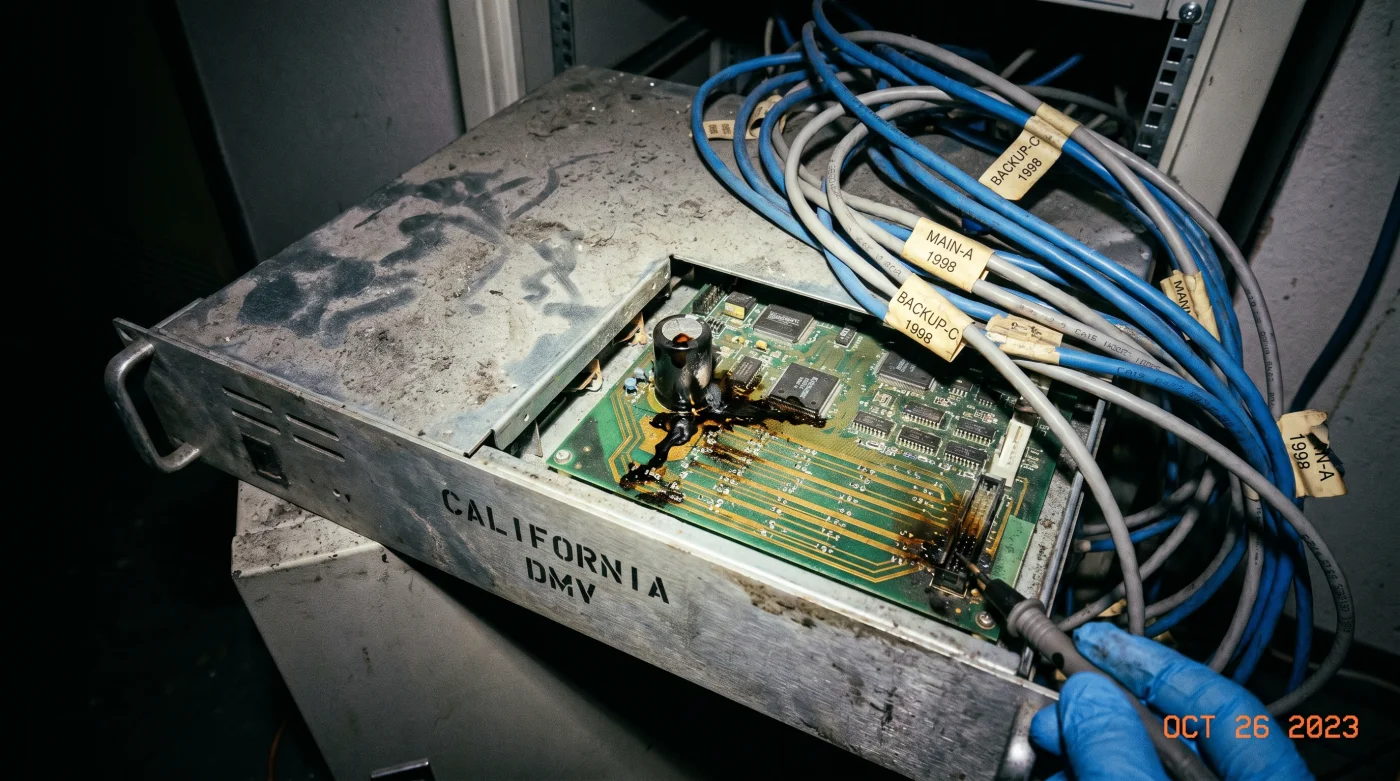
To understand why the system collapsed, we must examine the central metaphor of a glass penthouse built on top of a crumbling wooden pier. The California DMV’s customer-facing interface is sleek, responsive, and mobile-friendly. However, this modern frontend still communicates directly with a legacy backend run on archaic COBOL code and flat-file databases from the late twentieth century.
When you click “renew” on your phone, a sequence of modern API gateways attempts to translate your request into a format that the old mainframe can read. During the recent outage, a routine software update caused a synchronization error between these two layers. Because the legacy database cannot handle asynchronous multi-threading, it began processing requests in a single queue, leading to a catastrophic system lockup. Digital convenience remains entirely fragile without a complete modern overhaul of the backend servers.
- Ferrari Luce debut sparks a global titanium casting shortage as Maranello locks supplier contracts
- Honda Ridgeline production pause sparks a sudden dealership pricing war on used midsize trucks
- Dodge Viper successor rumors trigger massive dealer markups on remaining V10 inventory
- Toyota Tundra V8 blocks utilize a bizarre factory bearing tolerance ensuring million-mile lifespans
- Ford V8 AC Cobra replicas hide a lethal aerodynamic lift flaw at track speeds
A Hidden Witness in the Server Room
Marcus Vance, a fifty-two-year-old database engineer who spent a decade maintaining public infrastructure systems in Sacramento, watched the incident unfold with a sense of weary familiarity. He remembers when the first web integrations were patched onto the state’s mainframe during the early two-thousands. “We were using digital duct tape to connect modern web traffic to database architectures designed in the era of floppy disks,” Marcus explains. He warns that when a modern system attempts to force thousands of instant, automated lookups through these narrow, legacy channels, the system eventually suffocates under its own weight.
Who Feels the Real-World Friction?
The consequences of this digital failure ripple far beyond the walls of the server room, creating distinct challenges for different types of drivers across the state.
The Private Seller
For those attempting to sell a used vehicle privately, the outage turned a simple exchange into a high-stakes gamble. Without access to the state’s digital title transfer database, sellers could not verify that ownership had officially migrated out of their name. This left them legally liable for any toll violations, parking tickets, or accidents caused by the new buyer immediately after the transaction took place.
The Out-of-State Transplant
New residents trying to register their vehicles faced a bureaucratic wall. Without active database verification channels, local offices could not cross-reference emissions certifications or verify out-of-state titles. This forced transplants to park their vehicles and rely on rideshares, racking up unexpected transportation expenses while waiting for the network to recover.
The Commercial Fleet Manager
For businesses managing logistics and delivery fleets, the system crash disrupted daily operations. Unable to renew commercial registrations or obtain valid weight stickers digitally, fleet managers had to choose between keeping their trucks idle or risking heavy fines by sending drivers out with expired digital documentation.
Navigating the Outage: The Analog Contingency Plan
When the digital grid fails, safety lies in reverting to a physical paper trail. You must treat paper not as an obsolete nuisance, but as your primary shield against system-wide lockouts.
To protect your legal ownership and maintain peace of mind during a network disruption, practice these simple, mindful habits:
- Keep physical prints: Always print a hard copy of your online payment confirmations, pending registration applications, and temporary operating permits. Do not rely on saving them as PDFs on your mobile device.
- Obtain wet-ink signatures: When conducting a private vehicle sale, complete a physical Bill of Sale (Form REG 135) with wet-ink signatures from both parties, and make a photocopy for your records.
- Log your transaction history: Document the exact date, time, and error messages encountered during your failed registration attempts. This paper trail can help you dispute late fees or citations later.
By maintaining a dedicated glovebox folder with physical copies of your pending transactions, you ensure that your mobility remains entirely independent of server status updates in Sacramento.
Reclaiming Control in a Connected Era
The great digital promise was that paperless systems would free us from waiting in line and eliminate physical clutter. Yet, as this statewide network outage demonstrates, total reliance on digital processing introduces a new, unpredictable vulnerability into our lives. When a single server error can freeze your ability to legally operate your vehicle, the illusion of seamless efficiency quickly fades.
Embracing a hybrid approach—where digital tools are used for convenience but backed by physical records—restores your agency as a vehicle owner. We do not need to reject the speed of the digital age, but we must protect ourselves from its inevitable hiccups. By holding onto the security of the physical paper trail, we ensure that our ability to move freely is never dictated by a spinning progress wheel on a frozen screen.
“The greatest vulnerability of the modern world is our blind belief that a digital record is permanent, when in reality, physical paper is the only medium that survives a power outage.”
| Key Point | Detail | Added Value for the Reader |
|---|---|---|
| Legacy Server Flaw | COBOL mainframe database bottle-necked by modern API web traffic translations. | Helps you understand why systemic crashes happen and why they take days to repair. |
| Digital Redundancy | Relying on digital receipts leaves you vulnerable to road stops and ticketing. | Encourages keeping a physical backup folder in your vehicle’s glove compartment. |
| Private Sale Risk | Delayed title transfers leave sellers liable for post-sale driving infractions. | Highlights the absolute necessity of retaining a physical, signed bill of sale. |
Frequently Asked Questions
Is my digital vehicle registration valid if the DMV database is down?
If the law enforcement database is also offline, officers may not be able to verify your registration status instantly. Keeping a physical, printed copy of your registration card or temporary operating permit in your glove box is the only way to prove compliance during an outage.Will I be charged late fees if I cannot renew my registration due to a system crash?
Typically, the state DMV waives late fees incurred directly during a verified, statewide system outage. However, you must provide documented proof, such as screenshots of the error or printed payment receipts, to successfully dispute the penalties.Can I still drive my car if my digital registration renewal is pending?
You can drive if you have a valid, physical temporary operating permit. If your registration has expired and the digital system is down, you run the risk of receiving a fix-it ticket unless you can show physical proof of payment and a pending transaction status.Why can’t the DMV simply upgrade its legacy mainframes to prevent these crashes?
Migrating decades of sensitive, interconnected driver records from old COBOL mainframes to modern cloud servers is an incredibly complex, expensive process that carries a high risk of data loss. Agencies often opt to patch existing systems rather than risk a full-scale migration.What is the safest way to complete a vehicle title transfer during a network outage?
Complete the physical Certificate of Title with signatures from both buyer and seller, fill out a physical Transfer and Reassignment form, and mail it to the DMV via certified mail. This creates an indisputable, legal paper trail independent of online services.