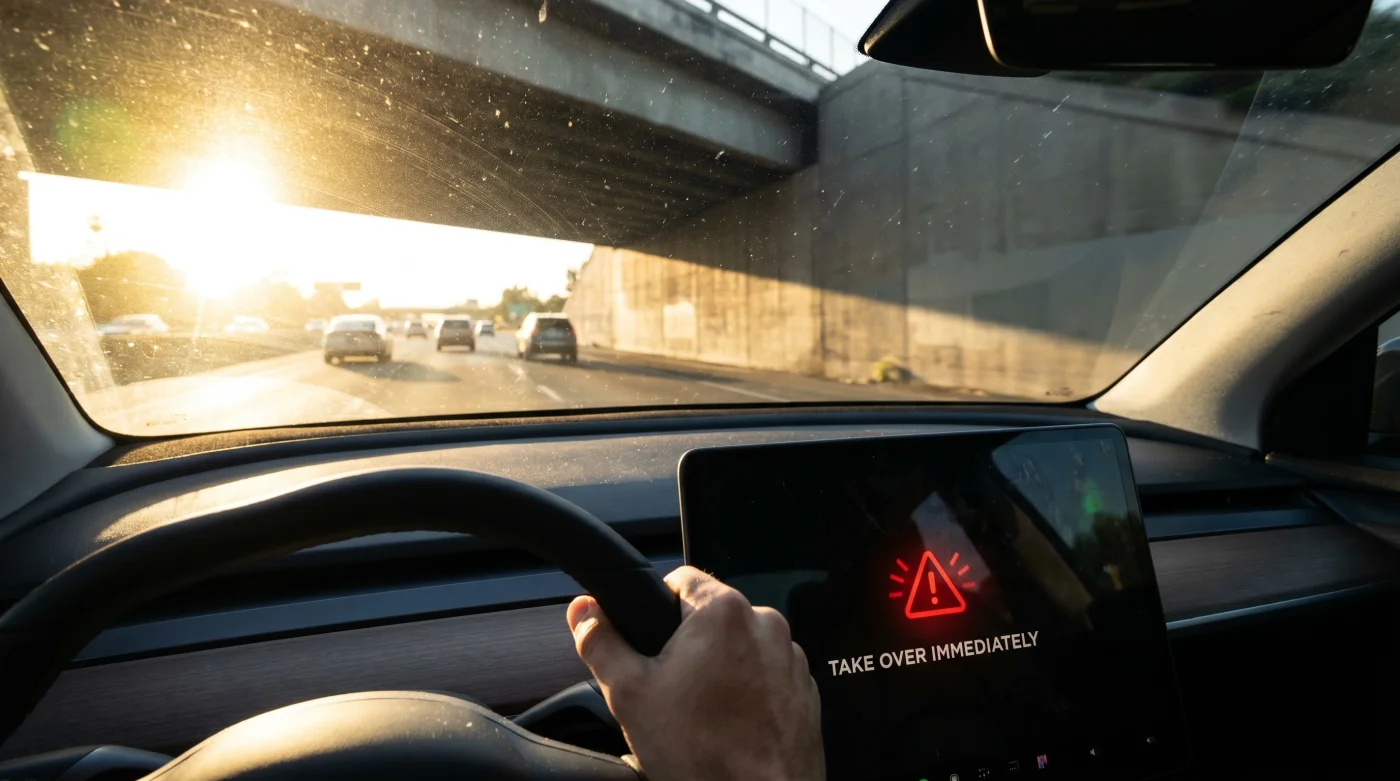
The afternoon sun on Interstate 5 is blinding, reflecting off the white hood of your Tesla Model Y like a sheet of polished glass. You hear the rhythmic hum of the highway tires, a steady, soothing vibration that makes the 70-mile-an-hour cruise feel almost effortless. Your hands rest lightly on the steering wheel while Autopilot handles the gentle curves of the concrete ribbon ahead. It feels like the future is supposed to feel: clean, quiet, and perfectly controlled.
Then, in a fraction of a heartbeat, the cabin air turns cold with tension. **Your seatbelt violently cinches** against your chest as the car slams on its brakes with terrifying force, dropping twenty miles per hour for absolutely no visible reason. Your morning coffee spills into the console, and behind you, a semi-truck blares its air horn, its massive chrome grille suddenly filling your rearview mirror.
There was no stalled car, no stray dog, and no sudden debris. There was only the dark, sharp-edged shadow of a concrete overpass cutting across the sun-drenched asphalt. What your eyes perceived as a simple patch of shade, your vehicle’s cameras treated as a solid, brick-like wall.
This sudden deceleration is not a random glitch in the software matrix; it is a physical limitation of relying solely on optical lenses to navigate a world built for three-dimensional human eyes. When Tesla removed radar in favor of a pure-vision architecture, they traded physical wave-based measurements for digital pixels, setting up **a quiet battle between** high contrast and high speed.
The Optical Mirage of Pure Vision
To understand why your Model Y misinterprets a simple shadow, you have to imagine squinting into a dark basement while standing in a bright, sunlit yard. Your eyes can adjust, but it takes a second for your pupils to dilate. **A digital camera sensor** struggles with this dynamic range in milliseconds. When the vehicle hurtles toward an overpass, the camera’s contrast sensors are overwhelmed by the sudden boundary where brilliant white concrete meets pitch-black shade.
Radar used to act as an invisible cane, bouncing radio waves under the shadow to confirm the road ahead was empty. Without it, the computer must calculate depth by comparing pixels from multiple camera angles. When a shadow is sharp enough, the system occasionally sees the dark edge as a physical barrier. It is an optical illusion that tricks the machine’s brain, transforming a harmless silhouette into an emergency stop.
- Wisconsin Department of Transportation hybrid registration fees quietly wipe out annual fuel savings entirely
- Newest electric cars from luxury brands share identical battery cell chemistry with budget crossovers
- Tesla Model 3 cabin heating mechanics actively drain high voltage range during city commutes
- California DMV network outage exposes a massive vulnerability in digital vehicle registration processing
- Ferrari Luce debut sparks a global titanium casting shortage as Maranello locks supplier contracts
Marcus Vance, a forty-two-year-old logistics analyst from Irvine, California, knows this sudden adrenaline spike all too well. Commuting thirty miles daily along the Interstate 10 corridor, he began tracking **the exact locations where** his Model Y would reliably panic. “There is a specific bridge near mile marker fifteen where the sun hits at exactly three in the afternoon,” Marcus explains. “If I am in the left lane, the car will try to stop every single time because the bridge column throws a hard diagonal line across the lane. I have learned to rest my foot lightly on the accelerator pedal before I even reach the shadow, ready to override the car’s hesitation.”
Deciphering the Shadow Profiles
Not all shadows are created equal in the eyes of a pure-vision system. The severity of the system’s reaction depends heavily on the angle of the sun and the layout of the concrete infrastructure above you.
The High-Contrast Noon Eclipse
When the sun is directly overhead during summer, overpass shadows are short, dark, and incredibly dense. **The transition is instantaneous**, leaving the camera sensors with zero ramp-up time to adjust their exposure levels. The system sees a black wall suddenly appearing in its path, triggering an immediate, defensive brake application to prevent what it perceives as an imminent collision.
The Angled Winter Solstice Shadow
During the winter months, the sun sits lower on the horizon, casting long, diagonal shadows that stretch across several highway lanes. These angled bands of dark and light confuse the lane-keep algorithms as well as the depth perception systems. The car can become unsure of its lane boundaries while simultaneously misinterpreting the diagonal shadow as a stationary obstacle blocking its path.
The Wet Asphalt Reflection
If a sudden rain shower is followed by bright sunshine, the highway surface becomes a mirror. **The glare from wet pavement** combined with the dark underpass shadow creates an extreme high-contrast environment. The camera sensors struggle to distinguish between the reflection of the sky on the road and the actual physical boundaries of the highway, leading to highly unpredictable braking behavior. Trying to see through this glare is like breathing through a dusty wool blanket; the processor simply runs out of clean data.
Mastering the Shadow Override
Navigating these high-contrast highway corridors requires a shift in how you interact with your vehicle’s semi-autonomous systems. Instead of treating Autopilot as an invisible chauffeur, think of it as a junior pilot who easily gets spooked by visual tricks. You must remain **an active participant in** the driving loop, especially when approaching known high-contrast zones.
Here is how to manage your drive safely:
- Keep your foot hovering over the accelerator pedal whenever you approach a highway overpass on a bright, sunny day.
- Gently press the accelerator the moment you feel the car begin to hesitate; this simple input instantly overrides Autopilot’s braking command without deactivating steering.
- Avoid using Autopilot in the far-left lane near concrete median barriers, as these structures cast the sharpest, most disruptive shadows.
- Clean your windshield regularly, paying special attention to the glass housing the front-facing cameras near the rearview mirror, as dust and smudges exacerbate optical glare.
The Tactical Toolkit
To keep your highway drives seamless, keep these practical parameters in mind:
- **Optimal Speed:** Keep your speed under 75 mph in high-risk shadow zones to give the camera processors more frames to analyze the road.
- **Windshield Care:** Use a high-quality glass cleaner every two weeks to prevent micro-films from scattering light into the camera lenses.
- **Time of Day:** Be especially vigilant between 11:00 AM and 2:00 PM (vertical shadows) and 4:00 PM to 6:00 PM (long, low-angle shadows).
The Balance of Light and Machine
Living with a vision-only electric vehicle means accepting that technology is still learning how to interpret our complex, physical world. The transition from physical sensors like radar to pure software-driven optics is a bold experiment in minimalism. It promises simpler manufacturing and lower costs, but it shifts the burden of vigilance back onto the driver during these edge-case scenarios.
When you learn to anticipate where these optical traps lie, **the anxiety of the** sudden brake tap disappears. You begin to read the highway not just as a driver, but as a photographer, noticing the interplay of light, concrete, and contrast. In doing so, you reclaim your peace of mind, transforming a sudden highway fright into a predictable, easily managed quirk of modern engineering.
“Optical systems are brilliant at reading signs and lane lines, but they must learn that empty air under a bridge is not a concrete barrier.” — Dr. Helen Vance, Autonomous Systems Researcher
| Key Point | Detail | Added Value for the Reader |
|---|---|---|
| Dynamic Range Limits | Rapid shifts from light to dark overwhelm lens exposure. | Allows you to predict and prevent sudden braking events before they happen. |
| Radar Absence | Pure-vision relies entirely on pixel depth calculation instead of radio waves. | Explains why older models with radar do not exhibit this specific behavior. |
| Manual Override | Pressing the accelerator instantly bypasses camera-initiated braking. | Keeps you in control of your highway pace without losing steering assistance. |
Frequently Asked Questions
Why did Tesla remove radar from the Model Y? Tesla transitioned to “Tesla Vision” to simplify the vehicle’s architecture, believing that a pure-vision system mimicking human eyes is ultimately safer and more capable than a mix of conflicting sensor inputs.
Is phantom braking dangerous for drivers behind me? Yes, sudden, unexpected deceleration on a high-speed highway can startle following drivers and increase the risk of a rear-end collision, which is why active driver monitoring is crucial.
How do I quickly override a phantom braking event? Simply press down on the accelerator pedal. This manual input immediately overrides the automated braking without canceling the Autosteer function.
Does dirty glass make phantom braking worse? Absolutely. Smudges, pollen, or water spots on the windshield directly in front of the camera housing scatter light and make it harder for the sensors to calculate contrast accurately.
Will software updates fix this issue permanently? Tesla frequently updates its neural networks to better identify shadows, but physical limitations of camera dynamic range mean some degree of visual confusion remains possible in extreme light transitions.