The scent of warm fork oil and heated rubber hangs thick in the garage after a fast morning run. You pull into the driveway, your forearms tight from wrestling a machine that should feel like an extension of your own skeletal system. Instead, every aggressive entry into a sweeping turn feels like a gamble against gravity, leaving you wondering why your premium sportbike behaves so unpredictably under pressure.
The physical feedback through the clip-ons tells a story of instability and sudden panic. When you grab a handful of front brake, the nose of your bike doesn’t just settle; it plunges toward the asphalt like a dropped anvil. This sudden weight transfer unweights the rear tire, making the back end wiggle and dance while you struggle to hold your line through the apex.
Many riders accept this behavior as an inevitable consequence of speed, blindly trusting that the factory settings on their Kawasaki are optimized for real-world roads. We assume that because a motorcycle left a highly automated plant in Japan, its suspension must be dialed in perfectly. But the reality is that stock configurations are engineered for an imaginary, static average rider cruising on frictionless, laboratory-grade tarmac.
When you take that generic setup onto public roads, the delicate balance between spring tension and oil flow falls apart completely. The front forks plunge too fast, using up their travel instantly and leaving no margin for bumps, which causes the bike to dives like a dropped stone when you need stability the most.
The Stifled Valve: Suspension as a Controlled Breath
To understand why your front end feels so nervous, think of your suspension not as a rigid set of metal springs, but as a system that needs to breathe. When you apply the front brakes, the fork oil must pass through tiny valves at a metered rate. If the setup is wrong, it is like trying to draw a deep breath through a thick down pillow.
If the fork collapses too quickly, it alters the chassis geometry of your motorcycle, sharpening the rake angle and turning a stable machine into a twitchy, hyper-reactive liability. This rapid drop is not a sign of poor components, but of a fundamental mismatch between the physical spring tension and the high-speed compression damping valving. By correcting the initial ride height, you restore the chassis to its intended balance, allowing the front tire to track smoothly over mid-corner ripples without upsetting your trajectory.
- Wisconsin Department of Transportation database loopholes instantly erase inflated high-risk insurance premiums
- Superyacht gyroscopic stabilizers hide a severe mechanical flaw engineers completely ignore
- Lamborghini next generation hybrid powertrain leak exposes a massive weight penalty engineers cannot fix
- Chevy electric vehicle chassis reality exposes a heavy compromise ruining long term tire longevity
- Tesla Autopilot anomaly reports expose a terrifying sensor blindness near specific highway sound barriers
A Lesson from the Pit Lane
Dave Vance, a forty-seven-year-old suspension specialist who spent two decades tuning race bikes in Ohio, discovered this design compromise while setting up track-day sportbikes. He noticed that factory specifications consistently featured an overly soft front preload to make the bikes feel comfortable and plush on showroom floors. To compensate for this softness, manufacturers over-tighten the high-speed compression damping. The result is a fork that dives instantly under light braking, yet feels incredibly harsh and jarring when hitting actual bumps at speed.
Tailoring the Front End: Weight and Style Profiles
Because there is no one-size-fits-all setup, the solution must match your physical footprint and how you interact with the pavement.
The Canyons Carver (160 to 190 lbs)
Riders in this weight range often suffer from mid-corner instability because the soft front end forces them to hold their breath through transitions. By raising the initial ride height, you keep the front suspension operating in the plush middle section of its travel, preserving valuable suspension stroke for unexpected mid-corner bumps.
The Sport-Touring Operator (Over 200 lbs)
For heavier riders or those carrying luggage, the factory setup is even more problematic. The stock springs are already compressed near their limit just by your sitting on the bike, meaning a sudden stab of the front brake can bottom out the forks completely, transferring the impact directly to your wrists and the tire carcass.
The 12-Millimeter Correction: A Step-by-Step Blueprint
To fix this geometry error without ruining the plush feel of your ride, you need to adjust the front fork preload to a precise physical measurement that keeps the nose from dropping too rapidly under heavy braking.
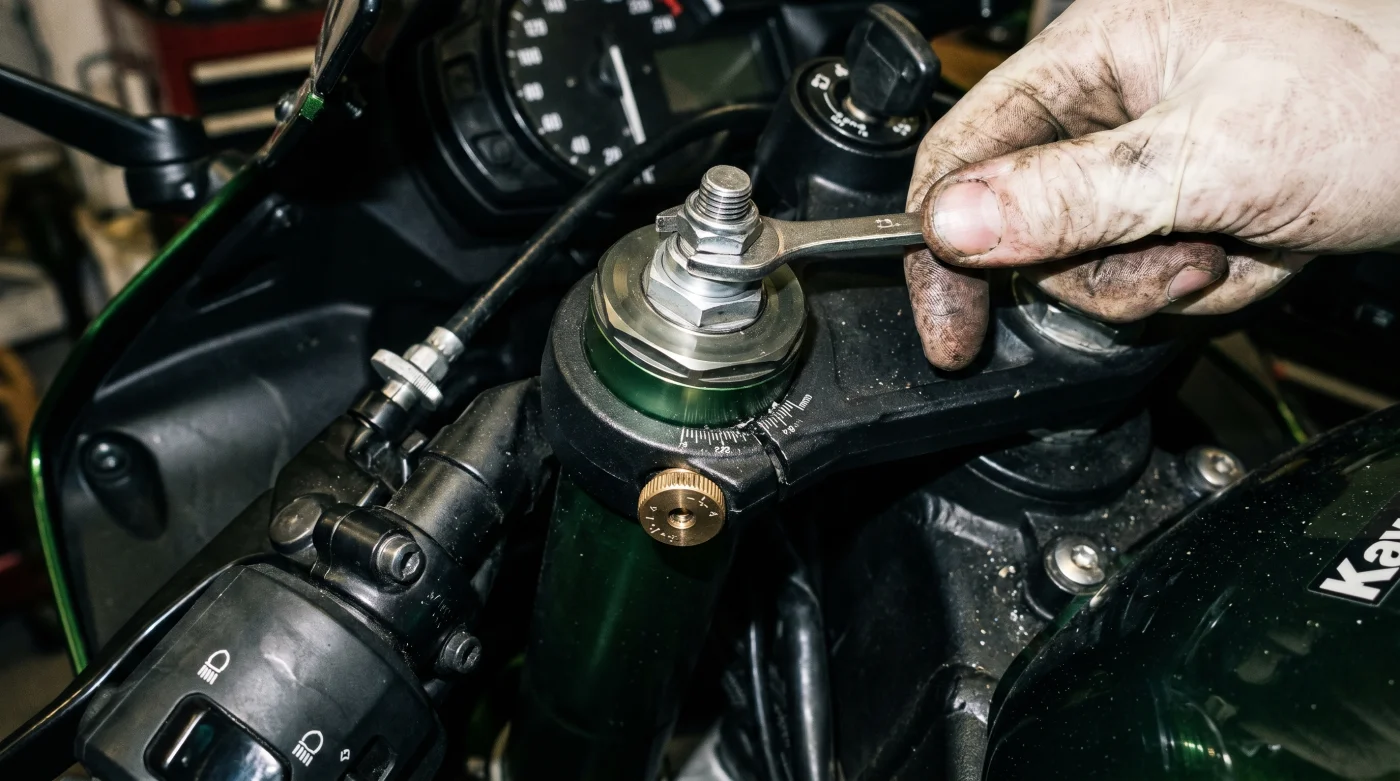
By setting the physical preload to show exactly 12 millimeters of thread on your fork cap adjusters, you raise the dynamic ride height of the front end. This simple physical change ensures the bike remains stable under hard braking, keeping your steering geometry consistent and your rear tire planted firmly on the ground.
- Place your motorcycle on a rear paddock stand, then use a front headlift stand to completely lift the front wheel off the ground, ensuring there is no load on the forks.
- Locate the hex-head preload adjusters on the top of each fork cap, which typically require a 14mm socket.
- Turn both adjusters counter-clockwise until they stop to find your zero point, taking care not to force them past their natural limit.
- Turn the adjusters clockwise, measuring carefully with calipers until you have exactly 12 millimeters of visible adjuster height showing above the fork cap.
- Locate the compression damping screw at the bottom of the fork leg and back it out by a quarter-turn to allow the internal oil to flow more freely through the valving.
The Tactical Toolkit
Having the correct tools makes all the difference when making fine adjustments to your chassis. Keep these items on your workbench:
- Digital vernier calipers for precise millimeter measurements
- A 14mm six-point socket to prevent rounding the soft aluminum adjusters
- A flat-head cabinet screwdriver for damping clickers
- A front headlift stand to safely unload the front suspension
Restoring Harmony to the Contact Patch
When you finish adjusting your forks, the immediate difference on the road is remarkable. The bike stops behaving like a nervous seesaw and starts moving as a cohesive, balanced unit. When you squeeze the brake lever, the front end holds its ground, offering a firm, reassuring platform that allows the front tire to bite the road surface predictably.
This correction does more than just stop a annoying nose-dive; it restores your confidence in the front contact patch. You can trail-brake deeper into corners with peace of mind, knowing your motorcycle will track exactly where you point it, free from the unsettling geometry changes that used to ruin your high-speed stability.
“Suspension isn’t about making a bike soft; it’s about keeping the tires in constant, predictable contact with the road under every force you throw at the chassis.” — Dave Vance
| Adjustment Point | Stock Behavior | Added Value after 12mm Fix |
|---|---|---|
| Front Ride Height | Collapses instantly, steepening rake | Maintains chassis geometry and steering stability |
| Compression Valving | Feels harsh over bumps, yet dives under braking | Allows smoother oil flow and better bump absorption |
| Rear Tire Traction | Lightens up, wanders under heavy braking | Stays planted, improving rear brake effectiveness |
Frequently Asked Questions
Will this 12mm adjustment make my suspension feel too stiff over daily road bumps?
No, because raising the preload doesn’t change the actual stiffness of the spring. It simply changes the ride height, keeping the fork from collapsing into the stiffest part of its travel too quickly.Do I need to adjust my rear shock settings after changing the front preload?
While not strictly necessary, checking your rear sag ensures your bike is balanced from front to back, preventing the rear end from squatting too much under acceleration.How can I tell if my front forks are still bottoming out after the adjustment?
Wrap a clean zip-tie around one of your inner fork tubes and slide it down to the dust seal before your next ride. After riding, check how close the zip-tie got to the bottom axle casting.Why does Kawasaki ship bikes with these settings if they aren’t ideal?
Manufacturers must set up bikes to accommodate a wide range of rider weights, often prioritizing a soft, forgiving showroom feel over high-performance stability.Should I perform this adjustment if I only ride on straight highways?
Yes, because maintaining high-speed stability and preventing sudden nose-dive during emergency braking is crucial for safety on any public road.