The interstate stretch ahead is a ribbon of wet, black velvet under a low November sky. Inside the cabin of your modern electric vehicle, the only sound is the quiet hiss of tires on asphalt and the soft, ambient hum of the electric drivetrain. It is comfortable, until a sudden drop in outside temperature causes a thin sheet of condensation to bloom across the bottom of the windshield. Your hand reaches out instinctively toward the center console, searching for the familiar, ribbed texture of a physical defroster dial.
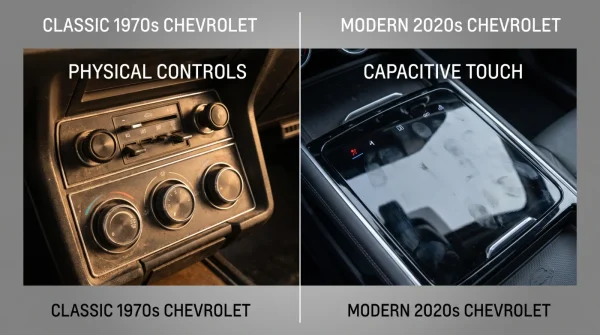
Instead, your fingers meet a cold, completely flat sheet of high-definition glass. The screen glare bounces off the wet windshield, forcing you to squint. You tap the screen twice, trying to hit a tiny icon, but a minor expansion joint in the concrete pavement sends your finger flying into the media player settings. **Your hand searches blindly** for a tactile anchor that simply does not exist in this sterile, modern interior.
Automobile manufacturers present this minimalist aesthetic as the pinnacle of forward-thinking cabin design. They frame clean dashboards as peaceful sanctuaries free from the clutter of yesterday. But out on the open highway at 70 miles per hour, this quiet minimalism transforms into a chaotic, high-stakes distraction that challenges your natural driving instincts.
The physical reality of operating a moving machine demands muscle memory, not eye-hand coordination. When a vehicle forces you to look away from a dark highway just to adjust the cabin temperature by two degrees, the design has failed its most basic safety mandate. Real-world driving **demands muscle memory, not** constant visual confirmation of every single touch.
The Illusion of the Seamless Cabin
To understand why this design pivot feels so unnatural, consider the difference between playing an acoustic guitar and tapping on a virtual piano app. A guitarist never looks at the strings to find a chord; the fingers rely on physical geography. Removing physical buttons from the newest electric cars is like stripping the frets off a fingerboard and asking a musician to play by sight alone. We have traded intuitive physical geography for digital real estate, forgetting that our eyes cannot safely look in two directions at once.
Telemetry data from independent automotive safety studies reveals the stark cost of this trade-off. While adjusting a physical rotary dial for temperature takes a driver’s eyes off the road for an average of 0.8 seconds, navigating a sub-menu on a capacitive screen requires up to 4.2 seconds. At 70 miles per hour, those extra three seconds mean your vehicle travels over 300 feet—the length of an entire football field—while you are staring at a piece of glass. **Designing a touch-only dashboard** prioritizes cheap manufacturing disguised as luxury over basic human biology.
The Flight Deck Perspective
Marcus Vance, a 48-year-old human factors specialist who spent two decades designing cockpits for commercial aerospace applications in Michigan, recognizes this dangerous pattern. “In aviation, we have a strict rule: if a control is critical to safety or basic situational comfort, it must have a distinct physical shape you can identify by feel alone in a dark, turbulent cockpit,” Vance explains. He notes that the automotive industry has ignored decades of established cognitive science, swapping reliable mechanical switches for cheap display panels to pad manufacturing margins while branding it as the future.
- Ford Bronco tire pressure settings require a massive deflation drop to survive washboard gravel roads
- Wisconsin Department of Transportation mileage filings legally slash high risk automotive insurance premiums
- Kawasaki hydrogen combustion motorcycle prototypes expose a massive thermal challenge masking zero emission viability
- General Motors Ultium architecture leak reveals a massive payload restriction stalling heavy duty trucks
- Gas engine phaseouts expose a massive infrastructure reality the electrical grid cannot support
Navigating the Screen: Segmenting the Risk
The Highway Commuter
For those who spend hours on high-speed freeways, the danger of touchscreen interfaces is compounded by speed. At high velocities, your brain requires maximum situational awareness to process lane changes, sudden braking, and road debris. Fumbling with a digital slider to stop a blast of cold air disrupts this processing loop instantly.
The Night Driver
Driving after dark requires your eyes to adapt to low-light conditions. Every time you are forced to look at a bright center console screen to turn down the heat, your pupils constrict. **Cold fingers compound the lag** of touch surfaces, leaving you partially blinded for several critical seconds as your eyes struggle to readjust to the darkness of the highway ahead.
Reclaiming Your Focus Behind the Wheel
While you cannot instantly install physical buttons in a vehicle designed without them, you can adopt specific, mindful habits to minimize the visual tax of modern infotainment screens.
Begin by mapping your physical steering wheel buttons to minimize screen interaction. Many of the newest electric cars allow you to program at least one tactile toggle to act as a shortcut for climate control or voice activation.
- Map your steering wheel custom key to the maximum defrost function.
- Use voice commands exclusively for minor, non-urgent cabin temperature adjustments.
- Establish a pre-drive routine where you set your baseline climate before shifting out of park.
By making it a habit to **adjust your settings before** you hit the road, you protect your attention when it matters most.
The Tactical Cabin Checklist
- Target Winter Cabin Baseline: 69°F (set before shifting into Drive)
- Display Mode: Set to Auto-Night to minimize pupil constriction
- Steering Wheel Shortcut: Programmed for immediate front defrost
- Voice Recognition: Calibration run performed while parked
The Return of Tactile Sanity
The trend of removing physical buttons is beginning to face a quiet, powerful resistance from safety agencies and frustrated consumers alike. True luxury is not a giant glass screen that demands your undivided attention; it is the confidence of intuitive control that leaves you free to enjoy the open road. When you take control of your cabin environment and minimize screen interaction, driving becomes what it was always meant to be: a smooth, focused, and deeply satisfying experience. Reclaiming your visual focus **reclaims your visual focus** and restores your peace of mind behind the wheel.
“Safety isn’t about how much information you can pack onto a screen; it’s about how little you have to look at it to stay in control.” — Marcus Vance, Human Factors Specialist
| Control Type | Eyes-Off-Road Time | Added Value for the Reader |
|---|---|---|
| Physical Rotary Dial | 0.8 Seconds | Allows muscle memory to guide adjustments without losing sight of the road ahead. |
| Capacitive Touchscreen Menu | 4.2 Seconds | Increases reaction time, forcing your vehicle to travel hundreds of feet unguided. |
| Steering Wheel Shortcut Toggle | 0.2 Seconds | Keeps both hands on the wheel and your focus locked on the driving environment. |
Frequently Asked Questions
Why are car manufacturers getting rid of physical buttons?
Car manufacturers are replacing physical buttons with touchscreens primarily to reduce assembly and manufacturing costs, as programming software is significantly cheaper than sourcing and wiring physical switches.
Are touchscreens in cars actually more dangerous than physical buttons?
Yes. Telemetry data shows that using a touchscreen increases the time a driver’s eyes are off the road by up to 400 percent compared to using traditional tactile dials.
Will future electric cars bring back physical controls?
There is a growing shift in the industry, driven by safety organizations like Euro NCAP, which are starting to penalize cars that do not have physical buttons for key safety functions.
How can I make my EV touchscreen less distracting?
You can reduce distraction by keeping the display in dark mode, programming steering wheel shortcuts, and utilizing voice commands for climate adjustments.
Can wearing gloves affect touchscreen climate controls?
Yes, standard gloves block the bio-electric current required to operate capacitive touchscreens, often rendering the climate controls completely unresponsive.