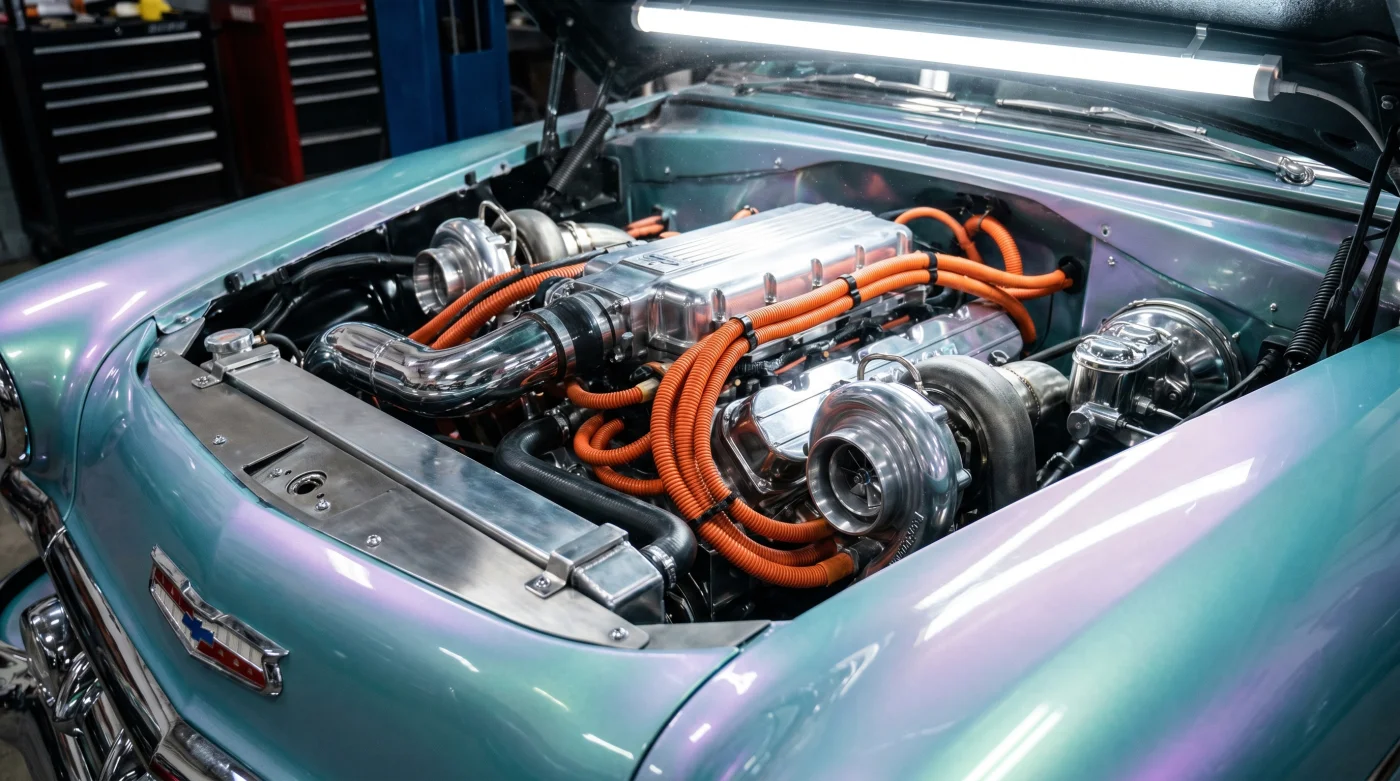
The hum of the Warren Tech Center is usually a low, synthetic purr—the sound of solid-state software and silent electric motors spinning on sterile test benches. But lately, there is a different vibration under the concrete floorboards. It smells of hot copper coils, stamping press grease, and the sharp, vinegar tang of curing silicone sealant. This is not the clean, antiseptic quiet of an all-electric dream. It is the heavy, physical sound of metal meeting metal.
For years, the public was fed a singular, pristine vision of the future: a quiet glide into 2035 on pure, battery-only power. The narrative was tidy, clean, and seemingly unalterable. Yet, if you stand near the loading docks of the Spring Hill assembly plant in Tennessee, the air tells a different story. The shipping crates arriving from tier-one suppliers do not contain the massive, flat skateboard batteries of a pure EV. Instead, the shipping crates arriving hold compact, liquid-cooled lithium-ion packs designed to snuggle alongside a gasoline combustion engine.
This quiet pivot on the assembly floor is the physical manifestation of a massive institutional recalibration. While the public slickly scrolled through press releases promising a tailpipe-free tomorrow, the cold mathematics of the market intervened. Wall Street demanded a bridge when the highway to total electrification proved too steep, too expensive, and too soon for the average American driveway.
The shift is led by a silent retooling of General Motors’ most sacred platforms. Rather than abandoning the internal combustion engine entirely, the manufacturing giant is marrying its proven gas-powered blocks with compact, high-efficiency electric motors. This is the return of the plug-in hybrid (PHEV), a pragmatic compromise disguised as a technological leap.
The Bridge Over the All-Electric Chasm
To understand this manufacturing u-turn, you must abandon the idea that progress is always a straight line. Think of a massive container ship attempting to pull a sharp u-turn in a narrow canal. It cannot simply spin on a dime; it must use its thrusters to pivot gradually, leaning into the resistance of the water. GM’s sudden shift back to traditional hybrid battery architectures is that ship using its thrusters.
The industry spent half a decade telling you that plug-in hybrids were merely a stepping stone—a temporary band-aid to be discarded as soon as massive battery factories went online. But as EV adoption hit a cold front of high prices and sparse charging infrastructure, that stepping stone became the only solid ground left. By marrying the 1.5-liter turbocharged Ecotec engine with a dual-motor direct-drive transaxle, GM is preparing to offer a fleet that delivers eighty miles of silent electric commuting without the paralyzing anxiety of a dead battery in a rural winter.
Consider the perspective of Marcus Vance, a 54-year-old senior tooling engineer who has spent three decades calibrating the assembly lines at GM’s Spring Hill facility. “We spent eighteen months preparing the floor for pure EV architecture,” Marcus says, rubbing a smudge of dark industrial grease from his temple. “Then the orders shifted. We didn’t scrap the machines; we adapted them. We are now dropping dual-motor transaxles onto the same lines we thought would only see battery packs. It’s about building what people can actually use today, not ten years from now.”
- Car accident lawyer searches spike as emergency braking sensors falsely assign liability
- Tesla Model Y inventory surges force regional delivery centers into shadow discounting
- Lamborghini V12 chassis rigidity exposes a massive torsional flex flaw Ferrari avoids
- Subaru Forester moonroof recall inspections require a specific drainage tube water test
- Ford Bronco EcoBoost engines demand a specific synthetic oil weight bypassing manuals
Deciphering the New Hybrid Lineup
The Suburban Commuter’s Sweet Spot
For those who live in the sprawling suburbs of Atlanta or Dallas, the new PHEV architecture offers the perfect daily envelope. Your morning drive to work fits comfortably within the forty-to-fifty-mile all-electric range of the redesigned midsize hybrid battery packs. You plug in at night using a standard garage outlet, bypassing the need for an expensive panel upgrade.
The beauty of this configuration lies in its thermal management system. Unlike pure EVs that lose up to thirty percent of their range when the mercury drops below freezing, these hybrid packs utilize waste heat from the engine to keep the battery at its optimal operating temperature. It is a closed-loop system of efficiency that makes pure EVs look remarkably fragile in northern winters.
The Long-Haul Utility Champion
For those who use their vehicles as mobile offices or tow rigs, pure electricity has always been a tough sell. The new GM hybrid architecture addresses this by pairing the battery pack with a high-torque gas generator that acts as both a propulsion unit and an onboard power station.
When pulling a trailer through the Appalachians, you are not constantly scanning the horizon for a functional high-speed charger. Instead, the system seamlessly transitions between battery assist and direct engine drive, keeping the electric motors cool and reserving battery power for the slow-speed, high-stress maneuvers where gas engines are at their most inefficient.
Maximizing the Hybrid Life Cycle
Owning one of these transitional machines requires a different mental model than maintaining a traditional gas car or a pure EV. You are managing two distinct lifespans under one hood, and longevity depends on how you balance them.
To ensure your hybrid battery survives well past the 150,000-mile mark, you must avoid the temptation to leave the gas tank dry. Fresh fuel is a lubricant for the entire fuel delivery system, even when you are driving almost exclusively on electricity.
The Tactical Toolkit for Hybrid Longevity:
- The 80/20 Rule: Set your charge limiter to eighty percent for daily commuting. Only charge to one hundred percent when you anticipate a long trip that will immediately deplete the battery.
- Fuel Rotation: Never let gasoline sit in the tank for more than three months. Use a high-quality fuel stabilizer if your daily commute is entirely electric.
- Coolant Inspections: The hybrid battery uses a dedicated low-conductivity coolant loop. Check the reservoir level every six months; it is completely separate from the engine radiator coolant.
- Brake Bedding: Because regenerative braking does ninety percent of the stopping work, your physical brake pads can glaze over from disuse. Perform three firm, safe stops from forty miles per hour once a month to keep the friction surfaces clean.
The Return of Pragmatic Engineering
This manufacturing shift is more than a simple corporate pivot; it is a return to engineering sanity. For years, the automotive industry was dominated by grand, sweeping promises that ignored the messy, beautiful reality of human infrastructure. Mary Barra’s quiet redirection of GM’s capital back to hybrid architecture is an admission that the transition to a new energy paradigm must be earned, not forced.
If you walk the assembly floor at Spring Hill today, you can see this compromise in physical form. The cold, mechanical reality of the market has asserted itself over corporate slide decks. It is proof that the future will not be built by discarding the past, but by wrapping it in the protective embrace of pragmatic technology, culminating in the newly installed high-voltage orange wiring harnesses on the assembly floor.
“The smartest engineers don’t build for the world they want; they build for the world that actually exists outside the factory gates.” — Marcus Vance, Senior Tooling Engineer
| Key Point | Detail | Added Value for the Reader |
|---|---|---|
| Architectural Shift | GM integrates 1.5L turbo Ecotec engine with a dual-motor PHEV system. | Gives buyers the range security of gasoline with zero emissions on daily commutes. |
| Thermal Advantage | Engine waste heat is recycled to warm battery cells in freezing weather. | Prevents the dramatic cold-weather range loss common in pure electric vehicles. |
| Grid Independence | Charges via standard 120V/240V residential outlets without panel upgrades. | Saves thousands of dollars on home electrical infrastructure installation. |
Frequently Asked Questions
Will GM still produce pure electric vehicles alongside these new hybrids?
Yes, GM will maintain its existing EV lines, but the production ratio has shifted to accommodate massive real-world consumer demand for flexible hybrid models.
How does this hybrid system prevent fuel from spoiling in the tank?
The vehicle features an automated pressurized fuel system and a maintenance cycle that automatically runs the gas engine if the fuel is too old.
Are maintenance costs higher because there are two propulsion systems?
While there are more parts, the gas engine operates under far less stress, and regenerative braking reduces wear on traditional brake components, balancing overall costs.
Can I drive this PHEV if the battery is completely depleted?
Absolutely. The system transitions into a standard parallel hybrid mode, utilizing the gasoline engine to power the vehicle and recharge the battery on the go.
Why did GM pivot away from its 2035 all-electric goal so suddenly?
Institutional shareholders expressed strong concerns over slowing global EV demand and inadequate public charging networks, prompting a pragmatic, market-driven correction.