The midday sun baking the black asphalt of the used car lot casts a harsh glare over the rows of inventory. You run a hand over the Pearl White paint of the Model Y, noting the heavy thud of the door closing. It feels solid. It feels like the future.
You slide into the driver’s seat, greeted by the sterile glow of the center screen. The dealer points to the top corner, proudly announcing the remaining range. At 310 miles, it looks perfectly healthy, almost brand new. But the screen is lying.
Most second-hand buyers trust that prominent green number blindly, assuming it acts exactly like a traditional mechanical gas gauge measuring a fixed volume of liquid. In reality, that dashboard estimate is a heavily processed guess based on recent driving habits, historical climate settings, elevation changes, and current ambient temperature. It is entirely detached from the actual chemical reality of the physical lithium-ion cells bolted securely beneath your feet.
Finding the truth requires stepping past the polished user interface designed for daily convenience. It means learning the subtle knocks and swipes that force the car to drop its digital mask and reveal the physical wear of its core components. This changes everything you know about buying a used EV.
The Battery Health Illusion
Think of the dashboard range estimate like a repeatedly stretched rubber band. The vehicle’s computer calculates how far that band usually stretches based strictly on who pulled it last. If the previous owner drove gently at moderate speeds, utilizing regenerative braking perfectly in mild 70-degree weather, the onboard software assumes the pack can stretch incredibly far under those exact, idealized conditions.
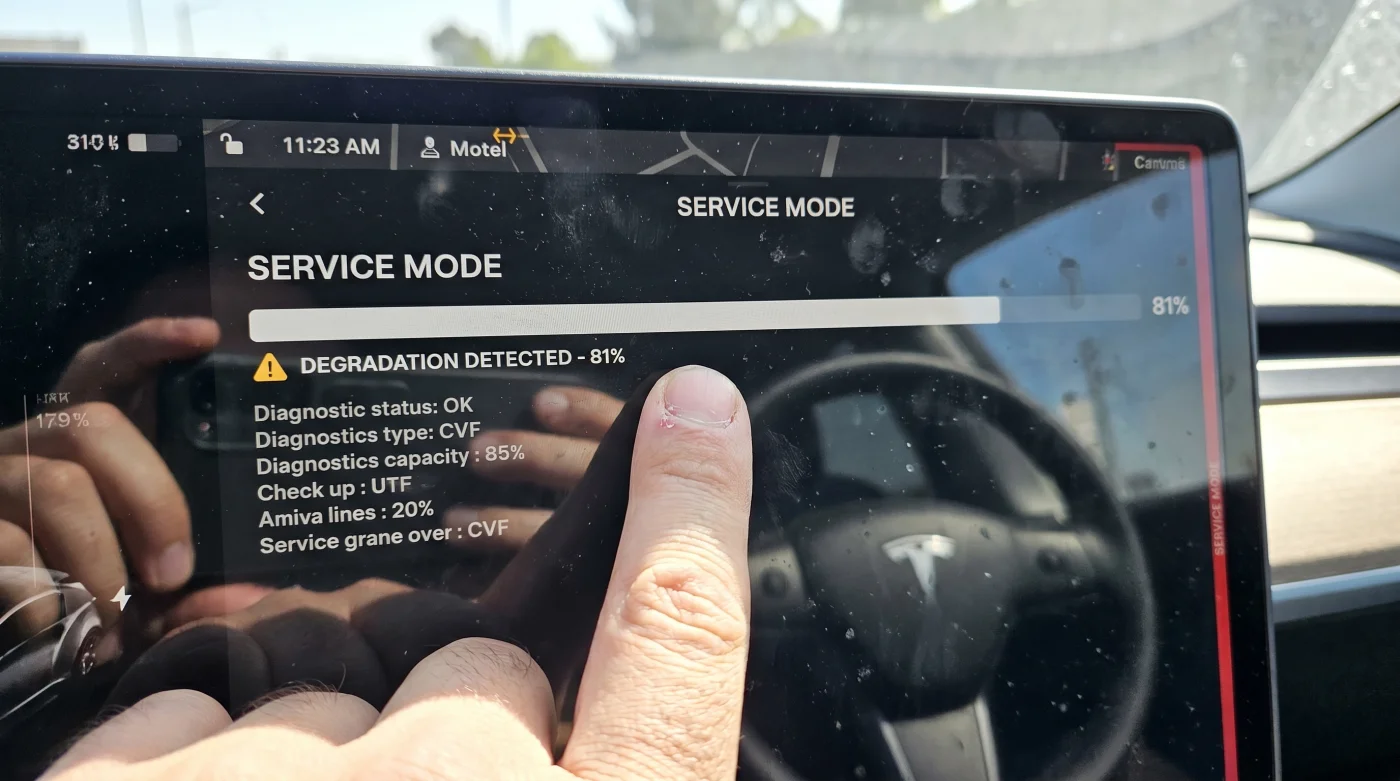
What you actually need to know is how much elasticity the rubber band has permanently lost over the years due to fast charging and heat exposure. The true degradation percentage is buried deep within the operating system, hidden away in a diagnostic mode designed specifically for technicians. Accessing this hidden internal menu transforms you from a passive consumer relying on sales pitches into an informed inspector.
Marcus Thorne, a 42-year-old independent EV inspector who spends his days sweating in Austin parking lots, sees this trap constantly. He recently walked away from a pristine 2021 Long Range model that a client was minutes away from buying. While the dashboard cheerfully promised 300 miles of range, Marcus activated the service menu and ran the internal battery health test. The real capacity? A staggering 18% physical degradation masked by a recent reset of the driving history. His client saved forty grand and a decade of regret.
- Tesla Model Y Suspension Failures Require This Hidden 100k-Mile Fix
- Tesla Model Y Standard Range Hides A Battery Software Truth
- The Silent F-150 Lightning Flaw The Rivian R1T Avoids Entirely
- The 10-Second Dipstick Test That Exposes A Failing CR-V Transmission
- The Hidden Cladding Purpose In The New Subaru Outback Design
Reading the Diagnostics by Driver Type
Not all battery wear is created equal, and your tolerance for degradation entirely depends on how you plan to use the vehicle. A daily commuter needs a totally different baseline than a cross-country road-tripper. Understanding your exact personal threshold dictates whether a specific car is an unbelievable bargain or a long-term burden.
For the High-Mileage Highway Cruiser. If your life dictates that you regularly drive 150 miles a day for work, you absolutely need a degradation reading below 8%. Sustained highway driving drains the battery pack rapidly due to continuous wind resistance at high speeds. Starting your ownership experience with a severely compromised capacity means you will be heavily reliant on frequent, expensive Supercharging stops along your route. Ironically, this high-voltage rapid charging introduces extreme heat, which only accelerates further chemical wear and tear on the internal cells.
For the Suburban Commuter. If your daily route involves dropping kids at soccer and driving ten miles to an office, a degradation level between 10% and 12% is perfectly acceptable. In fact, this slightly worn category is where you find the most aggressive price drops on the second-hand market. It becomes a strategic advantage when you sit down to negotiate the final price with a motivated seller.
For the Weekend Road-Tripper. Those planning monthly trips to remote cabins or national parks should be hyper-focused on the pack balance. The service menu does not just show total health; it shows voltage consistency across the internal cell blocks. A severely unbalanced pack will dramatically drop its charge when pushed hard under heavy loads like climbing steep mountain passes.
Executing the Service Mode Inspection
Entering this diagnostic state requires strict intention. It is not a casual flick of the wrist. You must communicate to the vehicle’s computer that you are performing maintenance, which requires the car to be securely parked, fully awake, and completely disconnected from any charging cables. Precision is highly critical here to avoid accidentally altering user settings.
Sit in the driver’s seat with the doors closed. Give yourself a moment of quiet focus before navigating the screen. Follow these specific steps to bypass the standard user interface and enter the diagnostic environment:
- Tap the ‘Car’ icon in the bottom left corner to open the main vehicle menu.
- Navigate to the ‘Software’ tab and locate the large ‘Model Y’ text at the top of the screen.
- Press and hold the ‘Model Y’ text for exactly five seconds, then smoothly release your finger.
- A prompt will appear asking for an access code. Type ‘service’ and hit confirm.
- The screen will outline in red, indicating Service Mode is active. Navigate to ‘High Voltage’ and select ‘Battery Health’.
The resulting screen will display a clear, unalterable percentage of remaining battery capacity. If the number is not immediately visible, the car may need to run a full depletion and charging cycle to calibrate, which is a massive red flag on a busy lot. Walk away if calibration fails or is pending on a car you want to drive home today.
Your Tactical Toolkit for this inspection is simple: You need 3 minutes of uninterrupted time, the car must have at least 20% charge remaining to display accurate metrics without stalling the system, and you should calculate acceptable wear at roughly 1% to 2% degradation per 10,000 driven miles.
Peace of Mind in the Electric Era
Evaluating an electric vehicle demands a radical shift in how we perceive mechanical wear. There are no oil stains on the concrete to point at, no rattling timing chains to listen for, and no exhaust smoke to meticulously analyze. The health is entirely invisible, locked securely within the chemistry of thousands of small cylinders beneath the floorboards.
By learning to access and interpret these hidden diagnostics, you are doing more than just protecting your wallet from a bad deal. You are taking active ownership of the technology. You reclaim the lost agency that modern, sealed-off digital appliances often strip away from us as everyday users.
It turns a stressful gamble into a precise, calculated decision. When you finally drive off the lot in your used Model Y, you will not be relying on blind faith or a salesperson’s empty promise about previous driving habits. You make an informed choice with total confidence, knowing exactly what is humming quietly beneath you.
“A dashboard range estimate tells you what the car did yesterday; the service menu battery health tells you what it will do for the next five years.” – Marcus Thorne, Independent EV Inspector
| Detail | Reality | Added Value for the Reader |
|---|---|---|
| Dashboard Range | A guess based on recent driving habits | Prevents you from overpaying for artificial software numbers. |
| Service Mode Access | Reveals raw, unfiltered hardware data | Gives you dealer-level inspection capabilities on the lot. |
| Battery Health % | Shows true chemical capacity loss | Ensures the car meets your specific driving and lifestyle demands. |
Common Inspection Questions
Will entering Service Mode void the vehicle warranty? No, accessing Service Mode to read diagnostics does not void the warranty; it is a built-in feature for viewing system health.
Can a dealer fake the Service Mode battery health percentage? The high-voltage system hardcodes this data. A dealer cannot manually alter the true degradation percentage shown in this specific menu.
What is a normal degradation rate for a used Model Y? Expect roughly 10% capacity loss within the first 50,000 miles, after which the degradation curve typically flattens out.
Does temperature affect the Service Mode reading? While extreme cold limits immediate usable capacity, the health percentage reflects the permanent physical state of the cells, independent of the current weather.
Can I exit Service Mode easily? Yes, simply press the red ‘Exit Service Mode’ button at the top of the screen to return the car to normal operation.