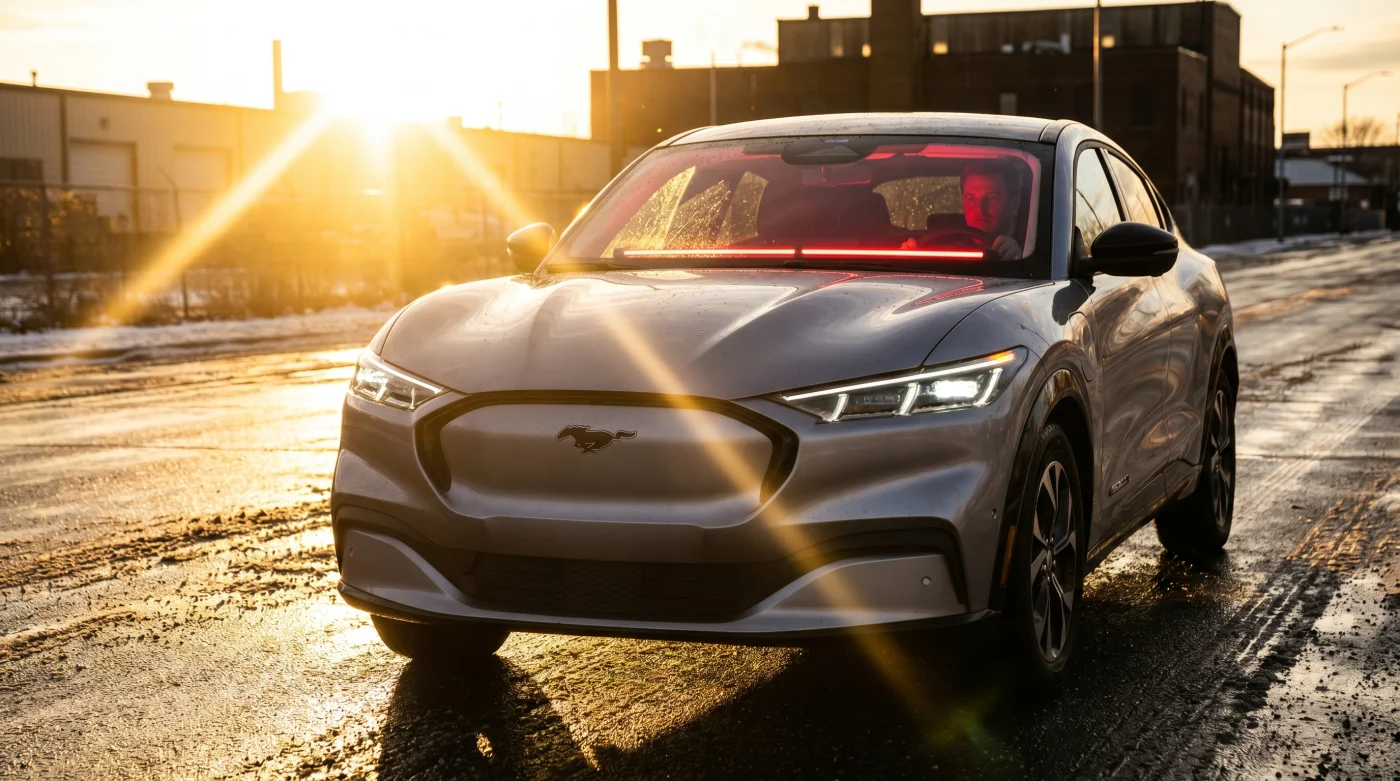
A crisp December morning greets your commute, the highway stretching out under a hard, pale sky. Inside the cabin, the climate control whispers a warm breeze against your ankles while the vehicle effortlessly maintains its lane. You rest your hands in your lap, trusting the soft blue glow of the instrument cluster to guide you along the asphalt.
The interstate slowly sweeps toward the southwest just as the sun begins its lazy ascent above the tree line. It is not the high, brilliant sun of midsummer, but a sharp, frozen glare that hovers mere inches above the horizon, striking the dashboard directly at a flat, unforgiving angle.
Suddenly, the calm cabin atmosphere shatters. The tranquil blue hue on the steering wheel vanishes, replaced instantly by an angry, pulsing crimson glare. A sharp, rhythmic chime demands your immediate attention as the digital instrument cluster flashes a stark warning to resume control. Your hands scramble for the cold leather of the wheel as the vehicle begins to drift slightly toward the shoulder, the sudden transition leaving your heart racing.
We are conditioned to believe that our advanced driving assistants possess flawless vision. We assume that because these systems rely on invisible infrared waves, they are immune to the simple, blinding hazards that make human drivers squint. The reality on the winter asphalt, however, is far more delicate.
The Digital Stage Light
To understand why this happens, we must look at the cabin’s eye-tracking module not as a flawless computer brain, but as a sensitive camera trying to read a script while someone shines a spotlight directly into its lens. The system relies on a small cluster of infrared emitters and a high-speed camera mounted directly on your steering column.
This tiny module constantly projects a grid of invisible light onto your face, measuring the distance between your eyelids and the direction of your gaze. Under normal conditions, this system works in perfect silence, creating a private bubble of semi-autonomous convenience.
But winter sunlight behaves differently. Because the sun sits incredibly low in the sky during the colder months, its rays strike the driver-side window at a near-horizontal angle. This flat trajectory allows raw, unshielded ultraviolet and near-infrared light to flood the cabin, washing out the delicate reflections the steering column camera relies on. It is the digital equivalent of trying to read a whisper in a crowded stadium; the signal is simply drowned out by the noise.
- Used Polestar 2 depreciation instantly triggers a hidden federal point-of-sale tax loophole
- Kia Telluride seatbelt recall spikes repair wait times across national dealership service networks
- Ram Rumble Bee debut pushes classic truck collectors to hoard remaining V8 inventory
- Dodge Charger Daytona pricing leaks trigger massive dealership pre-order deposit cancellations overnight
- Rivian R2 reservations wipe out initial production slots triggering secondary market allocation markups
Marcus Vance, a forty-eight-year-old optical systems tester based outside of Detroit, spent years analyzing how light interacts with cabin of a modern vehicle. He explains that winter glare acts like a blanket of white noise for infrared sensors. When that low winter sun hits the side glass, it creates a localized wash of high-intensity light that matches the exact wavelength of the interior driver-monitoring sensors, completely saturating the camera’s receiver.
How Seasonal Glare Affects Your Drive
The morning commuter faces the most frequent disruptions. Traveling east during the morning rush hour means the low-angle sun bounces off icy roads and enters the cabin directly, blinding both the forward-looking cameras and the steering column sensor simultaneously.
The cabin’s optical sensors struggle to distinguish your pupils from the high-contrast shadows cast by sunglasses under this intense, direct illumination. This leads to abrupt system disengagements precisely when you want the vehicle to handle the stress of slow-moving traffic.
For those driving through winding, tree-lined suburban roads, the challenge is rapid light modulation. The constant strobe effect of sun passing behind bare winter branches creates a flickering light pattern that confuses the eye-tracking algorithm, causing it to trigger safety aborts out of sheer abundance of caution.
At higher elevations, the air is thinner and the UV index, even in winter, is surprisingly potent. The sheer intensity of the rapid light modulation bouncing off snowbanks can cause the system to shut down even when the sun is not directly in the camera’s line of sight.
Managing the Shadow Play
Living harmoniously with your vehicle’s automated systems requires a handful of deliberate, tactical adjustments rather than fighting the technology. You can easily manage the cabin environment to minimize sensor saturation and keep your drives smooth.
Raising your seating position slightly can change the angle at which the steering column sensor views your eyes, helping to shield the camera lens from direct side-window glare.
A simple physical adjustment like angling your driver-side visor to block the low, lateral sun rays coming through the upper portion of the side window can make a massive difference. This simple block keeps the intense light from washing over your face and blinding the tracking camera.
Highly reflective or highly reflective or heavily polarized sunglasses can block the return signal of the infrared emitters, making it even harder for the camera to track your eyes when ambient light is high. Opting for non-polarized or lighter gradient lenses during winter drives helps the system maintain a clear lock on your gaze.
Keep the steering column sensor clean. Dust and fingerprint oils on the small glossy cover of the eye-tracking module can scatter light, magnifying the blinding effect of the sun. Use a dry microfiber cloth to keep this area pristine.
The Tactical Cabin Toolkit
- Microfiber cleaning cloth (stored in the center console for quick dust removal)
- Non-polarized gradient sunglasses (specifically for low-sun driving conditions)
- Slightly elevated seating profile (manually saved to your secondary driver profile)
Harmonizing with the Machine
The sudden transition from hands-free ease to manual control is a vivid reminder of the invisible boundaries that still define our relationship with technology. We expect our machines to be absolute, yet they remain subject to the same physical laws of light and shadow that govern our own human eyes.
Accepting these limitations does not diminish the value of automated assistants; rather, it makes us better, more mindful operators.
When you understand that the flashing red bar is not a system failure, but a polite admission of temporary blindness, you can reclaim your role as the true pilot of your daily path and commute, steering through the winter chill with calm, unhurried confidence.
“True vehicle automation is not about replacing human awareness, but creating a symbiotic partnership where both driver and machine recognize their physical limits.” — Marcus Vance, Optical Systems Analyst
| Key Point | Detail | Added Value for the Reader |
|---|---|---|
| Sensor Saturation | Low-angle winter sun matches infrared wavelengths, washing out the camera. | Explains the physical root cause of unexpected system disconnects. |
| Strobing Glare | Bare winter trees create rapid shadow transitions that confuse algorithms. | Helps drivers anticipate disengagements on rural and suburban roads. |
| Cabin Management | Adjusting visors and using non-polarized lenses reduces optical noise. | Practical, cost-free adjustments to maximize assist system uptime. |
Can I disable the driver-monitoring camera to prevent BlueCruise from shutting down?
No, the eye-tracking camera is a safety-critical component of the hands-free system; disabling or covering it will completely deactivate the system.
Do specific types of sunglasses make the sensor blindness worse?
Yes, heavily polarized or mirror-coated sunglasses can block the infrared light from returning to the sensor, especially when competing with bright winter ambient light.
Why does the red light bar flash so suddenly instead of giving a gradual warning?
The system prioritizes safety; if the camera loses track of your eyes for even a fraction of a second during a high-glare event, it must hand back control instantly.
Is this issue exclusive to Ford BlueCruise vehicles?
No, any active hands-free system utilizing infrared driver-monitoring cameras on the steering column can experience similar saturation issues in low-angle sunlight.
How can I keep the steering column sensor clean without scratching it?
Use a dry, high-quality microfiber cloth without any liquid cleaners to gently wipe away dust and oils from the sensor lens cover.