The crisp autumn air rolls through your open window as you grip the thick, leather-wrapped steering wheel of your brand-new Mazda CX-90. Under the hood lies the highly anticipated turbocharged inline-six engine, a mechanical marvel designed to mimic the poise of classic European luxury sport wagons. You turn onto a familiar, winding asphalt road, expecting the premium rear-wheel-drive dynamics you read about in every enthusiast forum. instead, the rear axle skips harshly over a minor frost heave, sending a jarring vibration straight up your spine.
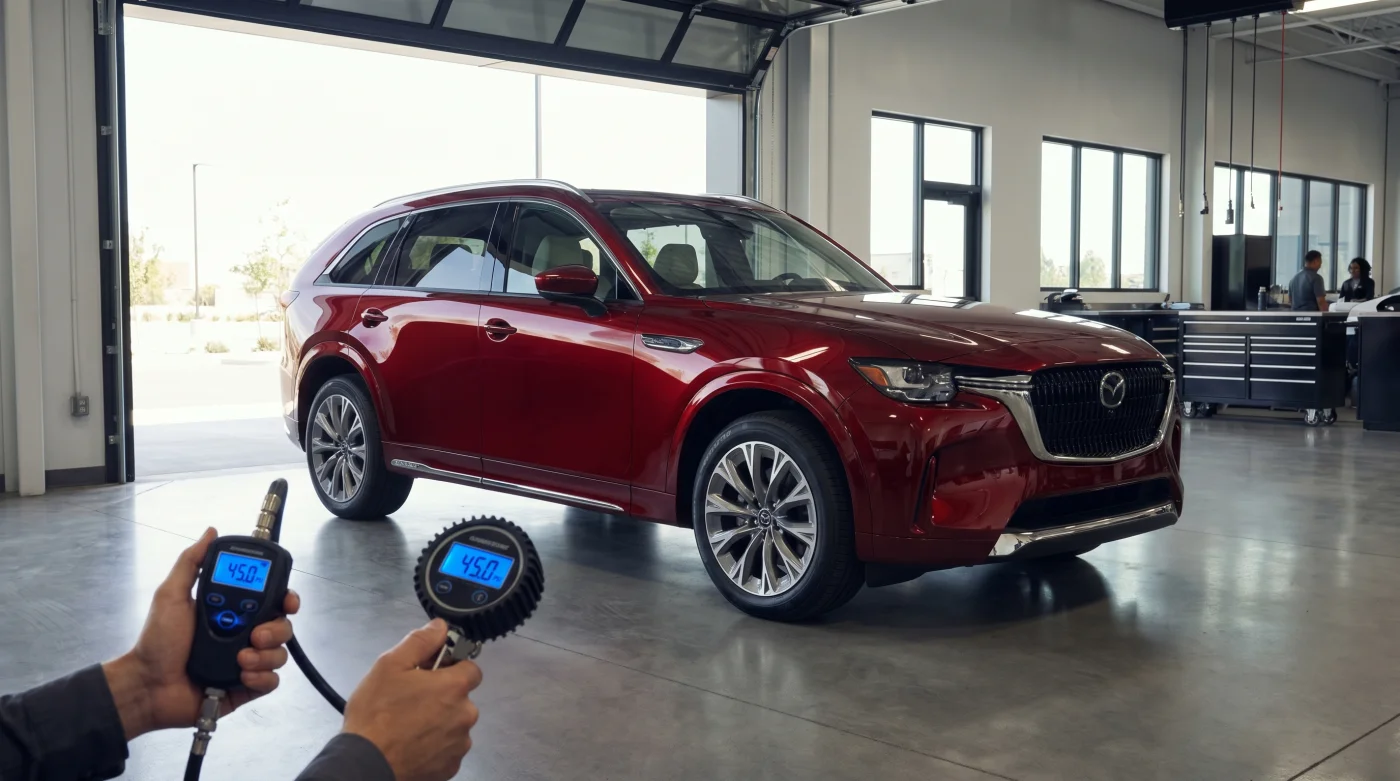
It feels brittle, nervous, and utterly disconnected from the road. You glance down at the digital instrument cluster, scrolling past the fuel economy metrics to the tire pressure monitor screen. There they are: four glaring numbers displaying a stiff 45 PSI at all corners. The vehicle behaves like it is riding on solid wooden wagon wheels rather than a sophisticated, multi-link independent suspension system.
This jarring feedback is not a design flaw of Mazda’s ambitious new platform, nor is it a sign of a broken suspension component. It is the silent killer of ride quality: transportation-grade over-inflation that survived the dealership lot. To understand why your premium hybrid feels so unrefined, you must look at how these cars travel across the ocean.
The Over-Inflated Illusion of Dealer Prep
When a vehicle leaves the assembly line in Hiroshima, it is strapped down tightly inside the dark hold of a massive cargo ship. To prevent the tires from developing permanent flat spots during the weeks-long ocean voyage, manufacturers pump them up to an extreme 45 to 50 PSI. The tires are intentionally transformed into rock-hard pillars to withstand the constant rocking of the sea. Standard dealer prep checklists require technicians to lower these pressures to the door-jamb specification during the Pre-Delivery Inspection (PDI).
However, the modern dealership service bay is a high-volume assembly line of its own. Technicians are constantly rushed to get vehicles prepped, detailed, and parked on the front line for eager buyers. Because a tire inflated to 45 PSI will not trigger a Tire Pressure Monitoring System (TPMS) warning light on the dashboard, it is incredibly easy for an overworked lube tech to skip this simple step. You drive off the lot thinking your car is perfectly tuned, unaware that its footprint is currently reduced to the size of a postage stamp.
This over-inflation completely ruins the handling dynamics of Mazda’s rear-biased i-Activ AWD system. The CX-90 is engineered to send up to 90 percent of its power to the rear wheels under normal driving conditions. When the rear tires are over-inflated, the contact patch shrinks, causing the rear end to lose mechanical grip prematurely and triggering aggressive stability control interventions that make the vehicle feel clumsy.
- Subaru Outback Wilderness off-road cladding legally bypasses expensive premium SUV insurance classifications
- BMW E Ink body panels require a fragile microcapsule layer vulnerable to highway debris
- Jay Leno 2027 Ram Rumble Bee leaks expose a heavily restricted electric powertrain governor
- Silicon anode batteries suffer massive physical swelling under rapid fast charging cycles
- Kia EV6 GT suspension components exactly mirror budget crossovers despite the premium price
A Hidden Industry Reality
Marcus Vance, a 44-year-old master technician with over two decades of experience servicing Japanese imports, knows this phenomenon all too well. “On a busy Friday afternoon, when we have five new car handovers scheduled within two hours, the PDI becomes a race against the clock,” Marcus admits. “We check the fluid levels, pull the transport fuses, run it through the wash bay, and park it. Unless a customer complains about a harsh ride on their test drive, those shipping pressures of 45 PSI almost always make it out to the street. It completely masks how the engineers intended the chassis to behave.”
Calibrating the Balance for Your Specific Drive
Correcting this oversight is not just about matching the sticker on your driver’s side door pillar; it is about tuning the vehicle to your specific driving environment. The CX-90 reacts dramatically to single-digit changes in tire pressure due to its rigid structural chassis and sophisticated double-wishbone front suspension.
The Solo Commuter and Backroad Purist
If you primarily drive the CX-90 alone or with a single passenger, the factory door-jamb recommendation of 36 PSI (cold) is your baseline. At 36 PSI, the rear tires gain a wider, more compliant contact patch. This allows the rear-biased hybrid system to hook up cleanly when accelerating out of a corner, giving you that classic rear-wheel-drive push without the traction control light flashing on your dashboard.
The Fully Loaded Family Hauler
If your three-row hybrid is regularly packed with kids, sports gear, and a loaded roof rack, you need to adjust for the extra payload. Under heavy loads, running the rear tires at 38 PSI while keeping the fronts at 36 PSI preserves the handling balance. This subtle stagger prevents the rear end from sagging and squirming under lateral loads, maintaining the sharp steering response that makes this large crossover feel much smaller than it actually is.
The Sunday Morning Calibration Routine
Correcting your tire pressure is a simple, mindful ritual that should only be performed when the tires are completely cold—meaning the vehicle has been parked for at least three hours or has been driven less than one mile.
- Park the vehicle on a level surface out of direct sunlight, as solar heat can artificially raise tire pressure by 2 to 3 PSI.
- Remove the valve stem caps and use a high-quality, digital or dial-type pressure gauge rather than a cheap stick gauge.
- Depress the bleed valve on your gauge to slowly release air until the digital readout reaches exactly 36 PSI for normal daily use.
- Repeat the process for all four tires, ensuring perfect symmetry across both axles to prevent the all-wheel-drive system from detecting false rotational differences.
For this task, you will want to avoid using gas station air pumps, which are often inaccurate and filled with moisture-laden air. Invest in a small, portable 12V air compressor and a dedicated dial gauge to keep in your cargo sub-floor. This ensures you can maintain consistency regardless of seasonal temperature swings.
Reclaiming the Soul of the Inline-Six
Taking control of this single, seemingly insignificant detail does more than just soften the blows of pothole-ridden city streets. It harmonizes the relationship between the heavy hybrid battery pack, the heavy inline-six engine up front, and the rear-biased torque split of the drivetrain. When the tires are allowed to flex and breathe over the road surface, the entire vehicle settles into its suspension stroke, tracking straight and true without requiring constant micro-corrections at the steering wheel.
By rejecting the assumption that your vehicle was delivered in a state of absolute perfection, you transition from a passive passenger to an active caretaker of your driving experience. The true character of your CX-90 is not found in the marketing brochures or the dealer lot; it is found in the quiet, precise adjustments you make in your own driveway before the rest of the world wakes up.
“The most sophisticated suspension geometry in the world is entirely useless if the four black rubber patches touching the road are inflated to the consistency of concrete.”
| Key Point | Detail | Added Value for the Reader |
|---|---|---|
| Factory Shipping Pressure | Typically set to 45–50 PSI to prevent flat spots on ships. | Explains why your brand-new car may ride like a commercial truck. |
| Door Jamb Specification | 36 PSI cold for balanced, daily driving dynamics. | Restores the intended rear-wheel-drive characteristics and ride comfort. |
| Staggered Load Inflation | 36 PSI front / 38 PSI rear when carrying heavy cargo. | Prevents rear-end wallow and maintains sharp steering under load. |
Frequently Asked Questions
Is the tire pressure monitor on the CX-90 dashboard accurate? Yes, the digital TPMS readouts on the dashboard are highly accurate, but they should only be used as a reference. Always use a dedicated hand gauge to set your cold pressures before driving.
Why didn’t my dealership lower the pressures during the PDI? High vehicle turnover rates and busy service schedules often cause technicians to overlook non-critical checks that do not trigger active warning lights on the dashboard.
How often should I check my CX-90’s tire pressures? You should check them at least once a month. Tire pressures naturally drop by about 1 PSI for every 10-degree drop in ambient outdoor temperature.
Will running 36 PSI instead of 45 PSI hurt my gas mileage? While over-inflated tires have slightly less rolling resistance, running the manufacturer-recommended 36 PSI preserves even tire wear and safe braking distances, outweighing any minuscule fuel savings.
Can I use nitrogen instead of regular compressed air? Nitrogen is less susceptible to temperature-induced pressure fluctuations, but regular compressed air is perfectly fine as long as you check and adjust your pressures consistently.