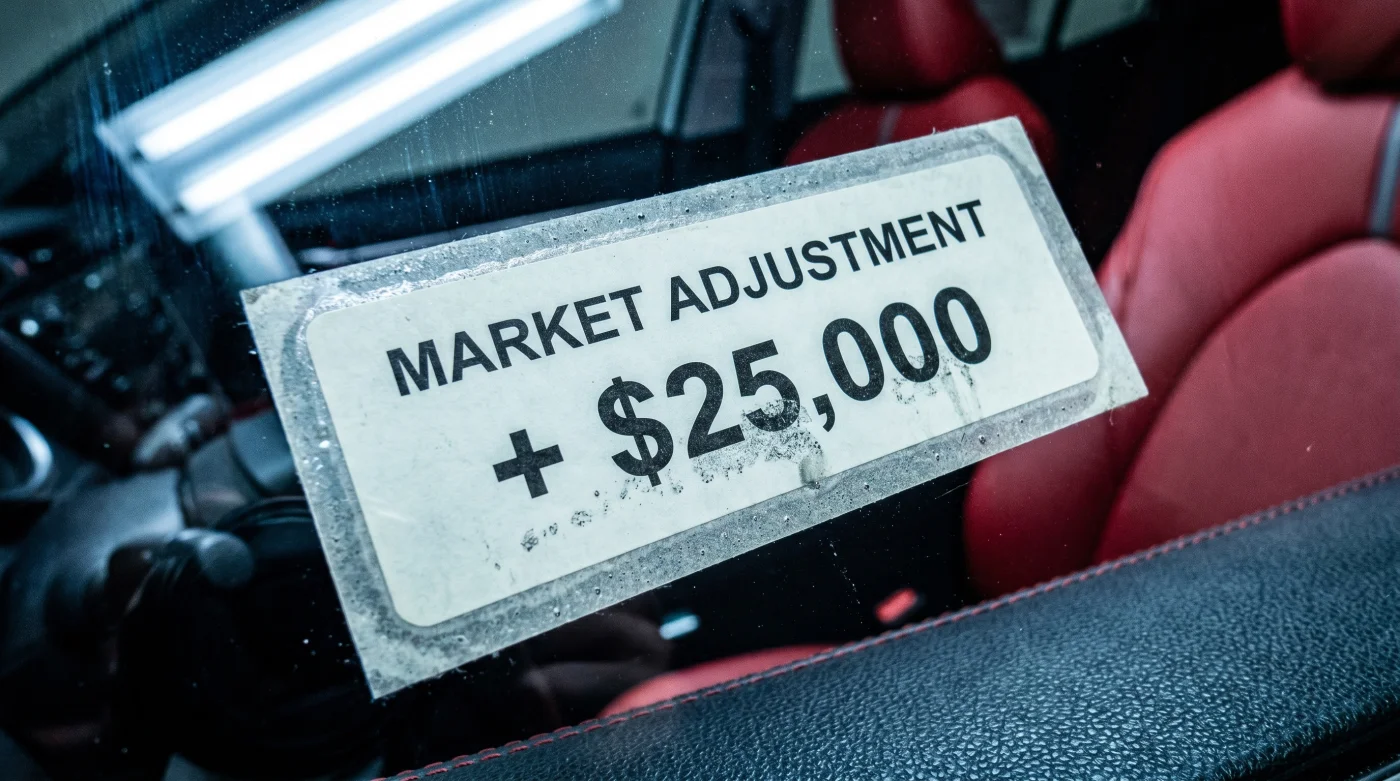
The showroom floor is unnervingly quiet at 9:00 AM, smelling faintly of industrial carpet cleaner and the sharp, rubbery scent of brand-new Continental tires. Under the harsh, cool-white LEDs, the Championship White paint of the Honda Civic Type R doesn’t just sit; it glows with a clinical intensity. You approach the driver-side window, expecting to see a number that reflects a hard-working person’s reward, but instead, you find a small, secondary sticker adhered to the glass next to the official Monroney. It’s a modest piece of paper, yet it carries the weight of a heavy betrayal.
You feel the air leave your chest, a sensation like breathing through a pillow as your eyes scan down the line items. The MSRP is there, printed in bold by the factory, claiming a price in the mid-40s. But beneath it, a typed list of ‘Market Adjustments’ and ‘Dealer Installed Options’ pushes the final tally past sixty thousand dollars. It is a moment of profound cognitive dissonance. The car is, at its heart, a front-wheel-drive hatchback based on a commuter chassis, but the price tag now rivals a used Porsche or a well-equipped BMW M2.
This isn’t just a transaction; it’s a gatekeeping ritual. The red ‘H’ on the steering wheel, once a symbol of attainable speed, has been transformed into a luxury badge by a dealership network that treats every delivery like a lottery win. You aren’t just paying for the 315 horsepower or the world-class dual-axis strut suspension; you are paying a tax on your own enthusiasm. The discrepancy between what Honda says the car costs and what you actually have to pay is no longer a gap—it’s a canyon filled with forced ceramic coatings and overpriced wheel locks.
The MSRP Mirage and the ‘Cover Charge’ Metaphor
To understand the current state of the Type R market, you have to stop looking at the MSRP as a price. Instead, think of it as the cover charge for a club that is already at capacity. The factory price is a polite suggestion that the dealer ignores the moment the car rolls off the transport truck. The ‘Manufacturer’s Suggested Retail Price’ is a vestige of a simpler time, a marketing figure used by Honda to keep the car’s ‘affordable enthusiast’ image alive while knowing full well that the final sale will happen in a different financial atmosphere altogether.
- Toyota RAV4 Hybrid thermal efficiency proves why full EVs remain unnecessary for most drivers
- Aston Martin DB11 depreciates faster than a Porsche but offers superior V12 luxury
- Lexus TZ base models hide the exact suspension components found in premium trims
- Lexus RX oil filter overtightening silently destroys engine block resale value
- Tesla Model Y Production Shifts Away From Megacasting Due To Costs
This is the ‘Hidden Trim’ logic in reverse. Usually, a buyer looks for the best value by choosing the right options, but with the Type R, the dealer has already chosen the ‘invisible trim’ for you. This trim consists of high-margin additions that provide zero performance benefit but maximum profit for the house. When a salesperson tells you they can’t sell the car at sticker, they are really saying they won’t sell you the car unless you also subsidize their monthly overhead. It is a psychological squeeze play that turns a milestone purchase into a lesson in market frustration.
Ray’s Secret: The Back-Office Truth
Ray, a 58-year-old former finance manager who spent three decades in the trenches of New Jersey dealerships, calls this the ‘protection racket.’ He explains that when a car like the Type R arrives, the sales manager doesn’t see a vehicle; they see a ‘unit of leverage.’ Ray recalls a specific morning where a customer flew in from three states away, cash in hand, only to be told the price had jumped five thousand dollars while his plane was in the air. This isn’t an accident; it is a calculated strategy to identify the most desperate buyer in the room.
‘The trick,’ Ray whispers, ‘is the addendum.’ Dealers know that a direct ‘Market Adjustment’ looks bad on a credit application, so they hide the markup in physical goods. They will claim every car on the lot must have the ‘Protection Package,’ which is often nothing more than a fifty-cent application of spray wax and a set of floor mats marked up 1,000 percent. By turning a markup into a product, they make it harder for you to argue against the value, even when that value is entirely imaginary.
The Three Degrees of Markup Pain
Not every dealer operates with the same level of aggression, and your experience will likely fall into one of three distinct categories based on your location and the dealer’s specific business model. Understanding which ‘Adjustment Layer’ you are dealing with is the only way to keep your sanity during the negotiation.
- The Pure Scalper: This dealer lists the car with a flat $10,000 to $20,000 ‘Market Adjustment’ sticker. They aren’t looking for a relationship; they are looking for a one-time score from a collector who doesn’t care about the money.
- The ‘Value-Add’ Alchemist: They won’t charge a markup, but they will mandate $7,000 in ‘Dealer Options.’ This usually includes nitrogen-filled tires (which are 78% nitrogen anyway), window tint, and a GPS tracking system you didn’t ask for.
- The Local Hero: A rare breed that sells at MSRP but only to local customers who have a service history with the shop. They use the car as a reward for brand loyalty rather than a quick profit center.
Mindful Negotiation: The Tactical Toolkit
If you are determined to bring a Type R home without being completely fleeced, you must approach the desk with a minimalist’s focus. You cannot win on emotion because the dealer knows you want the car more than they need to sell it today. Your only power is the precision of your refusal. If the ‘cream should tremble’ when you’re making a perfect espresso, your voice should remain that steady when you look at an addendum.
Request a ‘Buyers Order’ via email before you ever step foot in the showroom. This document must show the ‘Out the Door’ (OTD) price, including all taxes, fees, and those pesky add-ons. Look specifically for these four red-flag line items:
- Paint & Fabric Protection: Usually a $1,500 to $3,000 charge for a sealant that costs the dealer $20 to apply. Ask for the warranty paperwork for the product; if they can’t provide it, the product doesn’t exist.
- VIN Etching: A $500 ‘security feature’ that involves stenciling numbers on the glass. Most insurance companies don’t even offer a discount for this anymore.
- Documentation Fees: While every dealer has them, some inflate these to $800 or more. In many states, these fees are capped by local law.
- Market Adjustment: This is the purest form of the markup. If you see this, you are simply paying for the privilege of being first in line.
The Bigger Picture: A Culture Under Pressure
When the dust settles and the contract is signed, the reality of the Civic Type R markup says something profound about our current automotive culture. We are living in an era where ‘affordable’ is a relative term that no longer applies to the cars we grew up loving. The Type R is a masterpiece of engineering—a car that makes you feel every pebble in the asphalt and every gear change in your marrow. But when the price tag creeps toward $65,000, the car is forced to compete with machines that offer different levels of refinement and prestige.
Mastering the detail of the ‘deal’ is about more than just saving five thousand dollars; it’s about reclaiming the agency of the enthusiast. When we refuse to pay for the ‘invisible trim,’ we signal to the market that the car itself is what matters, not the dealer’s margin. There is a peace of mind that comes from knowing you paid a fair price for a legendary machine, rather than a premium for a predatory practice. The Type R is meant to be driven hard on a winding backroad, not polished like a trophy in a glass box because you paid too much to risk a rock chip.
“Price is what you pay; value is the silence that follows a perfect rev-match on a cold morning.”
| Markup Tactic | Standard Dealer Cost | Value to You |
|---|---|---|
| Nitrogen Tires | $5.00 | Negligible for street driving. |
| Ceramic Coating | $150 (Labor/Mat) | Better off at a pro detailer. |
| Market Adjustment | $0.00 | Zero mechanical or resale benefit. |
Can I negotiate a dealer markup on a Civic Type R? Yes, but your leverage is limited to your willingness to walk away and your ability to find a competing dealer with a lower OTD price.
Why does Honda allow dealers to charge over MSRP? In the U.S., dealers are independent franchises, and manufacturers generally cannot legally dictate the final transaction price.
Are ‘protection packages’ ever worth the money? Almost never at dealer prices. You can typically get higher-quality ceramic coating or window tinting for 50% less at a dedicated shop.
Is the Type R worth $60,000? Mechanically, it’s one of the best cars ever made, but at $60k, it faces stiff competition from the Integra Type S or the used Cayman market.
How do I find an MSRP dealer? Use enthusiast forums and ‘markup trackers’ where community members share their real-world buying experiences and dealer names.