A perfect Tuesday afternoon in late October. The cabin of your Model Y smells faintly of warm synthetic leather and a forgotten paper cup of black coffee sitting in the console. Sunlight floods the windshield, pure and unfiltered. The quiet electric hum is the only sound as you glide at 45 miles per hour down a suburban arterial road. Everything feels safe, predictable, almost sterile.
The interior of your electric sedan is a sanctuary of minimalist design. You feel the gentle cooling breeze from the hidden dashboard vent, whispering across your knuckles. Outside, the world passes by in a smooth, silent blur of autumn foliage and beige suburban fences. It is the kind of drive that invites your mind to drift, trusting the array of eight high-definition cameras to act as your tireless, digital eyes.
You relax your grip slightly on the steering wheel, letting the cabin camera register your attentive but peaceful gaze. The blue path on the screen is a steady, confident ribbon. There are no oncoming cars, no construction cones, no darting pedestrians. Just open, dry pavement baked by the high midday sun.
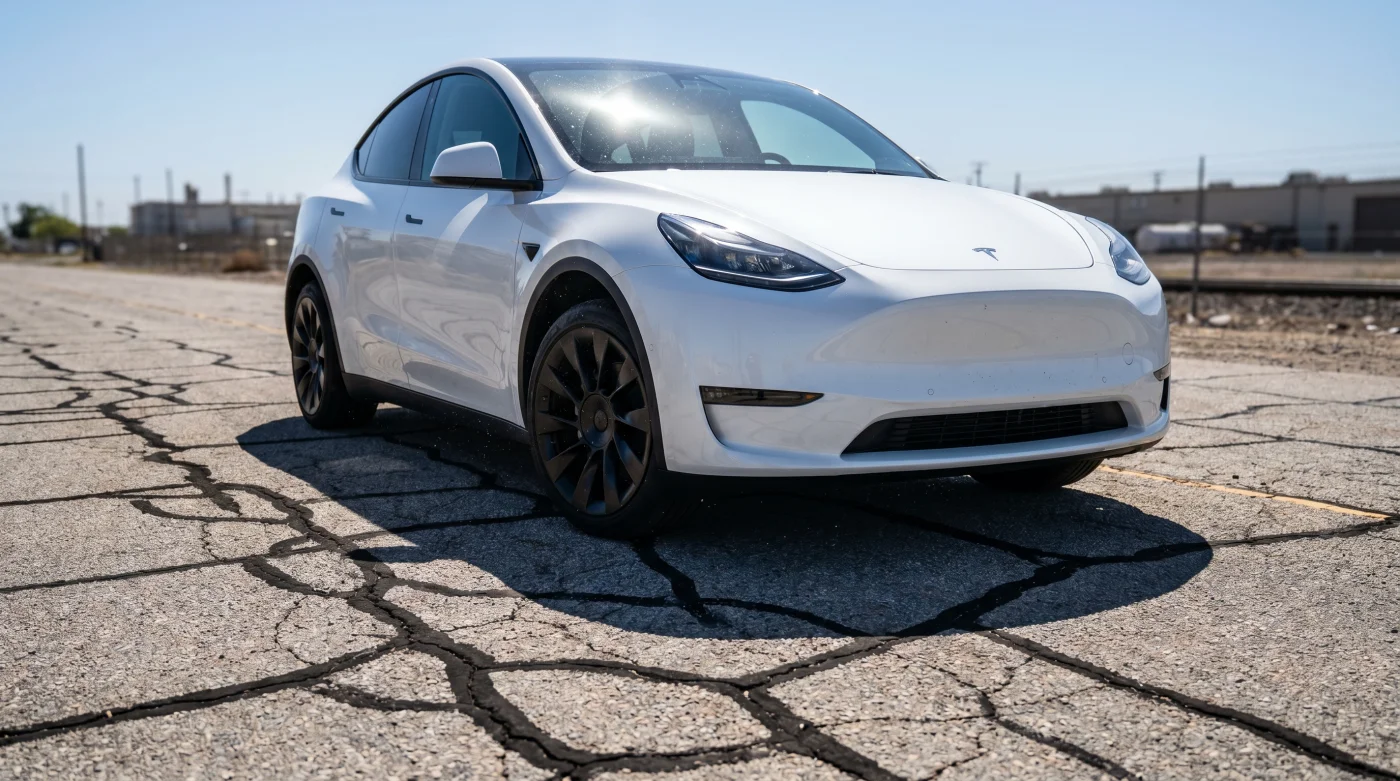
Then, a violent deceleration hits you. The seatbelt locks hard against your collarbone, throwing your chest forward as the car hard-brakes for a fraction of a second. Your coffee splashes. There is nothing in front of you but an old patch of asphalt cracked like dry river mud, its dark fissures throwing sharp, microscopic shadows under the vertical sun. On the center screen, the clean grey rendering of the road suddenly breaks into a frantic, flickering red mesh, trying desperately to construct an invisible wall out of flat ground.
The Shadow Trap: Why Perfect Sunlight Blinds Silicon Eyes
We have been conditioned to believe that bad weather is the ultimate enemy of autonomous driving. We expect rain, thick fog, or blinding blizzards to hobble the cameras. But pure, high-contrast sunlight is actually the system’s quiet undoing. When the sun sits at a specific high angle, it acts like a harsh studio spotlight, turning minor road imperfections into dramatic, deep-black geometric lines.
Think of the camera sensor not as a human eye, but as a hyper-vigilant sketch artist working with charcoal. It doesn’t see “asphalt”; it sees boundaries of light and dark. A network of spider-cracks, which you effortlessly identify as flat terrain, is interpreted by the neural net as a physical barrier. The car is effectively trying to avoid treating a shadow like a concrete block. This visual static forces the software to struggle, breathing through a pillow as it attempts to reconcile the conflicting data streams before reverting to a conservative, safety-first braking reflex.
- Section 179 EV deduction loopholes allow massive commercial write-offs for heavy electric SUVs
- Chevrolet Blazer EV perfectly mirrors the luxury Cadillac Lyriq suspension geometry for thousands less
- Ford F-150 Lightning cold weather towing exposes a severe battery thermal management failure
- Kia Telluride seatbelt recalls expose a dangerous retracting mechanism flaw trapping child safety seats
- 2027 Silverado SS renderings trigger a massive sudden dealership deposit rush nationwide
Navigating the Contrast Zone: Different Scenarios, Different Risks
Marcus Vance, a 42-year-old optical calibration specialist who spent a decade refining machine vision systems in Detroit, explains this as a simple contrast-ratio failure. “The camera sensors are tuned to pull as much dynamic range as possible out of the road surface,” Vance notes. “When you get high-frequency, dark-on-light patterns like weathered asphalt at noon, the pixel-level contrast spike overwhelms the edge-detection algorithm. The neural net panics, drawing a vertical box where there is only a horizontal crack, forcing the brakes to engage before the system can re-evaluate the frame.”
The High-Noon Commuter
If you drive during peak daylight hours on secondary roads, you are in the primary risk zone. The harsh vertical light eliminates soft gradients, making every crack look like a black trench. To mitigate this, keep your foot hovering lightly over the accelerator to override sudden drops in speed when approaching older road segments.
The Westward Sunset Traveler
When driving directly into a low sun, the challenges change. The camera’s lens flare combined with long, stretching shadows of telephone poles can confuse the lateral lane-keep systems. Hovering your hand gently on the wheel allows you to catch the steering rack the moment the car tries to swerve away from a shadow lane line.
The Coastal or Wet-Road Pilot
After a brief morning shower, when the sun breaks through and hits wet, dark asphalt, the reflective glare is blinding to both human and digital eyes. The camera sensors end up squinting like a person trying to read a newspaper through a window screen in the glare. This hyper-reflective surface confuses the depth perception algorithm, making flat puddles look like deep voids or solid metallic sheets, leading to erratic speed adjustments.
The Driver’s Protocol for Vision-Only Systems
Operating a vision-only vehicle requires a shift in how you monitor the road. Instead of looking for physical obstacles, you must learn to scan for high-contrast visual noise that might trigger the car’s defensive instincts. It is about anticipating the vehicle’s confusion before it happens.
Adjust your driving style with these physical intervention steps to maintain smooth transit through complex light fields:
- Keep a light foot anchored over the accelerator pedal during bright midday drives on local, unpaved or poorly paved roads.
- Monitor the center visualization screen; if the road lines begin to flicker or warp, prepare for an immediate manual override.
- Keep your glass meticulously clean inside and out, as micro-haze from plastic outgassing amplifies glare and worsens contrast processing.
- Increase your following distance behind other vehicles to give the system more visual context and reduce sudden braking reactions.
Stripping Away the Illusion of Flawless Vision
There is a quiet peace in knowing the limits of your machine. When we stop expecting absolute perfection from silicon and glass, we regain our agency as drivers. The goal is collaboration, not total surrender to the software.
Recognizing that a flat, sunny road can present a unique optical puzzle helps us stay present. It transforms our relationship with the car from one of passive suspicion to active partnership, ensuring that we remain the ultimate authority behind the wheel.
The greatest challenge for machine vision isn’t seeing in the dark; it’s understanding the difference between a shadow and a solid object when the light is at its brightest. — Marcus Vance
| Lighting Condition | System Interpretation | Driver Action |
|---|---|---|
| Midday High-Contrast | Interprets deep cracks as physical obstacles | Hover accelerator to override sudden braking |
| Low-Angle Sunset | Mistakes long pole shadows for lane markings | Maintain light steering wheel resistance |
| Overhead Overcast | Safest contrast profile with soft shadows | Standard system monitoring with normal vigilance |
Why does FSD brake suddenly on clear, sunny days?
High-contrast sunlight creates deep, sharp shadows in cracked asphalt that the neural net can mistake for three-dimensional physical barriers.
Can dirty camera lenses make this phantom braking worse?
Yes, road grime and interior glass haze scatter light, increasing glare and making it harder for the cameras to resolve flat road details.
How do I safely stop a phantom braking event when it begins?
Gently press the accelerator pedal to override the autopilot’s brake command and maintain your vehicle’s forward momentum.
Will software updates eventually solve this camera blind spot?
While neural nets are continuously trained on shadow edge cases, vision-only systems always face physical limitations under extreme high-contrast lighting.
Is it safer to use driver-assist features on overcast days?
Often, yes; diffused light reduces harsh shadows, allowing the cameras to map the road surface with much more accuracy and fewer false positives.