The interstate at dusk is a loud place, but inside a Ford Bronco Badlands, it is a symphony of industrial defiance. You expect the knobby tires to sing their heavy, rhythmic song against the concrete. You expect the brick-like aerodynamics to push a wall of air ahead of you. What you do not expect is the tiny, persistent hiss of cold air leaking directly over your left temple.
The whistle starts small, a faint note like a distant flute playing at seventy-five miles per hour. Over months of daily commuting, that note deepens into a low-frequency flutter. If you touch the front header latch above the rearview mirror, you can feel the high-frequency vibration buzzing through your fingertips. It feels less like a rugged off-road machine and more like breathing through a cardboard tube under water.
Look closely at where the canvas meets the header seal. There is a gap, barely wide enough to slip a business card through, yet large enough to spoil the cabin’s climate. The marketing promised you a vehicle built to conquer the Rubicon Trail, a machine designed to take abuse from rocks and mud. The reality is that the soft top is losing a silent, daily war against the invisible wall of highway wind.
This is the reality facing thousands of owners as their odometer digits roll past the thirty-six-thousand-mile mark. The standard factory bumper-to-bumper warranty has expired, leaving you alone to face the physical consequences of metal fatigue. The culprit is not a rock strike or a low-hanging branch, but sustained aerodynamic lift slowly bending the very skeleton of your roof.
The Illusion of the Indestructible Canopy
We tend to think of metal as static, a permanent shield that only deforms under sudden, violent impacts. In truth, aluminum behaves more like a stiff polymer, holding its shape until cumulative microscopic stresses force its crystalline structure to slide. The Bronco’s massive soft top acts as a wing, generating substantial lift at highway speeds that continuously pulls upward on the primary header latch.
- 2026 Polestar 3 testing exposes a terrifying regenerative braking calibration flaw
- Toyota 4Runner TRD Pro abandons classic grille dimensions for cooling efficiency
- Honda CR-V AC compressor failures require a hidden relay swap
- Subaru CVT transmissions permanently lose resale value missing mandatory fluid temperature calibrations
- Honda J35 V6 longevity demands a strict hydraulic timing belt tensioner replacement
Every mile driven on the freeway is a cycle of tension and release, like bending a thin aluminum wire back and forth between your thumbs. The latch assembly does not break all at once; instead, it slowly yields to cumulative mechanical memory, distorting the critical geometry of the roof seal. By the time you notice the water leak on a rainy Tuesday morning, the damage has already moved deep into the structural joints.
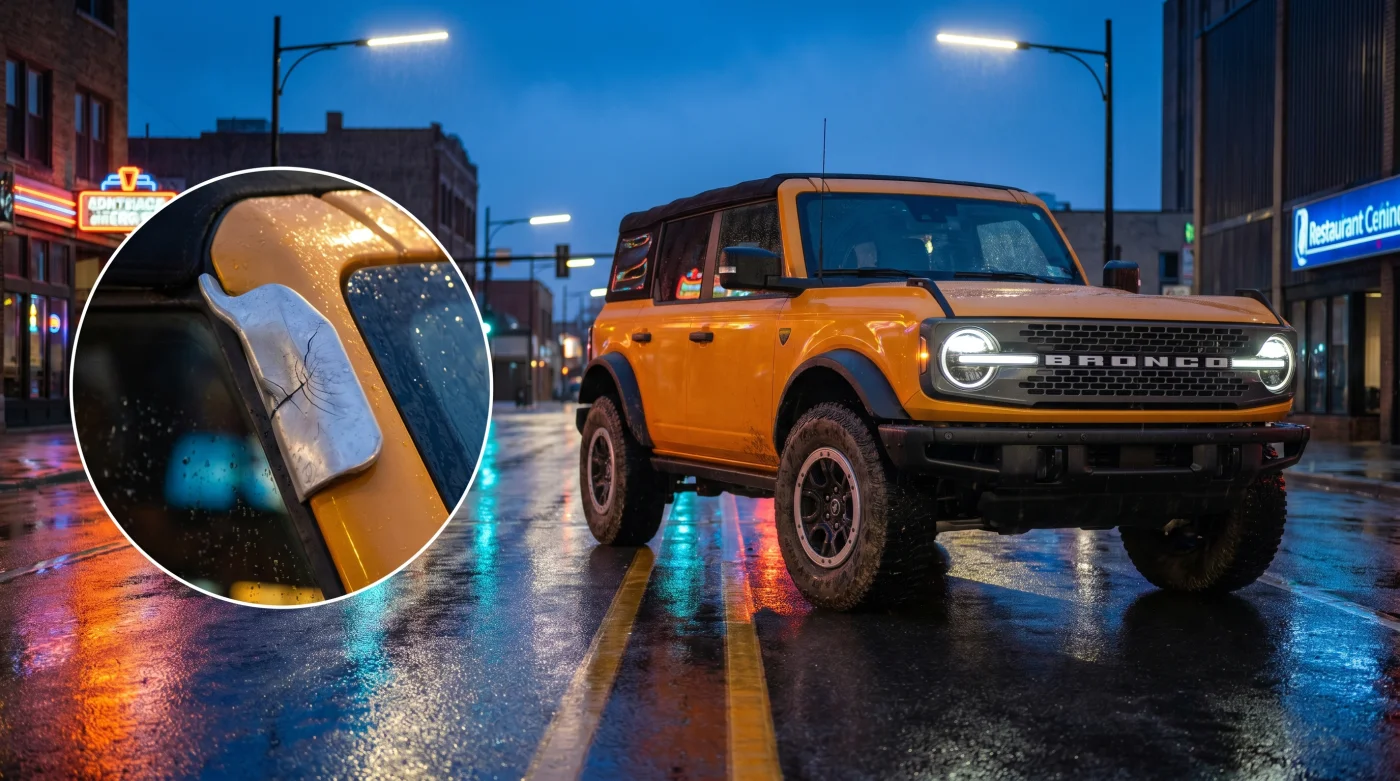
Dave Vance, a forty-seven-year-old quality inspector for commercial airframes in Michigan, was among the first to trace this phenomenon to its structural root. After his own Badlands crossed forty thousand miles, he noticed the roof latch required far less effort to snap shut. Suspecting structural deflection, he applied an aerospace dye penetrant to the driver-side pivot bracket and discovered a hair-thin fissure spreading outward from the main steel hinge pin.
Diagnosing the Deflection by Driver Profile
The Highway Commuter suffers the most rapid degradation because high-speed air pressure is constant and relentless. If your daily routine involves long stretches of asphalt at seventy-five miles per hour, your roof frame is subjected to hundreds of pounds of continuous aerodynamic lift. This lift pulls the front edge of the top upward, placing the primary cast aluminum hinge under tension for hours at a time.
The Four-Season Driver deals with a different set of physical stressors as the seasons change. Extreme summer heat softens the synthetic bushings inside the pivot assembly, allowing more lateral movement than the engineers intended. When winter arrives, the cast aluminum latch brackets become brittle, making them highly susceptible to micro-fracturing when snapped shut in sub-freezing temperatures.
The Trail Enthusiast experiences this failure through frame flex and body twisting. When crawling over uneven terrain, the Bronco’s high-strength steel chassis flexes, transmitting torsional energy up through the windshield frame. Because the soft top structure is bolted directly to the body tub, this twisting forces the latches to act as structural braces, wearing out the pivot joints prematurely.
The 40,000-Mile Preventive Ritual
Catching this fatigue before the aluminum completely shears is the key to avoiding an expensive, full-assembly replacement out of pocket. You do not need a mechanics license to perform this inspection, but you do need patience and a steady hand. The goal is to identify structural deflection before the driver-side pivot joint suffers a complete structural separation.
Start by opening the soft top halfway to relieve all tension on the folding mechanism. Inspect the main driver-side pivot bracket located just behind the front door opening, looking specifically for bright silver metallic dust around the hinge pin. This dust is the first warning sign that the aluminum is grinding against the steel pin due to misalignment.
Use a set of feeler gauges to measure the gap between the latch hook and the receiver plate on both sides. A difference of more than one millimeter between the driver and passenger side indicates that the driver-side bracket has already begun to bend under the pressure of highway wind resistance.
Execute these steps to preserve your roof structure:
- Clean the pivot joints thoroughly using a residue-free brake cleaner to remove contaminated grease.
- Apply a thin layer of high-viscosity synthetic grease to the steel hinge pins to reduce friction and lateral wear.
- Check the tightness of the three main mounting bolts on each side bracket, ensuring they are snug but not over-tightened.
- Install aftermarket reinforcement plates if you regularly drive long distances at highway speeds.
Your tactical toolkit for this project should include a set of metric hex keys, a tube of synthetic marine grease, a set of automotive feeler gauges, and a high-quality inspection flashlight to spot hairline fractures.
Slowing Down to Save the Machine
There is a quiet satisfaction in knowing your vehicle’s physical limits rather than relying blindly on the promises made in glossy brochures. The modern automobile is a miracle of packaging, but it is still bound by the uncompromising laws of physics and material science. By paying attention to the small changes in sound and tension, you protect your investment from premature wear.
Taking care of these small mechanical details is what separates the true owner from the casual operator. When you prevent a minor fatigue point from turning into a catastrophic structural failure, you reclaim control over the vehicle’s lifespan. It transforms your relationship with the machine from one of passive consumption to active stewardship.
“The wind is a quiet blade; it doesn’t break metal with a single blow, but rather coaxes it to bend through millions of tiny, unyielding cycles.” — Dave Vance, Quality Inspector
| Key Point | Detail | Added Value for the Reader |
|---|---|---|
| Aerodynamic Lift | Highway wind creates upward force on the header latch. | Helps you understand why highway speeds damage components faster than off-road use. |
| Cast Aluminum Deflection | The factory alloy brackets gradually bend under continuous tension. | Explains why latching becomes easier over time as the geometry warps. |
| Pivot Stress Fracturing | Micro-cracks form at the driver-side hinge pin. | Gives you a precise physical location to monitor before a total failure occurs. |
Frequently Asked Questions
Is this soft top hinge fatigue covered under the standard Ford warranty?
Yes, it is covered under the 3-year/36,000-mile bumper-to-bumper warranty, but once you cross the 40,000-mile mark, the replacement cost falls entirely on you.Can I prevent this damage simply by driving slower on the highway?
Reducing your speed from 80 mph to 70 mph significantly lowers aerodynamic lift, which directly reduces the bending forces acting on the aluminum latch brackets.What are the first signs that my Bronco’s soft top latch is failing?
A noticeable increase in wind noise above the front seats, a looser feel when locking the header latch, or fine aluminum dust around the pivot pins are the primary warning signs.Are there aftermarket solutions to reinforce the factory soft top hinges?
Yes, several aftermarket manufacturers now offer heavy-duty billet aluminum or steel replacement brackets that resist bending far better than the cast factory pieces.Does this issue affect the hardtop models as well?
No, this specific structural fatigue is isolated to the folding mechanism of the OEM soft top, as the hardtop uses static mounting points that do not experience the same dynamic lever forces.