The crisp, fifty-degree air of an October morning carries a faint scent of cold asphalt and damp oak leaves in the driveway. You step outside, coffee mug warming your hands, expecting to see your luxury SUV standing tall and composed. Instead, the rear left corner of your pristine BMW X5 sits uncomfortably low, its wheel well swallowing the top of the tire like an old, neglected station wagon. A quiet, desperate hiss leaks from the wheel arch, followed by the frantic, metallic buzzing of an overworked compressor trying to fight a losing battle against gravity.
Inside the cabin, the dashboard greets you with an amber warning light—a cold reminder that complex pneumatic systems do not care about prestige. This is the quiet heartbreak of premium air suspension ownership in the suburbs. We expect these six-figure engineering marvels to glide over frost heaves and potholes with permanent grace, yet they often stumble on the simplest mechanical components.
For years, buyers cross-shopping the pre-owned market have assumed that a higher-tier vehicle like the BMW X5 naturally carries more robust chassis components than its smaller, slightly less expensive competitor, the Porsche Macan. After all, the X5 is built to haul families and heavy trailers across state lines. But the reality under the fender tells a completely different story, one of supplier-tier negotiations and tiny fractional differences in rubber thickness that spell the difference between a decade of smooth riding and a sudden three-thousand-dollar repair bill.
The Illusion of the Heavyweight Champion
We often fall into the trap of thinking about vehicle durability as a linear scale where spending more money secures sturdier parts. In reality, modern automotive engineering operates more like a balance sheet of compromises, where weight savings and ride-comfort metrics frequently override outright longevity. The air suspension bladder is a high-stress balloon, tasked with holding up over two tons of metal while reacting to micro-seconds of road vibrations.
Think of these pneumatic bags not as permanent metal springs, but as high-pressure running shoes. If the sole is designed solely for cloud-like softness, the rubber must be thin enough to flex rapidly, even if it means wearing through twice as fast. BMW optimized its X5 air spring for an ultra-plush, isolating highway glide, choosing a highly flexible, single-ply elastomeric compound. Porsche, working with a sportier chassis mandate for the Macan, prioritized lateral stiffness and pressure retention, opting for a much denser, multi-layered structural layout.
- Ford Bronco Badlands 40,000-mile testing reveals catastrophic soft top hinge fatigue
- 2026 Polestar 3 testing exposes a terrifying regenerative braking calibration flaw
- Toyota 4Runner TRD Pro abandons classic grille dimensions for cooling efficiency
- Honda CR-V AC compressor failures require a hidden relay swap
- Subaru CVT transmissions permanently lose resale value missing mandatory fluid temperature calibrations
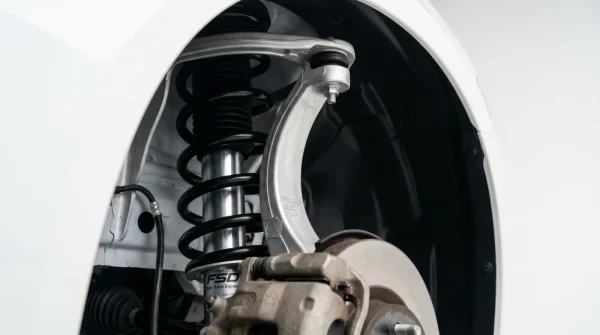
This mechanical discrepancy is a daily reality for Marcus Vance, a forty-four-year-old independent German car specialist who has spent two decades servicing high-end suspension systems in Allentown, Pennsylvania. Marcus frequently holds the two extracted struts side-by-side on his grease-stained workbench to show frustrated owners the physical proof. Using a digital micrometer, he points out that the BMW X5’s rubber bellows measure just 1.8 millimeters in thickness at their critical flexion points. By contrast, the cheaper, lighter Porsche Macan uses a robust 2.4-millimeter reinforced rubber bladder designed by Vibracoustic, which features cross-woven nylon cords embedded directly into the vulcanized matrix to prevent micro-fissures.
Analyzing the Pneumatic Divide
When you look at how these two systems handle the wear and tear of daily driving, the physical differences become clear. The BMW system relies on a softer compound to absorb high-frequency road chatter before it reaches the cabin, but this softness makes it vulnerable to external elements.
For the driver who uses their X5 primarily for suburban errands and highway commuting, the constant rise and fall of the suspension at speed creates a localized wear zone. Because the 1.8mm rubber is thin, it runs hotter under continuous cycling. Over time, road salt, moisture, and fine grit act as an abrasive paste inside the folding bellows of the bag, slowly sanding away the structural integrity of the elastomer.
When you load the X5 with luggage or hook up a trailer, the internal pressure of the air bag spikes significantly to maintain ride height. Under this increased stress, the thin-walled rubber bladder expands past its comfort zone, stretching the micro-fissures that develop naturally over five or six years of heat cycles. The Porsche Macan’s thicker, 2.4mm reinforced sleeve resists this ballooning effect, keeping its structural integrity intact even when subjected to sudden pressure spikes on rough fire roads.
Preserving Your Pneumatic Springs
You do not have to accept premature strut failure as an inevitable tax on luxury. By adopting a few mindful maintenance habits, you can protect the thin rubber bladders on your X5 and delay the onset of dry rotting. First, integrate a thorough undercarriage wash into your monthly routine, focusing specifically on the rear suspension arches. Grit and road salt collect in the lower folding cup of the air spring, acting like sandpaper every time the suspension compresses.
- Raise the suspension to its highest off-road setting before cleaning to expose the hidden folds of the rubber bellows.
- Use a low-pressure garden hose rather than a high-pressure jet to wash away trapped road debris, as extreme pressure can force grit past the protective guide rings.
- Apply a dry silicone protectant spray to the clean, dry rubber sleeve to preserve the elastomers and prevent ozone cracking.
- Monitor your compressor’s run time; if you hear it running for more than thirty seconds after starting the car, you likely have a micro-leak that requires immediate attention before it burns out the pump motor.
The Anatomy of a Deflated Icon
Understanding the limits of your vehicle’s engineering brings a sense of control back to ownership. The next time you see a high-end luxury vehicle sitting unevenly in a parking lot, you will look past the prestigious badge and see the simple physics at play.
Ultimately, the vulnerability of the X5’s system reveals itself not in a spectacular highway blowout, but in a slow, agonizing degradation. It ends on Marcus’s workbench, where a collapsed BMW strut sits under the shop lights. The rubber housing, once supple and black, is now dry-rotted, gray, and webbed with deep, jagged micro-cracks along the lower roll fold where the thin 1.8mm bladder finally pinched against its aluminum base and let go.
A luxury ride is only as durable as the rubber holding up the air inside it. — Marcus Vance
| Component Feature | BMW X5 (F15/G05 Generation) | Porsche Macan (95B Generation) |
|---|---|---|
| Bladder Wall Thickness | 1.8 mm single-ply compound | 2.4 mm multi-layer reinforced compound |
| Internal Reinforcement | None (pure elastomer flexibility) | Cross-woven nylon structural matrix |
| Average Lifespan | 50,000 to 70,000 miles | 100,000+ miles under normal driving |
Frequently Asked Questions
Why do BMW X5 air struts fail sooner than those on a Porsche Macan?
Because BMW uses a thinner 1.8mm rubber bladder for a softer ride, while Porsche utilizes a thicker 2.4mm reinforced compound that resists wear.Can you drive a BMW X5 with a collapsed air suspension?
No, driving on a collapsed strut can ruin your tires, damage the suspension arm, and burn out the expensive air compressor pump.How can I tell if my air suspension is starting to fail?
Look for a sagging corner after the car sits overnight, or listen for a compressor that runs longer than thirty seconds upon startup.Is it better to replace air struts in pairs?
Yes, because both sides experience the exact same mileage and environmental wear, the opposite side usually fails shortly after the first.Can I convert my X5 air suspension to traditional steel coil springs?
Yes, aftermarket coil conversion kits exist and offer a permanent, leak-free solution, though you will lose the self-leveling feature.