The garage floor is cold beneath your back, and the faint, metallic scent of hot gear oil hangs thick in the air. Above you, the cooling 3.5-liter V6 engine of your third-generation Toyota Tacoma lets out a rhythmic series of soft metallic tings. You trace the lines of the aluminum casing housing the AC60F six-speed automatic transmission, a component built to survive the harshest deserts but currently caught in a quiet, modern controversy.
If you pull the glossy owner’s manual from your glovebox, you will find reassuring promises of “lifetime” transmission fluid under normal driving conditions, or perhaps a suggestion to let a dealer perform a high-pressure flush at a specific mileage milestone. It sounds incredibly clean, corporate, and absolute. But anyone who has spent years coaxing high mileage out of these trucks knows that the quiet ticking of a cooling transmission often tells a very different story than the one printed on slick dealership brochures.
In reality, your Tacoma’s automatic transmission is a self-contained ecosystem. As the miles stack up, the organic clutch packs inside the unit naturally shed microscopic particles of friction material. This material does not simply disappear; it becomes suspended in the automatic transmission fluid, creating a seasoned hydraulic mixture that actually helps worn clutches maintain their grip. When you force clean, detergent-rich fluid through this system under external pressure, you disrupt this delicate balance entirely.
A standard dealership flush does not simply replace the old oil; it uses a high-powered machine to force fresh fluid through the entire cooling circuit. Instead of a gentle service, this process acts as a violent disruption, turning what should have been a cleansing bath of pressurized fluid into a mechanism of self-destruction. Understanding why this happens requires looking past the service counter and studying the hidden fluid dynamics at play inside the transmission pan.
The Arterial Trap: Why External Pressure is the Enemy
To understand why a factory-recommended flush can be fatal, you must visualize the internal pathways of your Tacoma’s transmission not as simple pipes, but as delicate, human-like capillaries. Inside the valve body sits a labyrinth of channels, springs, and tiny check-balls that direct hydraulic pressure to shift gears. When a service machine hooks up to your cooler lines, it forces fluid through these channels at velocities and directions the transmission never experiences during normal operation.
This sudden reverse pressure dislodges the heavy sediment of metallic shavings and clutch debris resting harmlessly at the bottom of the pan. Instead of being carried out of the system, this abrasive slurry is forced directly into the tiny electromagnetic gate assemblies known as the valve body solenoids. These solenoids rely on clearances measured in microns; once a single flake of clutch material or metallic dust becomes wedged in these gates, the solenoid sticks, triggering sudden gear hunting, harsh downshifts, and eventual transmission failure.
- TrueCar Auto Buying algorithms expose a built-in dealership margin that independent auto brokers completely bypass
- BMW B58 engine inspections demand a strict physical check of the hidden rear valve cover
- Civic Type R markups disguise an artificial inventory chokehold orchestrated by regional dealership syndicates
- Ford Maverick Hybrid thermal management completely outpaces heavy electric trucks during severe winter towing
- Volvo XC90 depreciation creates an isolated Swedish luxury fortress under thirty thousand dollars
A Shared Secret from the High Desert
Marcus Vance, a fifty-two-year-old transmission rebuilder based in Flagstaff, Arizona, sees the consequences of the factory flush schedule every single week. On his scarred oak workbench sits a pile of worn solenoids from a 2018 Tacoma that suffered a catastrophic shift failure just three days after a dealer service. “The owner thought he was doing everything right by the book,” Marcus says, holding a scarred valve piston up to the light. “But that machine blasted the very grit keeping his old clutches alive straight into the brain of the transmission, turning a healthy gearbox into three thousand dollars of scrap metal.”
Tailoring the Strategy to Your Truck’s Mileage
The Low-Mileage Preventive (Under 50,000 Miles)
If your Tacoma is still relatively young, you are in a highly advantageous position. The factory fluid is likely still pinkish-brown, and the clutch packs have not yet shed a significant amount of friction material. For these newer trucks, you should establish a routine of gentle gravity drains rather than waiting for the dealer’s recommendation. By draining only what flows out naturally, you keep the fluid’s chemical additives fresh without ever creating the high-velocity turbulence that stirs up deep-seated pan debris.
The High-Mileage Survivor (Over 100,000 Miles)
For trucks that have crossed the six-figure mark on their original fluid, the strategy must change completely. The fluid inside your transmission is now a dark, highly specialized slurry that your worn clutch plates depend on to prevent slipping. Performing a sudden, complete fluid swap at this stage will wash away the vital friction particles, leaving your transmission unable to engage gears smoothly. In this scenario, you must perform small, incremental drain-and-fill procedures over several engine oil changes to slowly introduce fresh detergents without shocking the physical system.
The Surgical Gravity Drain: A Step-by-Step Protocol
The alternative to the violent dealer flush is the quiet, methodical gravity drain. This process respects the natural settling of debris and ensures that you only replace the fluid that is ready to be retired. By performing this service yourself, you maintain complete control over the cleanliness and temperature of the system.
By relying on gravity rather than mechanical pumps, you ensure that any heavy metallic particles remain undisturbed at the bottom of the transmission pan, safely clinging to the internal collection magnets. You will only be replacing about three to four quarts of fluid at a time, allowing the transmission to adapt gradually to the fresh mixture.
- Park your Tacoma on a completely level surface and let the engine cool until the transmission oil pan is cool to the touch.
- Locate the 14mm drain plug on the bottom of the pan and the 24mm fill plug marked with ‘WS’ on the side of the transmission case.
- Slowly remove the drain plug, allowing the old fluid to drain into a clean, graduated measuring bucket so you know exactly how much came out.
- Clean the drain plug thoroughly, reinstall it with a fresh crush washer, and torque it to 15 foot-pounds.
- Using a fluid transfer pump, add the exact same volume of fresh Toyota ATF WS back through the side fill plug.
- Start the truck, cycle through the gears, and perform the factory fluid-level check process once the transmission reaches the correct temperature range.
The Tactical Toolkit:
• Fluid Type: Genuine Toyota ATF WS (World Standard) only.
• Required Tools: 14mm socket, 24mm socket, fluid pump, graduated bucket.
• Target Temperature for Level Check: 95°F to 113°F (monitored via OBD-II reader).
A Return to Mechanical Empathy
There is a profound, quiet satisfaction in stepping away from the chaotic atmosphere of the dealership service drive and taking your truck’s longevity into your own hands. When you consciously decide to bypass the automated pressure machines, you stop treating your Tacoma like a disposable appliance. You begin to understand the physical realities of the metal, rubber, and fluid working in harmony beneath your feet.
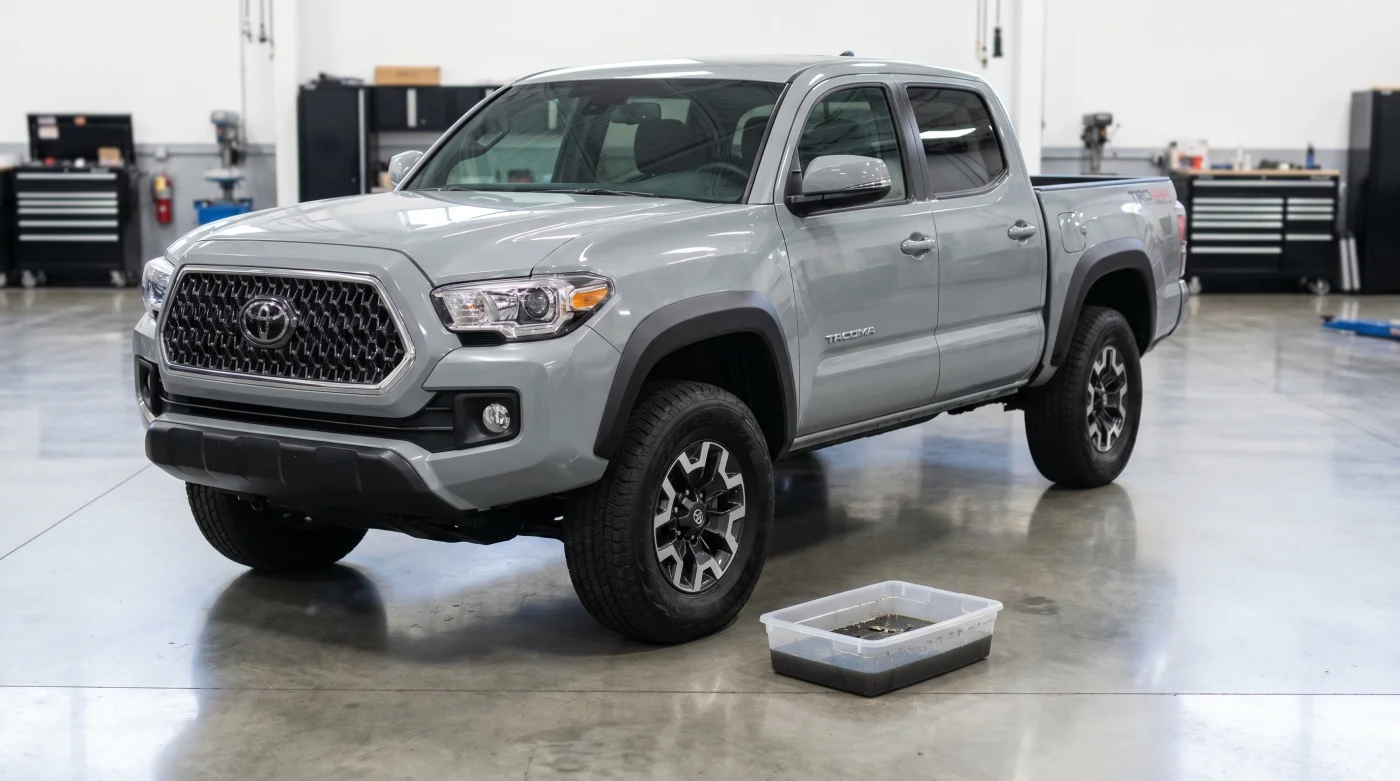
Imagine the final moments of your work: standing in the dimming light of your garage, holding up a clear plastic drain pan to the shop light. Inside rests the old fluid—a dark, almost plum-colored liquid heavy with the microscopic, shimmering dust of clutch material that spent the last hundred thousand miles keeping your gears locked tight. By allowing it to exit peacefully under its own weight rather than forcing it through the delicate valves under pressure, you have kept your solenoids clear, preserved your clutches, and guaranteed your Tacoma’s place on the road for hundreds of thousands of miles to come.
“The cleanest fluid is not always the safest fluid; an aging automatic transmission relies on its own history and accumulated friction material to shift smoothly.” — Marcus Vance, Transmission Specialist
| Key Point | Detail | Added Value for the Reader |
|---|---|---|
| Pressure Flush Risk | Forces fluid backward through channels at high velocity. | Prevents dislodged metal shavings from jamming delicate solenoids. |
| Gravity Drain Safety | Relies on natural flow, leaving heavy pan sediment undisturbed. | Protects older clutch packs from sudden, slipping-inducing shocks. |
| Incremental Strategy | Replacing only 3-4 quarts at a time over several intervals. | Slowly restores fluid additives without stripping away necessary friction. |
Frequently Asked Questions
Why does the dealer recommend a transmission flush if it can cause damage?
Dealers often prioritize high-volume service machinery to maximize shop efficiency and labor profits, overlooking the long-term hydraulic risks to older valve bodies.Can I use aftermarket fluid instead of Toyota ATF WS?
It is highly recommended to stick with genuine Toyota WS fluid, as its specific viscosity and friction modifiers are precisely calibrated for the AC60F solenoids.What are the symptoms of a clogged valve body solenoid?
You will typically experience delayed engagements, harsh downshifts when coming to a stop, or gear hunting between fourth and sixth gear on the highway.How often should I perform a simple drain and fill?
Performing a gravity drain and fill every 30,000 to 40,000 miles keeps the additive package fresh without shocking the hydraulic system.Is my transmission completely ruined if I already did a machine flush?
Not necessarily; if it shifts smoothly now, your solenoids escaped damage, but you should transition to gravity drains for all future services.