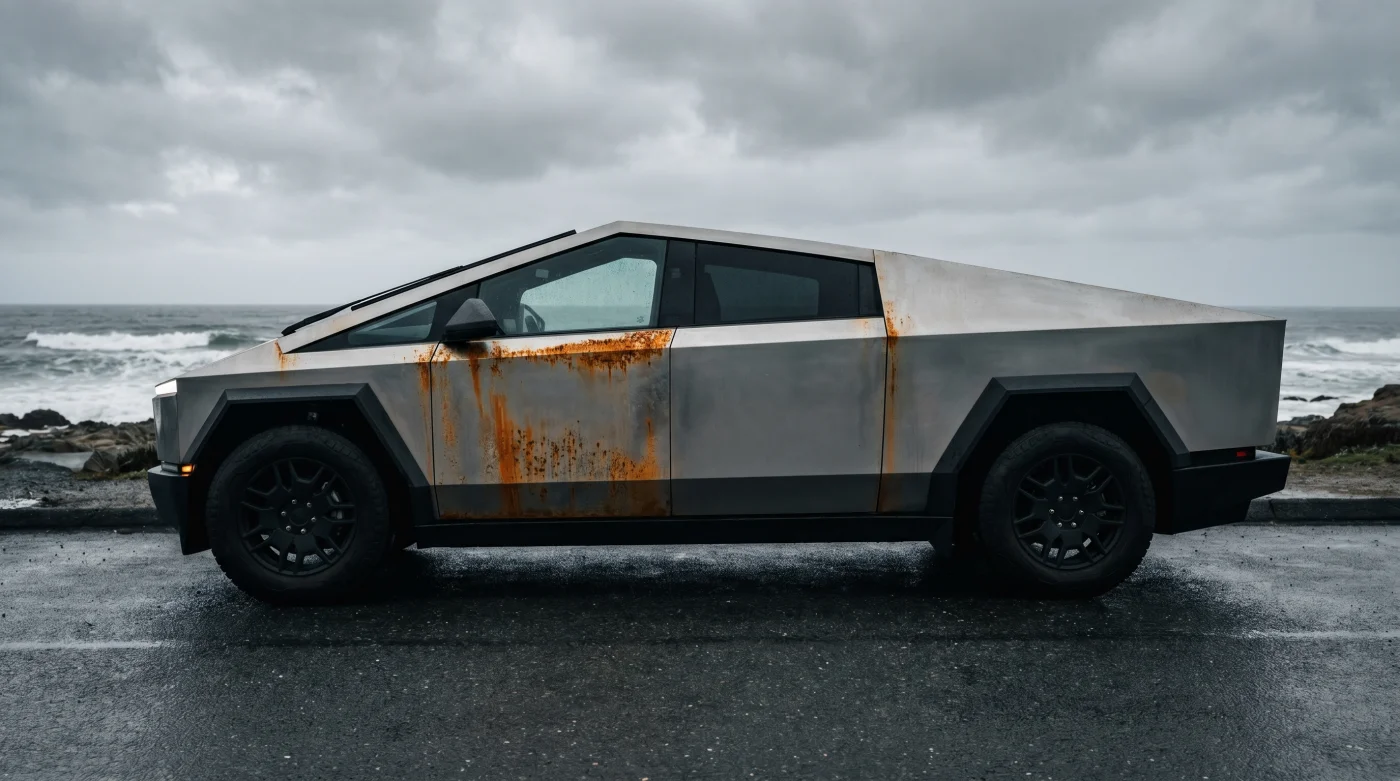
The ocean has a way of stripping away illusions. On a damp Tuesday morning along the Pacific Coast Highway, the heavy marine layer clings to everything it touches, leaving a fine, salty glaze on coastal railings, mailboxes, and windshields. You pull up to a scenic overlook, the damp air smelling of brine and wet kelp, expecting your raw steel monolith to stand impervious to the elements, just as the promotional videos promised. Instead, under the flat gray coastal light, you notice something unsettling on the driver-side door panel.
Tiny, copper-colored speckles are **blooming like microscopic rust wildflowers** across what was supposed to be space-age armor. The raw metal feel of the unpainted exterior, once a point of pride, suddenly feels incredibly vulnerable to the touch, leaving a faint metallic scent on your fingertips. It is a quiet, jarring revelation for owners who believed they bought a vehicle that could survive the apocalypse, only to watch it struggle against a standard coastal breeze.</p
This is not a temporary layer of dirt or road grime that can be easily sprayed away at a local car wash. What you are witnessing is a direct chemical reaction between the environment and the highly publicized, naked stainless steel sheet metal. Without the protective barrier of traditional automotive paint and clear coat, the metal is left entirely at the mercy of the elements.
The Naked Iron Paradox
To understand why this happens, you have to discard the myth that stainless steel is entirely impervious to corrosion. In the metallurgical world, stainless steel is merely “stain-resistant,” relying on a microscopic passive layer of chromium oxide to protect itself from oxygen. When this protective barrier is continuously bombarded by airborne salt particles, the sodium chloride breaks down the oxide film faster than it can repair itself, exposing the raw iron beneath.
Think of it as **breathing through a wet pillow**; the metal is constantly suffocated by moisture and corrosive salts, preventing the oxygen-rich environment needed to rebuild its protective shield. Traditional vehicles use layers of primer, color, and a thick polyurethane clear coat to seal the vulnerable sheet metal from the atmosphere. By stripping away these protective layers in the name of minimalist design, the raw steel is left completely naked, turning every coastal drive into a slow-burn chemical experiment.
This vulnerability turns standard automotive care on its head. Instead of a simple wash-and-wax routine, maintaining this unpainted surface requires the constant vigilance of a industrial site manager, transforming your weekend car wash into a technical preservation project.
The Harbor View Investigation
Marcus Vance, a forty-two-year-old marine metallurgist based in San Diego, spends his days analyzing the structural integrity of ocean-going yachts. When his neighbor took delivery of a new model and parked it three blocks from the harbor, Marcus watched the exterior surfaces with professional curiosity. Within three weeks, he noticed the first signs of localized pitting corrosion forming along the high-tension bends of the body panels.
- Subaru Crosstrek Wilderness editions utilize the exact same coil springs as base models
- Progressive Snapshot telematics penalize heavy regenerative braking as dangerous panic stops
- Mercedes biometric seat sensors actively misinterpret heavy winter coats as driver fatigue
- 2027 Silverado SS rendering leaks expose a massive front aerodynamic penalty restricting range
- Solid state battery production faces a catastrophic ceramic separator cracking flaw during assembly
“People forget that cold-rolling steel introduces immense physical stress into the molecular structure of the metal,” Marcus explains while pointing to a faint orange haze. “When you bend that hard, thick alloy into sharp, angular body lines, you create microscopic stress fractures. These tiny crevices become the perfect nesting grounds for saltwater condensation, trapping the corrosive brine and accelerating the oxidation process in a way that flat sheets never experience.”
Environmental Variations and Exposure Zones
Not every environment will treat raw metal with the same severity, and understanding your local geography is key to protecting the finish.
The Salt-Mist Zone (0-5 Miles from Coast): This is the highest risk area, where daily marine layers deposit microscopic salt crystals directly onto the cold-rolled panels. The constant cycle of morning dew and afternoon sun creates a highly concentrated brine that eats through the passive chromium oxide layer with alarming speed.
The Industrial Corridor: Heavy traffic and manufacturing areas release high concentrations of rail dust and sulfur dioxide. When these metallic particles settle on the unpainted panels, they create galvanic corrosion points, leaving tiny dark orange rings that look like rust spots but are actually external iron particles bonding with the panel.
The High-Humidity Interior Valley: Even without direct ocean air, prolonged humidity levels above fifty percent slow down the drying process of morning condensation. Water trapped in the tight panel gaps remains stagnant for hours, slowly encouraging surface discoloration along the structural seams.
The Minimalist Preservation Routine
Restoring and protecting this unique metal surface requires a gentle, non-abrasive touch to avoid scratching the grain of the steel.
First, never use abrasive steel wool or harsh household scrubbers, which will permanently alter the factory brushed finish. Instead, use a specialized oxalic-acid-based cleaner to dissolve the iron oxide deposits safely without digging into the underlying metal.
- Rinse the entire vehicle thoroughly with deionized water to remove any loose abrasive grit or salt crystals.
- Apply a pH-neutral iron remover spray directly to the orange spots, allowing it to turn purple as it dissolves the contaminants.
- Gently wipe the surface using a high-density microfiber towel, working strictly in the direction of the factory metal grain.
- Clean the residue with seventy percent isopropyl alcohol to prep the bare metal for a protective layer.
- Apply a high-solids SiO2 ceramic coating specifically formulated for raw metal to seal the pores and block oxygen.
By establishing this protective routine, you can **halt the chemical degradation** before it permanently pits the structural surface, keeping the unique metal finish clean and uniform.
The Reality of the Living Metal
In the end, owning a vehicle with an unpainted stainless steel exterior requires a fundamental shift in your expectations. You are no longer maintaining a static, glossy toy that remains frozen in time; you are managing a raw, living material that actively responds to the chemistry of the air around you. The dream of a completely maintenance-free, indestructible machine dissolves when confronted with the stubborn reality of basic chemistry.
To see this truth in its purest form, one only has to look closely at the sharp driver-side door edge where the heavy metal sheet was sheared. There, under the unforgiving sunlight, the clean silver line fades into **a jagged landscape of rust-colored pitting**, a stark reminder that even the most ambitious designs must eventually bow to the power of the sea.
“Raw metal has no loyalty to marketing promises; it only obeys the laws of chemical oxidation.” – Marcus Vance, Marine Metallurgist
| Key Point | Detail | Added Value for the Reader |
|---|---|---|
| Material Sensitivity | Unpainted proprietary stainless alloy lacks standard clear coat protection. | Helps you understand why typical car washes won’t prevent staining. |
| Corrosion Catalyst | Airborne sodium chloride breaks down the natural passive chromium oxide layer. | Explains the direct link between coastal living and rapid surface spots. |
| Preservation Need | Requires specialized non-abrasive iron chemical removers and ceramic sealants. | Saves you money by avoiding damaging scouring pads or incorrect polishes. |
Frequently Asked Questions
Is the metal actually rusting through the panels? No, this is surface-level oxidation and industrial fallout bonding to the raw steel, not structural rot, though it will pit if ignored.
Can I use standard car wax on raw stainless steel? Traditional waxes do not bond well to bare metal and will leave a cloudy, uneven streak; use a dedicated metal sealant instead.
Will a vinyl wrap permanently protect the steel? Yes, high-quality wraps seal out oxygen and moisture, effectively stopping coastal oxidation as long as the wrap remains intact.
How often should I rinse the truck if I live near the beach? A thorough fresh-water rinse every two to three days is highly recommended to prevent salt buildup from concentrating on the metal.
Are these spots covered under the manufacturer warranty? Generally, surface oxidation caused by environmental conditions is considered a maintenance issue rather than a factory defect.