The air at the trailhead is sharp, smelling of wet cedar and crushed shale. You roll down the window, listening to the crunch of gravel beneath your tires as the morning fog rises off the lake. If you had listened to the showroom brochure, you would be sitting in a Turbo Premium model right now, believing that its hefty price tag bought you the absolute peak of outdoor capability. But as you glide smoothly over a series of stuttering washboard ruts that would rattle your teeth in a pricier trim, a quiet realization sets in.
The steering wheel doesn’t dance in your palms; it remains calm, absorbing the impact with an elastic grace. This is the hidden genius of the unheralded entry-level setup. While car buyers naturally assume that paying more secures a more sophisticated ride, the physical reality of dirt-road dynamics tells a completely different story.
You are driving a machine that bypasses the stiff, unyielding composure demanded by high-horsepower engines. Instead, your vehicle breathes with the terrain, turning what should be a punishing trek into a serene crawl through the woods.
The Gravity of Over-Engineering
To understand why the cheaper trim excels, you must visualize a runner shifting from rigid mountain boots to flexible trail sneakers. The heavy-duty trap lures many into buying performance they cannot use. When Mazda engineered the CX-50 Turbo to handle 320 pound-feet of torque and tow up to 3,500 pounds, they had to stiffen the chassis response. This required heavy-duty spring rates and highly pressurized, stiffly valved dampers to prevent body roll during high-speed cornering and heavy loads.
The naturally aspirated base trims, carrying less mechanical weight and lower power figures, require no such stiffening. The softer shock valving in the 2.5 S models allows the dampers to compress and rebound with a fluid ease. When you hit a sequence of rapid washboard ridges on an unpaved county road, the base suspension reacts instantly, keeping the tire contact patch firmly planted on the ground rather than bouncing over the crests.
- 24 hours of Le Mans 2026 regulations force hypercars into severe aerodynamic drag penalties
- Scout Motors archival blueprints expose a heavy frame structural deficit early engineers ignored
- Ford CEO repair comments expose a massive software lockdown trend destroying independent mechanics
- Subaru Outback Wilderness suspension lifts drastically ruin highway stability compared to standard trims
- Telematics insurance application algorithms secretly penalize regenerative braking forces inflating monthly premium rates
Consider the insights of Marcus Vance, a 44-year-old chassis development tech who spent twelve years tuning suspension packages for overland racing syndicates. "A stiffer damper on dirt is a design compromise masquerading as capability," Marcus explains during a workshop visit. "Dealers love to sell the heavy-duty Turbo trim as the ‘ultimate’ adventurer, but on a corrugated gravel trail, that stiff valving turns minor pebbles into harsh cabin vibrations. The base model’s softer setup is actually the premium tool for the wilderness."
Matching Trim Logic to Your Path
Not all adventures require the same mechanical compromise. By understanding the subtle differences between these setups, you can align your purchase with your actual weekend habits.
For the Backcountry Purist: Choosing the base 2.5 S Select or Preferred trim delivers the sweet spot of mechanical compliance. These models pair the softer damper valving with 17-inch wheels, providing a taller tire sidewall that acts as a primary cushion before trail impacts ever reach the metal springs.
For the Interstate Cruiser: If your travels consist entirely of smooth asphalt and high-speed passing maneuvers, the Turbo’s firm poise makes sense. The trade-off is clear when you exit the highway; that same firmness translates into a restless, busy ride on anything rougher than fresh blacktop.
The Dirt-Road Optimization Protocol
Getting the most out of your base suspension requires a few simple, mindful adjustments. You do not need expensive aftermarket modifications to find overland bliss; you simply need to work with the vehicle’s native physics.
- Drop the pressure slightly when transitioning from highway to dirt. Reducing your tire pressure to 28-30 PSI allows the rubber to absorb micro-textures.
- Maintain a steady momentum between 20 and 25 miles per hour over washboard sections to let the dual-stage valving find its natural frequency.
- Let the wheel float slightly in your hands, allowing the vehicle’s natural tracking to follow the ruts without fighting the steering rack.
Our tested tactical toolkit for trail runs includes keeping a simple digital pressure gauge in the glove box, aiming for 29 PSI on dirt, and keeping a soft microfiber cloth handy to clear dust from the console.
Embracing the Honest Utility
This structural realization changes how you look at the vehicle’s exterior design. On the high-end trims, color-keyed, painted fender flares are sold as a premium upgrade. Yet, the moment a stray gravel chunk kicks up from your front tire, that expensive paint chips, exposing raw white plastic underneath.
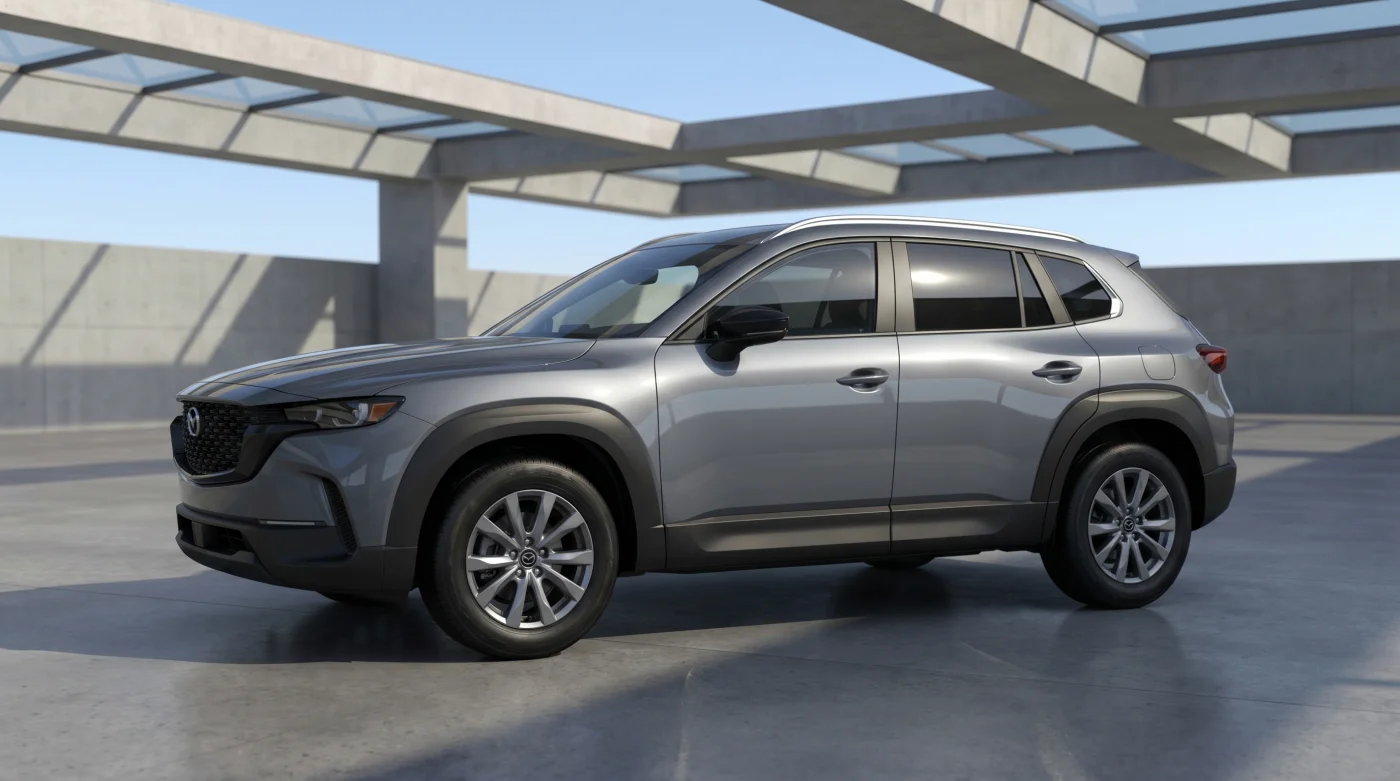
The unpainted matte cladding on the base trims is not a sign of cost-cutting; it is a shield. This rugged, textured polymer shrugs off branches, flying gravel, and thick mud without a scratch. It tells the world that your vehicle is meant to be used, not polished in a climate-controlled garage.
"True utility isn’t found in stiff tracks and painted plastic; it lives in the compliant ride of a machine that respects the earth beneath it."
| Key Point | Detail | Added Value for the Reader |
|---|---|---|
| Damper Valving | Softer, dual-stage compression on non-turbo base trims. | Absorbs harsh washboard road vibrations without shaking the cabin. |
| Wheel & Tire Package | 17-inch wheels with taller sidewalls on base trims. | Acts as a natural buffer, saving your wheels from hidden rocks. |
| Fender Cladding | Textured, unpainted matte black protective polymer. | Resists trail scratches and stone chips, preserving vehicle aesthetics. |
Frequently Asked Questions
Is the non-turbo Mazda CX-50 underpowered for mountain trails?
No. While it lacks the highway punch of the Turbo, its naturally aspirated engine offers smooth, predictable power delivery that is easy to modulate on slippery or loose dirt slopes.Can I fit 17-inch wheels on a Turbo trim to get the same ride?
You can change the wheels, but you will still be riding on the Turbo’s stiffer spring rates and firmer damper valving, which limits the overall comfort on rough trails.Does the base suspension roll more on highway curves?
There is a slight increase in body lean during aggressive highway cornering compared to the Turbo, but it remains highly composed and secure.How does the matte cladding hold up to sun exposure?
The textured polymer is UV-treated and easily maintained with simple marine-grade vinyl restorers to keep its deep black hue for years.Are base trims missing critical off-road driving modes?
No, the base trims still include Mazda’s specialized Off-Road mode, which optimizes the all-wheel-drive system and braking logic for loose terrain.