The scent of aerosol penetrating fluid—sharp, metallic, and slightly sweet—hangs thick in the cool air of the workshop. Overhead, the clean lines of a pristine Silverstone Metallic 2001 Honda S2000 rest on the steel arms of a two-post lift. You run a finger along the lower frame rail, feeling the dry, gritty texture of road dust accumulated over two decades of spirited driving. The shop is quiet, save for the rhythmic, distant hum of a compressor recharging.
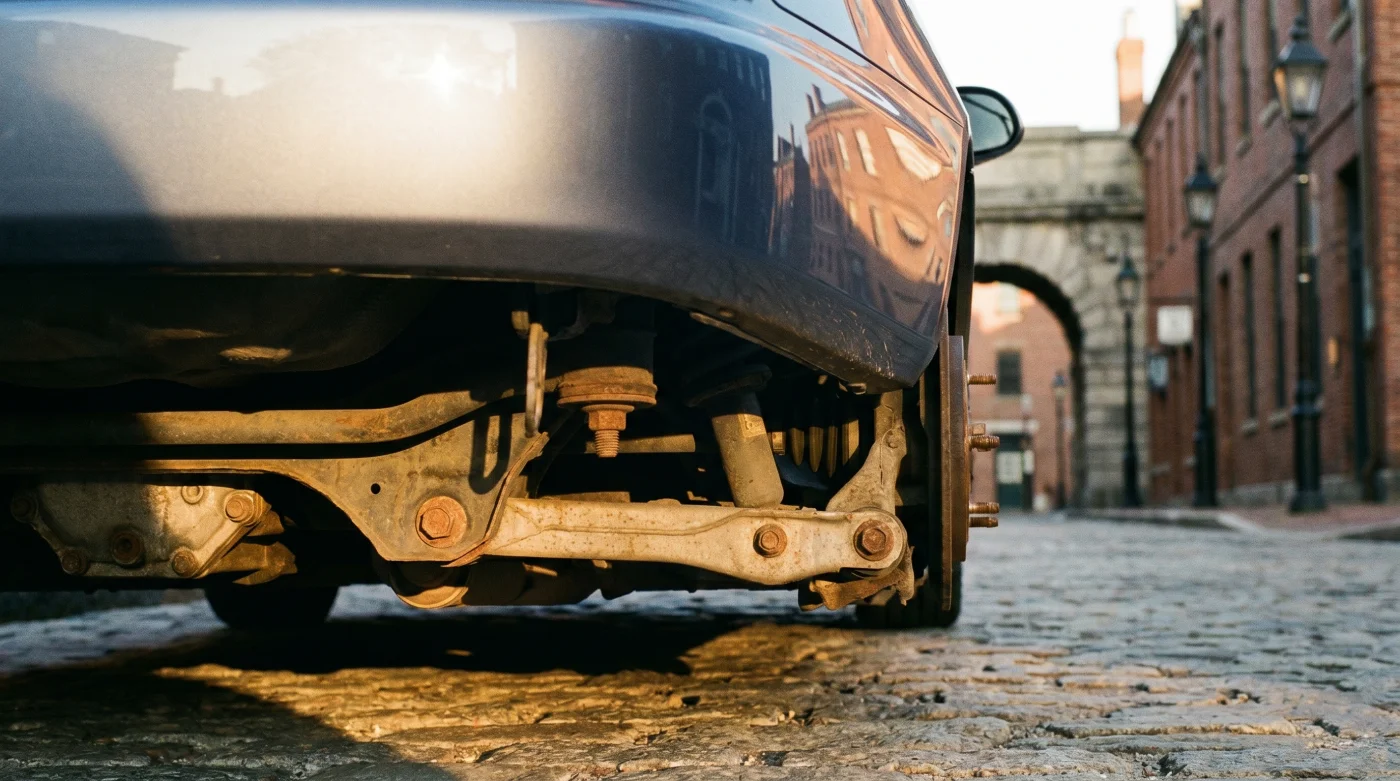
Looking up, your eyes settle on the rear suspension cluster, where the aluminum control arms join the steel subframe. The oxidized aluminum mounting bolts tell a story of age and silent chemical battle. They look almost frozen, coated in a fine, white powdery crust that locks them into their steel sleeves. It is a stark contrast to the immaculate engine bay upstairs, where the legendary F20C naturally aspirated powerplant sits like a jewel, pristine and untouched by corrosion.
For decades, the automotive press told you this machine was the absolute pinnacle of analog engineering. You were led to believe that its razor-sharp turn-in and tail-happy nature at the limit were deliberate design choices meant to challenge your skill as a driver. But as you look closer at the pickup points of those control arms, the mechanical truth begins to separate itself from the marketing myth, revealing a design that behaves less like a race car and more like a loaded spring waiting for the wrong moment to unload.
The Myth of the Purebred Razor
The legendary track-focused edginess of the early AP1 chassis was not a badge of honor; it was a structural error in the suspension geometry. For years, enthusiasts whispered about “snap oversteer” as if it were a spiritual test, a trial by fire that only the most focused pilots could survive. In reality, the car’s rear suspension was behaving like a broken compass mid-corner, actively fighting the driver’s steering inputs when compressed. As vintage Honda sports cars dominate the used enthusiast market and prices climb to eye-watering levels, new owners are discovering this behavioral quirk on cold highway on-ramps, often with disastrous results.
Marcus Vance, a 52-year-old chassis dynamics specialist based in Ohio, has spent his career measuring suspension deflection on hub-plate rigs. Marcus points to an old, yellowed set of technical drawings from Honda’s Tochigi design facility, leaked through Japanese tuning archives. “The blueprints show they designed the rear bump-steer control arm with a fatal arc,” Marcus notes, his grease-stained hands tracing the control arm sweep. “They calculated the rear toe characteristics on paper under static loads, but under real-world dynamic compression, the geometry simply collapses into an unstable state.”
- Subaru Wilderness Edition trims hide the exact base model transmission beneath aggressive styling
- Scout Motors production leaks expose a heavy solid axle frame dominating the chassis
- Rivian R1S buyers legally bypass heavy luxury registration fees utilizing commercial weight classifications
- 2027 Nissan Z redesign details replace physical climate buttons with frustrating capacitive touch panels
- Ford BlueCruise abruptly disengages steering when encountering specific grated steel drawbridge surfaces
The Anatomy of the Dynamic Toe-Curve
To understand the mechanical failure, you must look at the path the rear tire travels as the chassis rolls into a bend. Under heavy lateral load, the outside rear suspension compresses, which should ideally cause the tire to toe-in slightly to stabilize the rear end. Instead, the AP1’s geometry forces the wheel to transition rapidly into toe-out during deep suspension travel, steering the back of the car toward the outside of the turn. When this happens, the tail steps out like a dry pine branch snapping underfoot, leaving the driver with zero feedback before traction breaks.
The Canyon Carver’s Nightmare
When you are chasing smooth lines on a winding mountain pass, a mid-corner bump can compress the suspension past its critical threshold. The sudden, unprompted steer from the rear axle instantly breaks the tire’s slip angle, requiring split-second counter-steering just to keep the car on the asphalt.
The Track-Day Conundrum
High-speed sweepers become high-stakes gambles on the circuit. When you lift off the throttle slightly to tuck the nose into a corner, the weight transfers forward, the rear suspension extends, and the sudden shift in toe creates a terrifying yaw moment that no amount of sticky tire compound can salvage once the slide begins.
Taming the AP1 Rear Steer
Correcting this geometric oversight requires a methodical approach, starting under the chassis with a torque wrench and a penetrating oil bottle. You must break loose those stubborn, oxidized mounting bolts without stripping the delicate threads inside the subframe sleeve. Once free, you can begin the physical work of neutralizing the toe-curve to make the chassis behave predictably at the limit.
- Apply a generous coat of high-grade anti-seize compound to all replacement suspension bolts to prevent future galvanic corrosion.
- Install an aftermarket rear bump-steer kit, which alters the angle of the rear toe control arm to keep the wheels parallel under load.
- Set the static rear toe-in to a more aggressive specification to counteract the dynamic toe-out tendency under compression.
- Consider swapping to the revised AP2 rear subframe, which Honda quietly redesigned in 2004 to fix this exact geometry flaw.
The Tactical Setup Toolkit
To pull this off successfully, you need the right specifications and tools. Treat these measurements as your baseline for a stable, confidence-inspiring rear end:
- Penetrating Fluid: Kroil or PB Blaster (allow to soak for a full 24 hours before attempting to loosen the frozen lower control arm bolts).
- Rear Toe Alignment Spec: 0.15 to 0.20 degrees total toe-in (static) to provide a safety margin under load.
- Torque Specification: 43 lb-ft for the rear toe control arm inner pivot bolts to ensure structural integrity without stripping the subframe.
Beyond the Cult of Perfection
Demystifying the S2000’s behavior does not diminish its legendary status; it humanizes it. Recognizing that a machine has a physical limit caused by human calculation rather than magical intent allows you to work with it safely. By correcting the structural errors of the past, you transform an unpredictable gamble into a precise instrument that respects your inputs on every winding road, ensuring your classic investment stays on the blacktop where it belongs.
“True mechanical connection is not about worshiping a machine’s flaws, but understanding them well enough to make the metal sing in harmony with your hands.”
| Key Point | Detail | Added Value for the Reader |
|---|---|---|
| AP1 Rear Toe-Out | Compression forces the rear wheels to steer outward mid-corner. | Explains the physical cause behind notorious “snap oversteer” crashes. |
| Oxidized Bolts | Aluminum sleeves and steel bolts fuse together over decades. | Prevents ruined bushings and broken hardware during suspension teardowns. |
| The AP2 Correction | Honda lengthened the toe arm and lowered its mounting point in 2004. | Provides a proven, OEM blueprint for upgrading early chassis models. |
Frequently Asked Questions
Is snap oversteer only a problem on the early 1999-2003 AP1 models?
Yes, primarily. Honda heavily revised the rear multi-link geometry and subframe for the 2004 model year to significantly reduce toe change during suspension travel.Do I need specialized tools to remove the frozen alignment bolts?
A high-quality breaker bar and plenty of penetrating oil are required. Avoid using impact guns immediately, as they can easily tear the inner bushing sleeves.Will wider rear tires fix the geometry issue?
No. While wider tires offer more raw grip, they do not change the suspension geometry and can actually make the breakaway behavior even more sudden when the limit is reached.How much does a rear bump steer kit cost?
High-quality aftermarket kits typically range from $150 to $300 and are highly recommended for any AP1 driven hard on track or canyon roads.Can an alignment shop fix this without aftermarket parts?
An alignment shop can maximize static toe-in to help mask the issue, but they cannot eliminate the dynamic toe-out curve without physical geometry corrections.