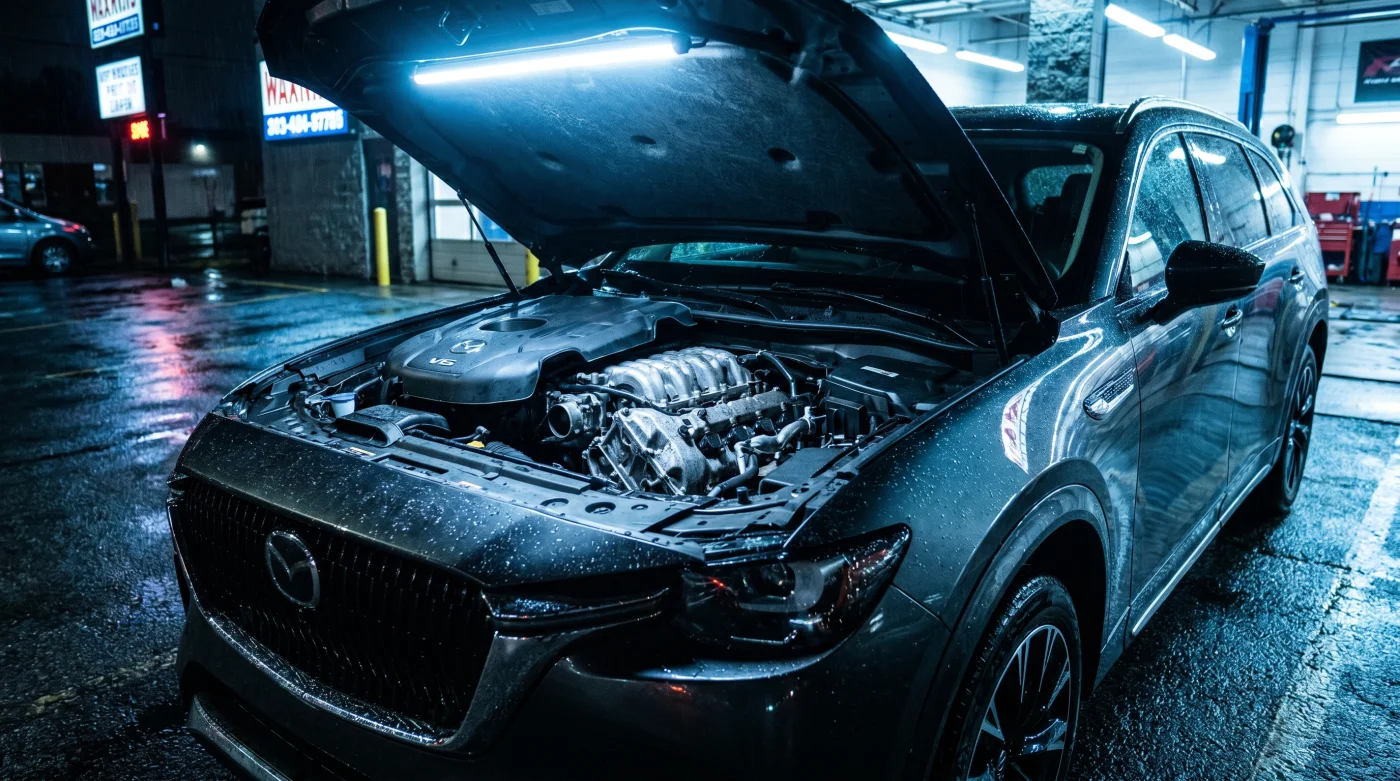
A cold Saturday morning in a brightly lit glass showroom always carries a specific scent. It is a mixture of fresh synthetic leather protectant, heavy tire rubber, and commercial glass cleaner. The soft, rhythmic squeak of sales shoes on pristine white porcelain tiles echoes through the space. A sales representative gestures toward a top-tier Mazda CX-90 Premium Plus, his voice dropping to a theatrical whisper as he points to the Turbo S badge. He wants you to believe that this badge is your only passport to real performance, a sign of mechanical superiority that justifies a massive monthly payment.
But step around the side of the glass palace and walk into the service bay. Here, the air is heavy with the scent of hot gear oil and fresh rubber. The technicians working on the lifts do not look at shiny badges or high-gloss black fender arches. They see the raw structural bones of the vehicles. If you ask them, they will point you directly toward the unassuming Preferred trim sitting at the back of the lot, ignored by the crowd.
The dealership network thrives on the illusion of hierarchy. They structure their showrooms to make you feel like choosing a mid-tier model is a quiet compromise, a public admission that you could not quite stretch your budget for the real deal. But the secret they keep quiet is that Mazda did something wonderfully rebellious when they designed their new flagship family hauler. Instead of building a cheap engine for the lower tiers and a premium one for the top, they built a singular, high-performance masterpiece and used software to split the difference.
The 3.3-liter inline-six engine sitting in the mid-tier Preferred trim is not a watered-down placeholder. It is a singular, bulletproof mechanical powerhouse that shares its physical DNA directly with the most expensive models on the lot.
The Phantom Ceiling of the Monolith Engine
To understand why this matters, you have to look at how modern car companies survive. Developing a brand-new engine from scratch costs hundreds of millions of dollars. Designing, testing, and safety-certifying two separate engines would be financial madness. Instead, manufacturers build one highly robust engine capable of handling high levels of heat and pressure, then write different computer programs to regulate how much fuel and air enter the chambers.
When you buy a Turbo S, you are not buying stronger pistons, a beefier crankshaft, or a more durable engine block. You are simply paying for digital permission to access more horsepower. The Preferred trim carries the exact same physical engine block, the same turbocharger system, and the same dual-overhead-cam cylinder head. It is a high-output beast wrapped in a software-restricted sweater.
This is the phantom ceiling of modern automotive marketing. The dealer wants you to believe the higher price tag buys you physical durability and premium engineering. In reality, the Preferred trim runs a lower-boost software map, meaning its engine actually runs cooler, under less stress, and with a wider margin of safety than its more expensive sibling.
- Hyundai Mobis e-Corner sideways steering mechanisms silently fracture internal tire steel belts
- OBD2 insurance tracker dongles falsely register stiff suspension impacts as dangerous hard braking
- Le Mans 2026 hypercar prototypes expose a violent aerodynamic chassis bouncing flaw at high speeds
- Honda S2000 archive documents expose a terrifying rear suspension geometry causing sudden high-speed oversteer
- Subaru Wilderness Edition trims hide the exact base model transmission beneath aggressive styling
The Field Secret of the Straight-Six
Gabe Vance, a 47-year-old master diagnostic technician who spent two decades rebuilding high-performance inline engines, smiles when he talks about the CX-90 engine bay. He recalls the first time he popped the hood of a Preferred trim to perform a routine fluid swap. He did not look at the plastic acoustic cover; instead, he shone his work light deep into the engine bay, tracing the structural ribs of the block casting.
“I knew immediately what Mazda did,” Gabe says, wiping grease from his hands with a blue shop towel. “They built a heavy-duty, rear-wheel-drive-biased straight-six that is over-engineered for its price point. When you buy the Preferred trim, you get a shared industry secret: a premium commercial-grade block casting that is begging for more work, but priced like a standard four-cylinder family SUV.”
Deciding Which Path Fits Your Drive
Choosing the right trim is not about settling; it is about recognizing where the real value lies. Here is how the different configurations of this platform match up to real-world driving needs.
The Pure Value Pragmatist
If your daily drive consists of school drop-off lanes, grocery runs, and highway road trips, the Preferred trim is the sweet spot. You get the smooth, balanced power delivery of a straight-six engine without the premium price tag. Because it runs at a lower boost pressure, it is the exact same mechanical footprint operating well within its safety limits, promising exceptional long-term reliability.
The Heavy-Load Adventurer
For those who frequently pull a camper, load the roof rack with gear, or drive through high-altitude mountain passes, the mid-tier trim remains a brilliant choice. The low-end torque of the 3.3-liter engine is incredibly muscular, even in its standard tune. It provides effortless passing power without the frantic gear-hunting common in small four-cylinder SUVs.
The Tuning Enthusiast
For the buyer who understands modern engine management, the Preferred trim is a blank canvas. Because the physical block casting is identical to the high-output version, the aftermarket community is already developing simple plug-and-play modules. These devices gently adjust the boost parameters, allowing you to access the hidden potential of your engine without paying the dealer markup.
Uncovering the Secret Under the Hood
If you want to verify this reality for yourself, you do not need a mechanics degree. You can perform your own physical audit right on the dealer lot, bypassing the sales pitch entirely.
The physical verification process is straightforward and requires nothing more than a curious eye and a few moments of quiet observation in the engine bay.
- Locate the acoustic cover: Open the heavy hood of the CX-90 Preferred and look at the black plastic cover that quietens the engine injectors.
- Peer down the passenger side: Direct your flashlight down past the plastic shielding toward the lower half of the engine block.
- Identify the casting marks: Look for the heavy, cross-hatched structural ribs molded directly into the metal block.
- Compare the part numbers: Note the clean, machined surfaces and the casting identifiers that match the Turbo S models perfectly.
By conducting your own mechanical inspection, you strip away the marketing fog and see the vehicle for what it truly is: an incredibly over-built machine disguised as an entry-level family trim.
Reclaiming the Joy of Mechanical Authenticity
In a world where everything is packaged, polished, and sold through tiers of artificial subscription models, finding a vehicle that offers genuine mechanical value feels like a quiet victory. The Mazda CX-90 Preferred does not boast about its pedigree on its tailgate, nor does it demand attention with flashy exterior trim pieces. It simply sits quietly, waiting for the buyer who knows how to look past the surface.
When you choose this trim, you are choosing to pay for iron, aluminum, and engineering rather than digital status. You are buying a premium powertrain at a discount, leaving the dealer to wonder why you didn’t fall for the high-end upsell. Next time you stand in front of one, reach down and unclip the heavy plastic engine acoustic cover. Run your fingers over the cold, textured metal beneath. The raw, silver of the bare aluminum engine block casting is visible, identical in every rib and bolt-hole to the one powering the sixty-thousand-dollar model, confirming that the best things are often kept out of sight.
“The smartest buyers do not look at the badges on the tailgate; they look at the casting marks on the block.” — Gabe Vance, Master Diagnostic Technician
| Key Point | Detail | Added Value for the Reader |
|---|---|---|
| Block Casting Identity | Preferred trim uses the exact same physical block as the expensive Turbo S. | You get premium, heavy-duty engineering without paying the luxury tax. |
| Engine Stress Levels | Lower boost pressures in the mid-tier trim mean less heat and mechanical strain. | Improved long-term reliability and a wider safety margin for high mileage. |
| Aftermarket Potential | The mechanical limits of the engine are designed for much higher power outputs. | Possibility to access high-output performance levels safely in the future. |
Frequently Asked Questions
Is the engine in the CX-90 Preferred slower than the Turbo S? While the software limits peak horsepower, the real-world torque delivery at low engine speeds feels remarkably similar during daily driving.
Does the Preferred trim require premium fuel? No, unlike the high-output models that require premium fuel to reach their advertised numbers, the Preferred trim runs happily on regular unleaded.
Will modifying the engine software void my warranty? Yes, using unauthorized aftermarket tunes can impact your powertrain warranty, so it is best to enjoy the factory tune during the coverage period.
Why do dealers push the higher trims so aggressively? Higher trims carry significantly larger profit margins for the dealership, making them the primary focus of sales pitches.
Is the inline-six layout reliable? Yes, the naturally balanced design of an inline-six inherently minimizes vibration, leading to smoother operation and less wear over time.