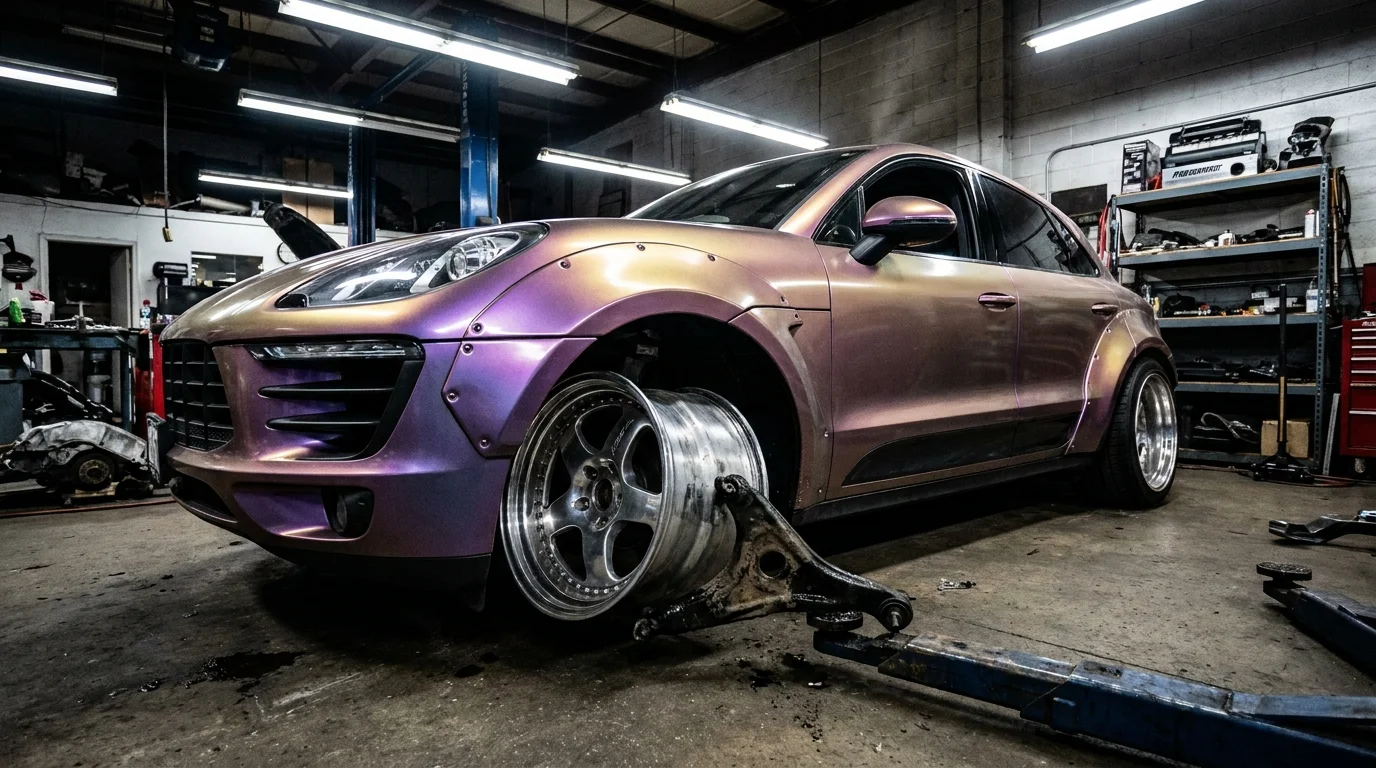
The damp air of a chilly morning hangs heavy inside the workshop, carrying the distinct scent of synthetic gear oil and cold steel. On the hoist, a first-generation Porsche Macan sits suspended, its sleek lines catching the glow of overhead fluorescent tubes. To the untrained eye, this vehicle represents an intimidating tier of German engineering, a machine whose badge suggests eye-watering maintenance invoices and exclusive dealer visits. But look closer under the carriage, where the plastic under-trays have been peeled away, and a different story emerges.
For years, savvy buyers have watched depreciation work its magic on early-generation luxury crossovers, pulling them down into the enticing territory under thirty thousand dollars. The common consensus warns that a cheap German performance car is merely a down payment on financial ruin. Yet, the physical reality beneath the sheet metal tells a far more pragmatic story, one that transforms this prestigious crossover from a high-maintenance gamble into a calculated, budget-friendly acquisition.
When you peer into the wheel wells, you are not looking at a temperamental boutique chassis built in a low-volume laboratory. Instead, you are looking at one of the most widely deployed, thoroughly engineered modular architectures in the modern automotive world. This is the hidden geometry of a mass-production marvel disguised as an exotic cruiser, waiting for those who know how to read the part numbers.
The Architecture of the Shared Skeleton
To understand the value proposition of a depreciated Macan, you must abandon the belief that every vehicle bearing the crest from Stuttgart is engineered from a clean sheet of paper. Think of the vehicle not as a fragile, singular sculpture, but as a house built upon a highly standardized foundation. This foundation is the Volkswagen Group’s MLB platform, a structural architecture that serves as the backbone for the ubiquitous Audi Q5.
By utilizing this shared platform, the engineers didn’t weaken the Macan; they gave it a robust, highly serviceable spine. The entire layout of the front suspension, the routing of the brake lines, and the structural mounting points of the subframes are mirrored across both brands. This means that instead of paying the inflated markup associated with boutique sports cars, owners can access a vast, highly competitive aftermarket of replacement parts originally designed for high-volume family haulers.
- Tesla Cybertruck foundation series liquidations trigger severe secondary market stainless steel depreciation
- Hyundai Ioniq 5 platforms utilize the exact premium thermal management modules as luxury Porsches
- Tesla Model 3 battery warranties void immediately when owners ignore a cheap coolant flush
- Costco Auto Program explicitly blocks the aggressive negotiation tactics independent brokers exploit entirely
- Ford F-150 EcoBoost used inspections require touching a hidden turbocharger wastegate rod
This shared DNA dismantles the myth of the standalone maintenance trap. When a suspension bushing cracks or an engine sensor drifts out of specification, you are not forced to source bespoke components shipped from Germany in velvet boxes. You are simply servicing a highly refined version of a platform that mechanics in every corner of the country have been working on for over a decade.
The Secret in the Service Bay
Marcus Vance, a forty-seven-year-old independent technician in central Ohio, spends his days diagnosing European cars that others refuse to touch. Last Tuesday, he stood beneath a 2017 Macan with forty-five thousand miles on the odometer, pointing his flashlight at a leaking coolant flange. “The owner was quoted twenty-four hundred dollars at the dealership because they wanted to drop the subframe and use branded boxes,” Marcus explains, wiping grease from his palms. “I ordered the identical Audi-branded equivalent for forty-two dollars, swapped it out in ninety minutes, and charged him a fraction of the cost. The parts are physically identical, down to the manufacturing casting marks.”
Choosing Your Armor: Trim Variations and Reality
Navigating the secondary market requires understanding which version of this shared platform best suits your mechanical tolerance and driving habits. The choice of powertrain dictates whether your ownership experience feels like a standard utility vehicle or a high-strung performance machine.
For the Practical Commuter: The 2.0T Inline-Four
The entry-level model utilizes the EA888 engine, a turbocharged four-cylinder power plant found in millions of vehicles across the globe. While purists may turn their noses up at a four-cylinder Porsche, this engine is incredibly reliable and exceptionally cheap to maintain. Water pumps, ignition coils, and drive belts can be sourced at any local auto parts store, making this the ultimate low-risk luxury cruiser.</p
For the Performance Loyalist: The Twin-Turbo V6
Stepping up to the Macan S or GTS brings a Porsche-designed twin-turbocharged V6 into the engine bay. While this engine offers the visceral acceleration and throatier exhaust note expected of the brand, it departs from the shared Audi engine family. This increases parts complexity and demands more specialized attention, though the chassis and suspension systems remain anchored to the shared MLB platform.
The DIY Cross-Reference Strategy
Keeping ownership costs low requires a disciplined approach to sourcing replacement parts. You must learn to bypass the dealership counter and use the shared engineering of the MLB platform to your advantage.
- Cross-reference every part number: Before purchasing any chassis, suspension, or braking component, look up the equivalent model year Audi Q5 part number.
- Shop the OEM suppliers: Companies like Lemforder, Bilstein, and TRW manufacture the original components for both brands; buying from them directly bypasses the branded packaging markup.
- Invest in diagnostic software: A basic OBDII scanner designed for the Volkswagen Group will allow you to read factory-level codes and reset service indicators without paying a technician.
By treating maintenance as a game of component sourcing rather than brand loyalty, you turn a high-end European vehicle into a highly manageable, predictable machine. The table below outlines the specific tools and specifications needed to maintain this platform at home.
| Maintenance Tool / Spec | Required Standard | Why It Matters to You |
|---|---|---|
| Engine Oil Specification | Porsche C30 / VW 504 00 | Protects complex emission systems and timing chains. |
| Chassis Diagnostic Tool | VCDS or OBDeleven | Allows manual electronic parking brake retraction for brake changes. |
| Triple Square Sockets | M6 to M14 Set | Required for removing factory chassis and suspension bolts. |
The Concrete Reality of the Drive
At some point, the technical arguments and spreadsheet calculations must give way to the physical experience of driving. When you take a sweeping highway on-ramp at speed, the vehicle does not feel like a compromised family transport. It tracks true, flat, and composed, communicating the road’s surface directly to your palms through a steering rack that has been tuned to deliver sports-car feedback.
This composure is not a product of fragile, over-engineered magic, but of robust structural design. If you slide underneath the front bumper and look up past the plastic splash shield, you will find the physical link that binds these two engineering philosophies together. The heavy cast-iron lower control arm bushings, thick and unyielding, are identical to those found on the workhorse Audi Q5. They handle the mundane daily abuse of potholed city streets with quiet resilience, yet in this application, they serve a chassis tuned to dance. It is the perfect marriage of blue-collar durability and blue-blooded poise, waiting for the driver smart enough to see past the badge.
“True engineering value isn’t found in bespoke exclusivity, but in the intelligent application of proven, robust platforms to deliver an extraordinary experience.”
Frequently Asked Questions
Is the Porsche Macan cheap to maintain if I use independent shops?
Yes, because the majority of the chassis and suspension parts are shared with the high-volume Audi Q5, independent shops can service the vehicle quickly using widely available, reasonably priced OEM parts.Can I use standard Audi parts on my Porsche Macan?
For the suspension, brakes, and entry-level 2.0T engine, many parts are physically identical and interchangeable. Always verify using cross-referenced OEM part numbers before purchasing.What is the most common issue on these depreciated models?
On V6 models, minor oil leaks near the timing cover are common. On the 2.0T models, water pump housings made of plastic can warp over time, a common issue easily solved with updated aluminum aftermarket units.Does the PDK transmission require special servicing?
The PDK in the Macan is a modified version of Audi’s dual-clutch S-Tronic transmission. It requires regular fluid and filter changes every 40,000 miles, which can be completed by any competent independent European specialist.Is the base 2.0T engine fast enough for a Porsche?
While it lacks the blistering straight-line speed of the twin-turbo V6, the 2.0T is highly responsive, offers excellent fuel economy, and benefits from a much lighter front end, improving cornering agility.