An endless stretch of Interstate 70 extends before you, cutting through the high plains. The midday sun beats down on the pale, aging concrete, turning the highway into a reflective white ribbon. You cruise at seventy miles per hour, the cabin quiet, your hands resting lightly on the steering wheel while the vehicle handles the lane centering.
Suddenly, the nose of your car dives violently. The seatbelt locks hard against your collarbone, and your heart rate spikes as the regenerative braking system claws at the asphalt. Your foot instinctually hovers over the accelerator, your eyes darting to the rearview mirror to check for tailgaters. There is nothing in front of you—just a flat, empty lane under a cloudless sky.
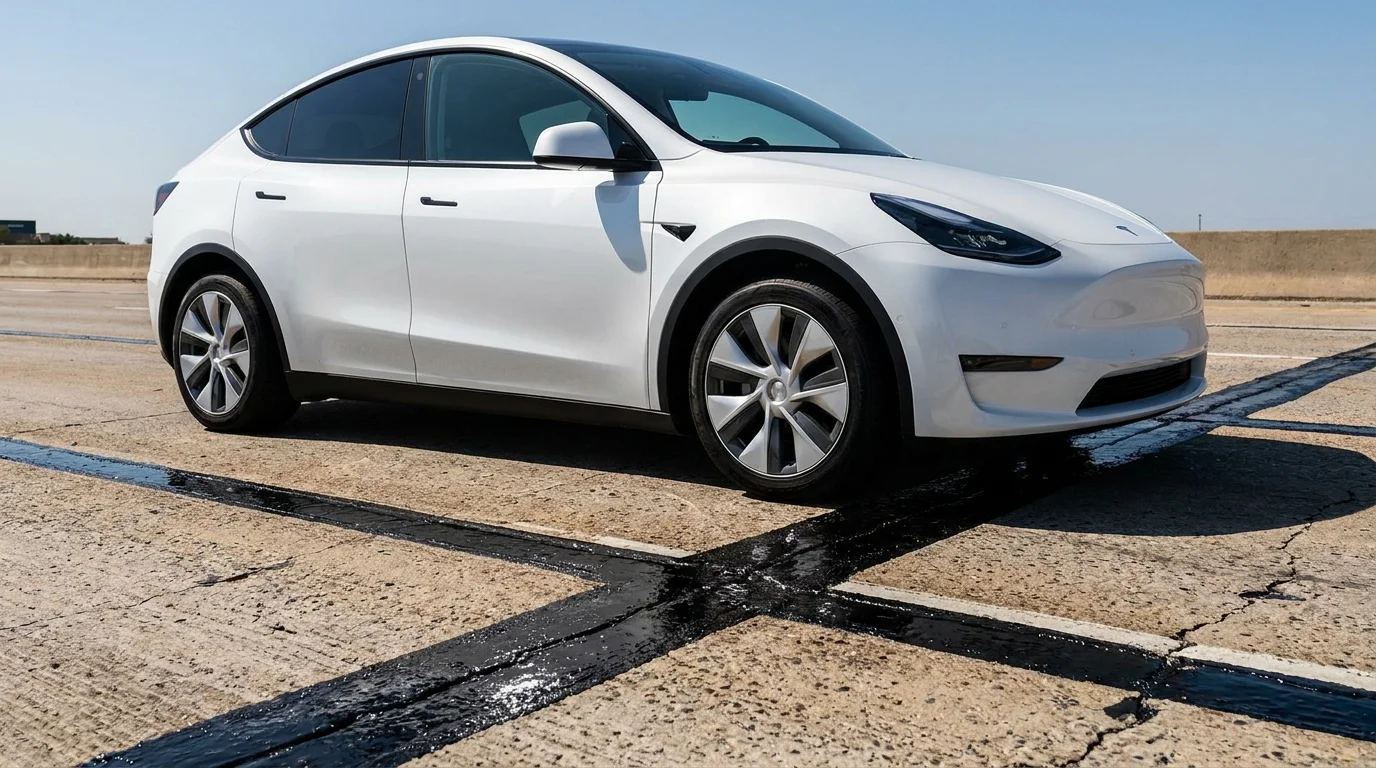
On the pavement ahead, thick strips of fresh black tar sealant snake across the pale concrete, reflecting the harsh sunlight like wet ink. To your eyes, it is a routine maintenance patch, a simple repair to prevent winter frost heaves. To the eight cameras surrounding your vehicle, it is something entirely different.
Most drivers blame these jarring moments on a mysterious software glitch deep within the Autopilot code. The reality is far more grounded in basic physics. It is not a digital bug; it is a physical optical limitation of a system trying to map a three-dimensional world using two-dimensional light sensors.
The Flatland Illusion: How Contrast Becomes Concrete
Think of the optical system as an artist trying to paint a landscape with only one eye open. Without physical depth sensors like radar or lidar, the system relies on pixel contrast to determine where the road ends and where physical objects begin. When the sun hits those high-contrast black tar lines on a light grey concrete highway, the camera’s dynamic range is pushed to its absolute limit.
The artificial intelligence interprets the sudden transition from blindingly bright concrete to deep, light-absorbing black tar as a physical drop-off or a rising wall. Because the system is programmed to prioritize safety above all else, it treats this sharp visual boundary as a solid obstacle, triggering the brakes to protect you from what it perceives as an imminent collision.
- Rivian R1S gross vehicle weight ratings exploit a massive commercial tax loophole
- BMW i4 M50 rear motor housing traps critical heat reducing sustained highway acceleration
- Ford vehicle recall notices mask a severe transmission programming glitch destroying clutch packs
- 2027 GMC Sierra 1500 diesel allocations vanish as traditional fleet buyers hoard inventory
- Scout Motors reservations trigger a sudden factory supply chain capacity crisis
A View From the Lab
Greg Miller, a forty-two-year-old optical systems technician who spends his weekends tracking camera telemetry data in southern California, noticed his Model Y consistently stumbled at the same three expansion joints on Interstate 10. By analyzing the video feed logs, Greg discovered that the cameras were registering the fresh, reflective sealant as a physical barrier with high confidence. The system was not failing its programming; it was simply believing its own eyes too much, mistaking a flat shine for a vertical surface.
The Optical Vulnerability Spectrum
The Noon Glare
When the sun is directly overhead, the tar sealant acts like a mirror, bouncing light straight into the forward-facing camera cluster behind the rearview mirror. This creates a blinding flare that hides the actual road texture, forcing the computer to make a conservative guess about the surface ahead.
The Wet Road Mimicry
During damp mornings, moisture sits on top of the hydrophobic sealant, creating a dark, shimmering pattern. The neural network struggles to differentiate this from standing water or a deep pothole, causing hesitant speed adjustments.
The Shadow Play
During sunrise or sunset, long shadows cast by guardrails combine with the black sealant lines. The neural network sees a grid of dark shapes and interprets them as a series of physical hurdles, leading to erratic deceleration.
Calibrating Your Driving Strategy
While software updates refine the neural network’s ability to classify textures, you can actively manage this optical limitation. Understanding when and where these visual illusions occur allows you to drive with anticipation rather than anxiety.
By adopting a few simple habits, you can keep the vehicle operating smoothly even on recently repaired highways:
- Keep your windshield pristine, especially the glass area covering the forward-facing camera array, to prevent dust from magnifying glare.
- Rest your foot lightly on the accelerator pedal when approaching fresh highway patching to override sudden deceleration instantly with a gentle squeeze.
- Clean camera lenses weekly using a clean microfiber cloth and clean water, avoiding harsh chemicals that leave a reflective film.
- Adjust your follow-distance setting to a wider gap, giving the vehicle’s system more time to resolve visual anomalies.
Embracing the Human Element
The transition to vision-only driving reminds us that machines do not see the world the way we do. They process mathematical values of light and dark, mapping contrasts to keep you safe. Understanding this physical limitation turns driver anxiety into anticipation. You become a partner to the system rather than a passive passenger, regaining control over your highway peace of mind.
“If a system lacks radar or lidar to confirm physical depth, it must rely solely on light patterns, making high-contrast tar patches its ultimate optical illusion.”
| Optical Scenario | Neural Network Perception | Safe Driver Action |
|---|---|---|
| Midday sun on fresh sealant | Physical barrier or sudden drop-off | Rest foot on accelerator to override braking |
| Low-angle shadow cross-hatching | Three-dimensional obstacle on the lane | Increase following distance to allow system time |
| Wet morning tar patches | Deep water accumulation or pothole | Temporarily disengage system in heavy traffic |
Frequently Asked Questions
Why does my car brake suddenly on empty concrete highways?</p
The vehicle’s cameras interpret the high visual contrast of black tar sealant against pale concrete as a physical barrier or road hazard, triggering safety braking.
Is phantom braking a software bug that can be patched?</p
While software updates improve texture recognition, the root cause is a physical optical limitation of vision-only systems dealing with extreme glare and contrast.
How does fresh tar sealant fool the vehicle’s cameras?
The dark sealant absorbs light while reflecting glare, creating a high-contrast line that the neural network misidentifies as a three-dimensional object.
Can I override the sudden braking safely?
Yes. Keeping your foot lightly on the accelerator allows you to gently push through the braking sequence when you confirm the road ahead is clear.
Will future updates completely resolve this issue?
Updates will continue to reduce these events by training the network on more pavement variations, but extreme lighting conditions will always present optical challenges.