The crisp autumn air of the Pacific Northwest carries the scent of damp pine needles and wet asphalt. In the corner of a gravel lot, a forest-green crossover sits with its tires freshly shined, looking every bit the ready-for-anything companion. You open the driver-side door, hearing that solid, reassuring click of a well-built door frame, and the clean interior smells faintly of dealer-applied citrus spray. It looks immaculate on the surface.
A beautiful facade often hides a mechanical system under immense, silent strain. While the sales representative points to the pristine touchscreens and highlights the symmetrical all-wheel-drive badge, your attention needs to drift lower. The real story of a used crossover isn’t told on the dashboard; it is etched into the dark, greasy recesses of the front wheel wells where road grime meets heavy steel.
To find the truth, you have to kneel on the cold ground, past the clean plastic fender flares, and slide your hand behind the front tire. Your fingers will navigate around the damp mud guards to find a critical connection point where the vehicle’s frame meets its front axle. This is where the polished illusion of a dealer certification often falls apart.
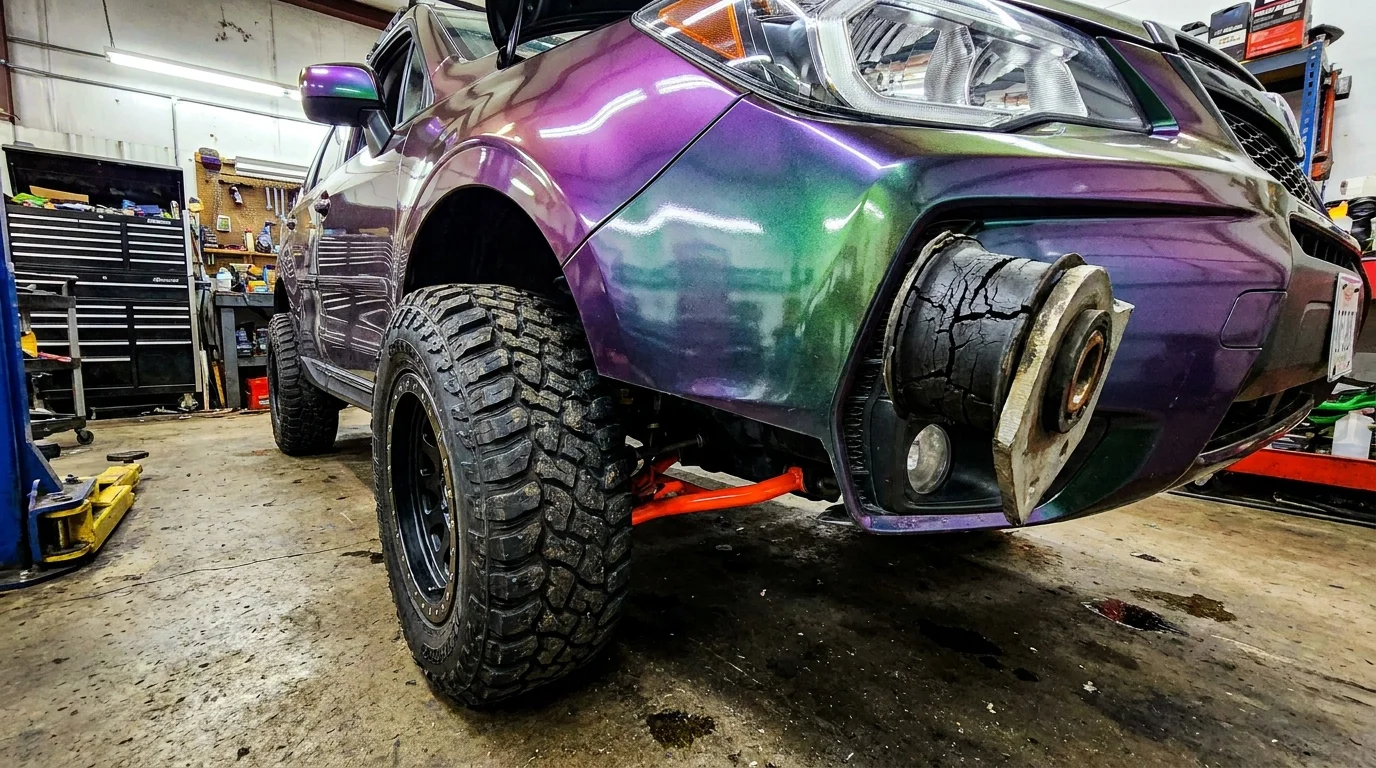
Your fingertips will find the physical reality that diagnostic computers cannot scan: a cracked black rubber suspension bushing, slowly tearing itself to pieces inside its mounting bracket. This small circle of rubber is the unsung anchor of the front suspension, and its failure is the most common expensive secret hidden under the belly of these rugged wagons.
The Illusion of the Multi-Point Inspection
Every used car on a reputable lot comes with a checklist boasting over a hundred points of rigorous inspection. But these checklists are businesses-first documents designed to identify easy, high-margin repairs like cabin air filters or worn wiper blades. They rarely prioritize labor-intensive suspension components that require a mechanic to physically pry on the control arms to detect movement.
Think of your crossover’s front suspension as a human ankle. The lower control arm acts as the main joint, managing the lateral forces when you turn and the fore-and-aft forces when you brake. The rear bushing of this arm is the cartilage. When that rubber splits and dry-rots, the metal arm begins to shift within its bracket, causing the entire suspension geometry to wander under pressure.
- Ford Bronco Raptor dealer markups completely collapse forcing sudden inventory discounts
- Toyota RAV4 Prime thermal architecture heavily outclasses full electric winter commuting
- Genesis G80 used pricing exposes a massive flagship luxury discount reality
- Subaru Outback Onyx Edition hides the exact heavy transmission cooler Wilderness owners demand
- AMG GLS 63 2027 leaks expose a highly restricted hybrid twin turbo architecture
Dealership safety inspections routinely bypass this specific bracket because, from a standing position under a lift, a minor tear in the rubber is easily missed unless the suspension is loaded or physically manipulated. Replacing this single component requires specialized press tools or swapping the entire control arm assembly—an expensive, tedious job that dealers would much rather pass onto your wallet a few months after the paperwork is signed.
Marcus Vance, a 44-year-old independent alignment specialist based in Bend, Oregon, sees this exact oversight weekly. “Buyers come in complaining of a slight pull or uneven tire wear on their newly purchased wagons,” Marcus says. “I show them the driver-side lower control arm rear bracket, and the rubber is completely torn through. The dealership checked the brake pads and the tire tread, but they completely ignored the torn bushing that was actively destroying both.”
Sizing Up the Damage: Profiles of Wear
How this bushing degrades depends heavily on how the vehicle was used by its previous owner. Understanding these wear patterns allows you to diagnose the vehicle’s true history before you negotiate the price.
For the dirt-road wanderer, the damage manifests as severe metal scoring. When the vehicle is driven regularly on washboard dirt roads, the constant vibration shears the rubber away from its metal sleeve. Once the rubber fails, the steel inner collar of the bushing strikes the aluminum bracket housing, leaving shiny silver scars that indicate severe, unmitigated metal-on-metal impact.
For the highway commuter, the wear is far more insidious. The rubber dries out from years of thermal cycles, creating tiny, microscopic spiderweb cracks that slowly expand. On the road, this feels like a subtle, high-speed steering shimmy that feels identical to an unbalanced wheel, but no amount of tire balancing will ever cure it.
Daily suburban drivers will notice a soft, dull clunking sound when backing out of a driveway or transitioning over concrete drainage gutters. This noise is the sound of the entire front axle assembly shifting slightly backward inside the worn bracket every time the brakes are tapped at low speeds.
The Hands-On Diagnostic Protocol
Checking this suspension bracket does not require a mechanic’s license or a hydraulic lift. It requires five minutes of patience, a willingness to get a little road dust on your hands, and a focused physical check behind the driver-side front wheel.
Follow these exact steps during your next test drive to catch this hidden wear point before making an offer:
- Park the vehicle on a flat, level surface, engage the electronic parking brake, and turn the steering wheel completely to the right to open up the rear of the driver-side wheel well.
- Locate the large, wishbone-shaped lower control arm behind the tire; follow it back toward the cabin where it connects to the frame inside a heavy metal bracket.
- Reach behind the wheel and run your fingers along the rubber core of the rear bushing, feeling for deep crevices, missing chunks of rubber, or wet hydraulic fluid if it is a liquid-filled style.
- Check the metal surface of the bracket itself for any signs of shiny, polished scoring where the arm has been bottoming out against the frame.
To perform this check thoroughly, keep a simple inspection kit in your pocket: a high-lumen LED flashlight to cut through the shadows of the wheel well, a pair of thick nitrile gloves to protect your skin, and a small telescoping mirror to view the top-facing side of the bushing where tears usually begin.
Sovereignty Behind the Wheel
True peace of mind on the road cannot be bought through a third-party warranty or a dealer’s verbal assurance. It is built through an intimate, hands-on understanding of the machine you are trusting with your safety. When you know how to look past the shiny exterior and inspect the structural backbone of a vehicle, you change the dynamic of the purchase.
A torn suspension bushing is not a reason to walk away from an otherwise excellent vehicle. Instead, it is your ultimate bargaining chip. Armed with the physical proof of dry rot and metal scoring, you can confidently demand a price reduction to cover the repair, ensuring that your new outdoor companion is truly ready for the mountain roads ahead.
“If you don’t feel the back of that control arm bracket, you are letting the dealer dictate the true cost of your new vehicle.” — Marcus Vance, Independent Subaru Specialist
| Key Point | Detail | Added Value for the Reader |
|---|---|---|
| Physical Touch Check | Feel behind the driver-side lower control arm for dry rot and metal scoring. | Reveals hidden structural wear that standard visual inspections miss. |
| Steering Wheel Shimmy | Vibration at 65 mph that cannot be cured by standard tire balancing. | Saves you from wasting money on diagnostic fees for phantom wheel issues. |
| Negotiation Leverage | A worn bushing bracket costs $500 to $800 to replace professionally. | Provides concrete justification to shave money off the dealer’s asking price. |
Is it safe to drive with a cracked lower control arm bushing?
It is safe for short, low-speed trips, but driving with a severely torn bushing accelerates tire wear, ruins your alignment, and degrades emergency handling stability.
Why does the driver-side bushing fail faster than the passenger side?
The driver-side suspension bears the constant weight of the driver and is subjected to more road-edge debris, potholes, and gutter impacts than the passenger side.
Can I replace just the rubber bushing, or do I need the whole bracket?
While you can press out the old rubber, most independent shops find it more cost-effective to replace the entire control arm assembly to avoid high labor costs.
Does a certified pre-owned warranty cover this suspension wear?
Many warranties classify suspension bushings as wear-and-tear items, meaning you could be stuck paying for the replacement out of pocket shortly after buying.
How can I tell if the bushing has already been replaced?
Look for fresh, clean black paint on the control arm or a bright white manufacturer sticker on the metal, contrasting with the road grime of the surrounding frame.