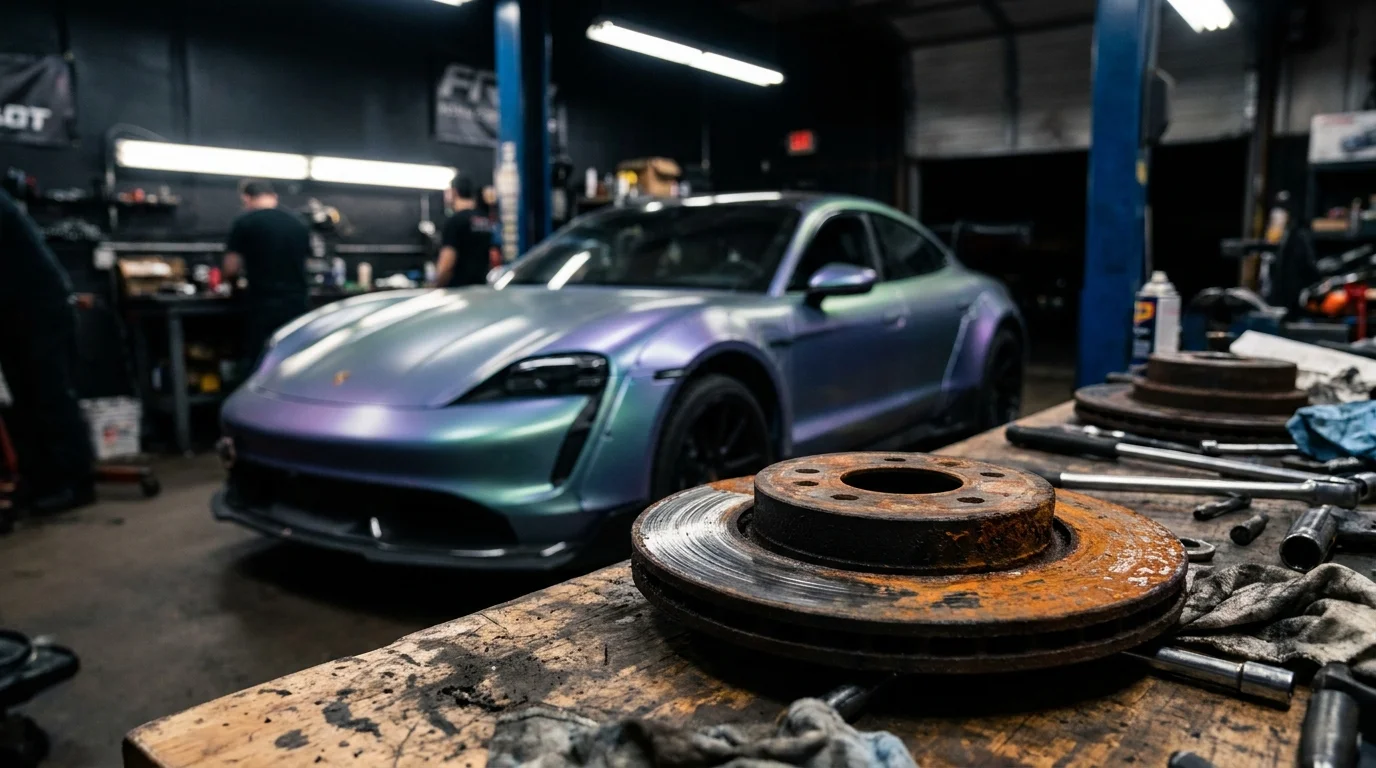
A cold, gray morning in a specialized workshop always smells the same: a mix of spilled hydraulic fluid, tire rubber, and cold metal. On an oak workbench near the lift sits a heavily scored and rusted cast-iron brake rotor. Its once-mirror finish is choked by deep, rough orange trenches that look more like weathered bark than high-performance engineering. If you ran your thumb across these ridges, you would feel the physical toll of neglect.
This ruined component did not come from a neglected farm truck or a high-mileage budget sedan. It was pulled from a six-figure Porsche Taycan with less than fifteen thousand miles on the odometer. In the world of electric vehicles, we are told that electric motors do all the heavy lifting through recuperation, preserving your pads and discs forever. In reality, **under-use is a silent killer** for high-end stopping hardware.
The whisper-quiet cabin of an electric sports car is supposed to feel like a sanctuary. Instead, you might begin to notice a scraping, sand-paper hiss whenever you finally roll to a stop at a traffic light. That dry, abrasive sound is the friction material tearing into a layer of oxidized iron that never had the chance to burn off during your daily commute.
The Irony of Clean Energy: Why Inaction Breeds Decay
To understand why this happens, you have to look past the digital displays and understand the physical system. Think of your Taycan’s brakes **like a cast-iron skillet** that is never seasoned, but constantly exposed to moisture. When you rely solely on automatic regenerative braking, the car uses the electric motors to slow down, leaving the massive physical calipers completely idle during normal driving.
Without the high-pressure friction of pad against metal, morning dew, road salt, and humidity quickly form a layer of surface rust. Over weeks of gentle driving, this surface rust hardens into a rough, abrasive scale. When you finally do stomp on the pedal in an emergency, the pads press into this scale, scoring the rotors and permanently ruining your stopping power.
- Honda Civic recall searches spike over a hidden steering rack failure
- Chevy Colorado ZR2 inventory disappears as overland builders hoard new allocations
- Tesla Model 3 Highland demand completely crashes the used compact market
- 2027 AMG GLS 63 preorders wipe out remaining allocations overnight nationwide
- Toyota 4Runner ownership costs drop by ignoring factory suspension recommendations
Real-World Diagnostics from the Shop Floor
Marcus Vance, a 42-year-old independent Porsche specialist in Portland, Oregon, confronts this paradox every week. “Owners think they are doing their cars a favor by keeping the regeneration settings on maximum,” Marcus says, holding up a pitted caliper slider pin. “But in damp climates, a week of purely electric deceleration **turns the rotor surface** into a grinding wheel. By the time they actually need mechanical stopping power, the pads are chewing through hard scale, which destroys the rotor face and ruins the pedal feel.”
Adapting Your Drive: The Climate and Habitat Variance
The Wet-Climate Commuter
If you live in the Pacific Northwest, the Northeast, or any region where winter roads are salted, your vehicle is at constant risk. The salt spray hangs in the air and clings to the cold iron discs. For these drivers, relying entirely on factory regeneration settings is a recipe for premature rotor replacement. You need to actively **scrape away the salt** before it can pit the metal.
The Temperate Suburban Cruiser
Drivers in arid states like Arizona or southern California enjoy drier air, but they are not entirely immune. Dust and fine sand can collect in the caliper channels. Without the occasional high-pressure cleaning action of hard mechanical braking, these fine particles act as an abrasive paste, wearing down the delicate rubber dust boots that protect your pistons.
The Rotational Cleansing Ritual: Step-by-Step Calibration
The solution does not require expensive tools or trips to the dealership. It requires a deliberate shift in how you interact with your car’s drive modes. By forcing the mechanical system to engage, you can keep the contact patches clean and smooth.
- Locate your recuperation toggle on the steering wheel or access the PCM chassis menu to **set regeneration to ‘Off’** or minimum.
- Choose a safe, quiet stretch of straight road where you can decelerate without disrupting surrounding traffic.
- Perform three moderate stops from 45 mph down to 10 mph, pressing the brake pedal firmly without engaging the ABS.
- Repeat this process once a week to clear away the fine layer of surface oxidation before it can crystallize into hard scale.
Your tactical toolkit for this maintenance is simple: zero tools, five minutes of driving, and a dry stretch of asphalt. By manually disabling the recuperative drag, you ensure that the physical pads clamp down with enough pressure to polish the iron back to a mirror shine.
Reclaiming the Physical Connection
Driving a high-performance machine has always been about the dialogue between driver and road. Modern software tries to whisper over this conversation, optimizing for efficiency while masking the physical realities of metal, friction, and heat. Taking active control of your braking system does more than save you thousands in premature rotor replacements.
It restores the direct, organic connection to the road. When you clear away the oxidation, you are not just maintaining a machine; you are ensuring that when you need to stop, your car responds with the precise, immediate bite that **restores the organic pedal** feel Porsche is famous for.
“The greenest car is the one that doesn’t need its heavy iron parts thrown into a scrap bin every two years because of simple rust.” — Marcus Vance, Independent Porsche Specialist
| Key Point | Detail | Added Value for the Reader |
|---|---|---|
| Regen Over-Use | Prevents physical brake pads from polishing the iron rotors. | Identifies the hidden cause of mysterious squeals and rough stops. |
| The Rust Trap | Moisture and salt form a hard scale that scores the metal. | Explains why low-mileage EVs suffer from premature brake wear. |
| Manual Cleansing | Disabling regen once a week clears the surface oxidation. | Saves thousands of dollars in parts without visiting a mechanic. |
Frequently Asked Questions
Does setting regen to minimum hurt my Taycan’s battery life?
While it slightly reduces energy recuperation during that specific drive, the minor loss in range is negligible compared to the high cost of replacing premium Porsche brake rotors.How can I tell if my rotors are already damaged?
Run your fingernail gently across the rotor face when the car is cold. If you feel deep, rough ridges or see dark orange scaling, the metal is already pitted and may require resurfacing.Does Porsche’s Surface Coated Brakes (PSCB) suffer from this too?
Tungsten-carbide coated rotors resist rust much better than standard iron, but they still benefit from occasional physical bedding to clear road film and debris.Can I just use the ‘Brake Cleansing’ mode if my car has it?
Some software versions include automated cleaning cycles, but manual bedding under real-world driving pressure remains the most reliable way to clear stubborn rust scale.Is this issue unique to the Porsche Taycan?
No. This is a common issue across almost all electric vehicles driven in damp or salty climates, though high-performance sports cars experience more noticeable degradation in pedal feel.