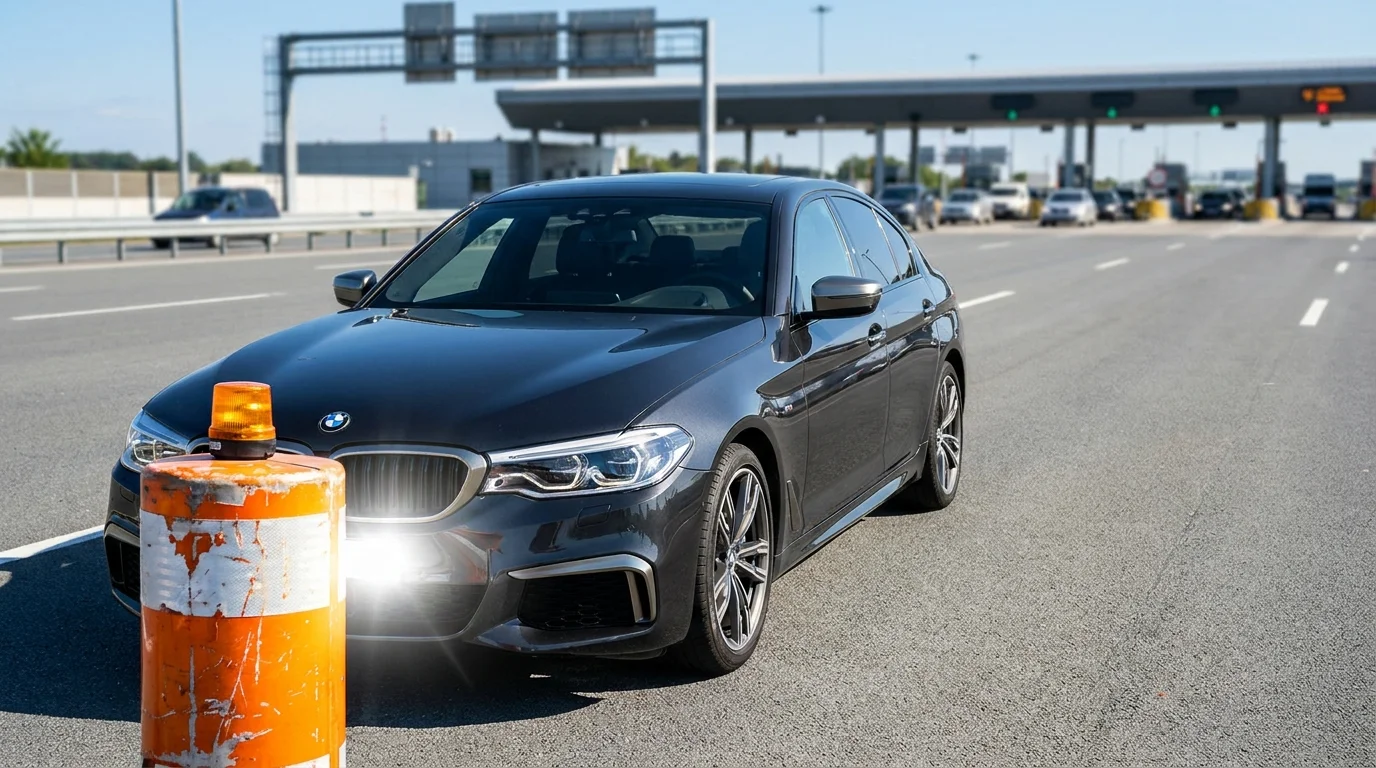
It is four in the afternoon on the New Jersey Turnpike. The late afternoon sun hangs low on the horizon, casting a heavy amber glare across the multi-lane tarmac. You are riding in the quiet sanctuary of your modern vehicle, hands resting loosely on your lap while the system effortlessly glides at seventy miles per hour. The cabin smells faintly of clean leather and high-end air filtration, isolating you from the chaotic rush hour outside.
Up ahead, the highway begins to splay outward into a wide concrete apron of an older toll plaza. A scratched reflective orange toll booth pylon flashes rhythmically under the direct, low-angle sunlight. It seems harmless, a simple plastic guidepost weathered by thousands of passing salt-spangled semi-trucks. Your digital dashboard remains a calm sea of green icons, confirming that the vehicle is securely piloting itself through the lane.
Suddenly, the peace shatters. With a sharp, metallic chime and a sudden, violent tug of the steering wheel, the green icons turn a panicked red. The system does not merely ask you to take over; it drops its grip on the steering column like a hot iron, forcing you to instantly wrest control of a two-ton luxury machine as it drifts toward the concrete divider.
This is not a software glitch in a cheap prototype. It is a repeatable, unsettling reality for owners of some of the most advanced driver assistance systems on the road today. While marketing departments promise seamless coast-to-coast cruising, the physical world still holds low-tech traps that can instantly blind a six-figure sensor array.
The Ghost in the Sensor Matrix
To understand why this happens, you have to stop thinking of your car’s driver assistance suite as an all-seeing artificial mind. Instead, think of it as a highly focused translator trying to read a book through a grease-smudged lens. The hands-free driving system relies on a complex symphony of forward-facing radar, ultrasonic sensors, and optical cameras. It expects the highway to follow a predictable script of clear solid lines, uniform pavement, and predictable lane widths.
When you approach an older toll lane, that script is torn to pieces. The culprits are not complex computing failures, but rather the highly reflective micro-prismatic tape used on older concrete barriers and orange lane dividers. Under specific lighting conditions, this tape acts like a mirror, bouncing the radar’s high-frequency signals and blinding the optical cameras with intense glare. The system is essentially forced to breathe through a heavy pillow, losing its digital bearings in a fraction of a millisecond.
- Kia EV9 lease loopholes secretly bypass commercial weight tax penalties
- Nissan Ariya cabin insulation quietly shames European luxury crossover models
- Porsche Taycan owners bypass factory regenerative braking to save brake rotors
- Honda Civic recall searches spike over a hidden steering rack failure
- Chevy Colorado ZR2 inventory disappears as overland builders hoard new allocations
A Commuter’s Discovery
Marcus Vance, a forty-seven-year-old logistics director from Philadelphia, experienced this exact phenomenon during his daily commute. He noticed that his luxury sedan consistently disconnected at the exact same toll booth on the Delaware River bridge. “Every Tuesday morning, without fail, the car would give up the ghost at the exact same spot,” Marcus says. He realized the system only panicked when the morning sun hit the high-intensity retroreflective sheeting on the temporary construction barriers. This micro-level real-world insight reveals that the car’s advanced intelligence is easily humbled by simple, high-visibility highway safety gear.
Dissection of the Infrastructure Blind Spots
The root of the issue lies in the physical makeup of legacy toll plazas, which were built long before engineers imagined self-driving cars. In these zones, lanes widen abruptly without painted lines, and the vehicle is forced to rely heavily on its radar to track physical barriers. When these barriers are coated with high-intensity grade reflective tape, the incoming radar signals bounce back with such high energy that they overwhelm the receiver, creating a blind spot exactly where the vehicle needs clarity most.
Additionally, the transition from wide open lanes to tight, concrete-walled toll booths creates a massive spike in spatial data. As the car tries to process the sudden wall of concrete on either side, any glare from the sun hitting a dusty pylon can trick the camera into seeing an imminent collision, triggering an emergency abort sequence that hands steering control back to you without warning.
Taking Back the Reins: Safely Navigating High-Glare Zones
You do not need to turn off your driving assistants entirely to avoid these sudden disruptions. Instead, you must learn to anticipate the infrastructure traps before your car’s sensors do.
By adopting a proactive routine when approaching toll plazas, you keep yourself in complete control of the vehicle’s physical momentum. Use these steps to navigate the transition safely:
- Deactivate early: Manually cancel the hands-free mode using the steering wheel button at least 500 feet before entering the toll lane approach.
- Identify the glare: Watch for reflective orange pylons positioned directly in line with a rising or setting sun, as they are highly likely to blind the radar.
- Maintain central lane position: Grip the wheel firmly and guide the vehicle manually through the unpainted concrete sections of the plaza.
- Keep the sensor glass spotless: Wipe down the front bumper radar plate regularly to prevent road grime from scattering incoming signals.
Tactical Toolkit:
• Optimal Disengagement Distance: 500 feet before toll striping dissolves.
• Critical Sun Angle: 15 to 30 degrees (early morning/late afternoon).
• Target Maintenance: Clean the lower central bumper intake radar dome weekly.
The Beautiful Friction of the Real World
There is a quiet lesson in the way a state-of-the-art vehicle hesitates before a simple plastic pylon. It reminds us that our physical infrastructure is a living, historical document, patched together over decades with concrete, paint, and metal. Technology must adapt to reality, not the other way around.
When you take manual control through these legacy bottlenecks, you are not admitting defeat; you are stepping into your rightful role as the ultimate decision-maker. This small friction preserves the joy of active driving, turning a daily commute from a passive ride into a mindful partnership between human intuition and machine precision.
“The most sophisticated neural network on wheels is still hostage to a dollar’s worth of reflective tape on a dirty concrete barrier.” — Dr. Helen Zhao, Transportation Systems Engineer
| Infrastructure Element | Sensor Reaction | Added Value for the Reader |
|---|---|---|
| Micro-prismatic reflective tape | Scatters radar signals and causes optical camera overexposure | Allows you to predict and prevent system drop-outs before they occur. |
| Faded lane markings | System loses track of physical lane boundaries | Reminds you to take manual control when lanes widen into toll plazas. |
| Low-angle sunlight on pylons | Creates a blinding reflection that mimics an obstacle | Helps you maintain a safe following distance to give yourself reaction time. |
Frequently Asked Questions
Why does the system disengage so abruptly near toll booths?
The combination of high-intensity reflective tape on pylons and low-angle sunlight overloads the radar and camera sensors, forcing the system to shut down for safety.Is this issue exclusive to BMW models?
No. Most advanced driver assistance systems that rely on optical cameras and forward-facing radar experience similar blind spots at legacy highway infrastructure.Does cleaning the car’s sensors prevent these drop-outs?
While clean sensors improve general performance, they cannot prevent optical glare caused by retroreflective paint under direct sunlight.How can I tell if a toll plaza will trigger a system shutdown?
Watch for older, narrow toll plazas with heavy concrete barriers, orange pylons, and highly reflective, weathered safety tape.Is it safe to use hands-free driving through construction zones?
It is highly recommended to disable the system in construction zones due to unpredictable lane configurations and high-glare markers.