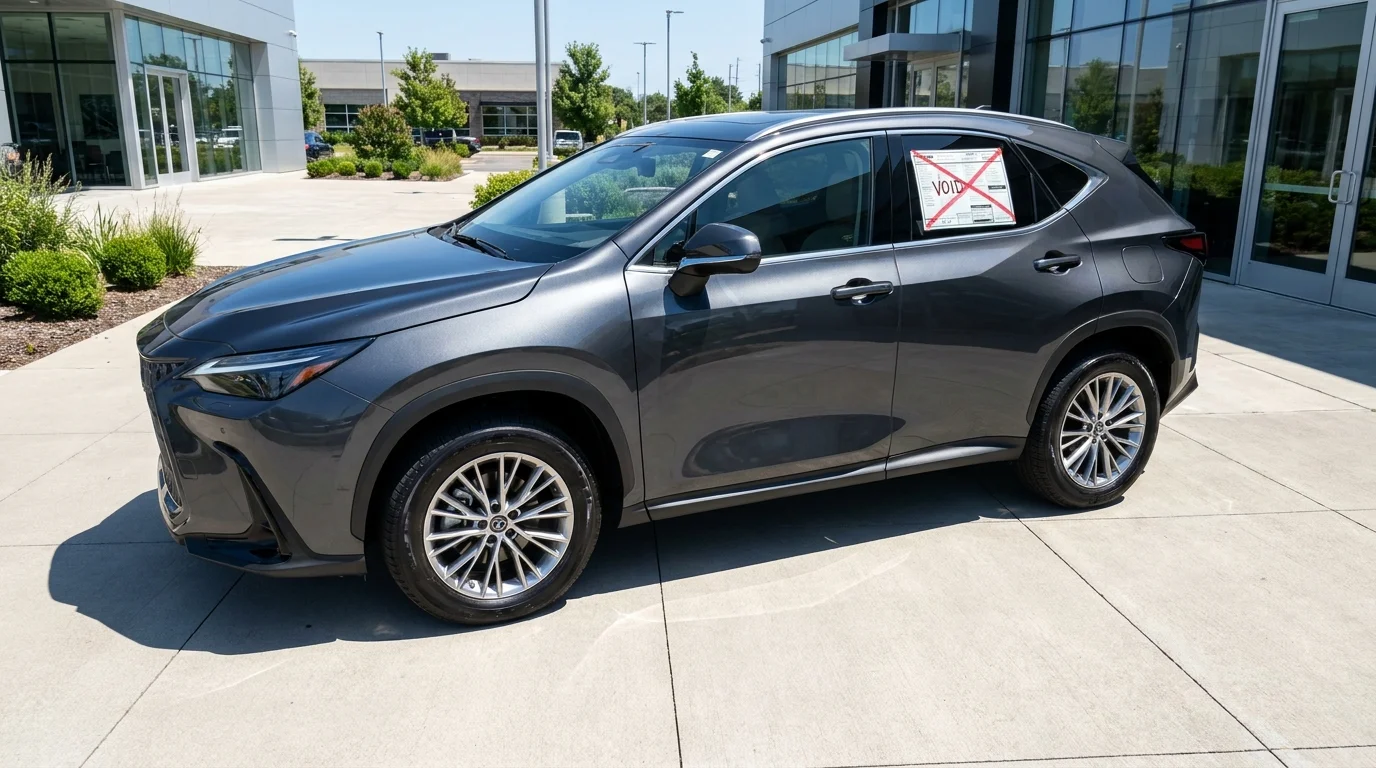
The air inside a dealership finance office always carries the faint, sterile scent of fresh copier paper and cheap leather cleaner. You sit in a low-backed chair, listening to the monotonous hum of a laser printer churning out endless pages of legal-sized documents. Outside, on the showroom floor, the shiny SUV you spent three hours test-driving sits under the spotlights, its windshield bearing a laminated dealership add-on window sticker marked out in red ink, signaling thousands of dollars in unavoidable dealer accessories.
For decades, this room has been the final, most exhausting gauntlet of the car-buying experience. The finance and insurance manager, often the highest-paid employee in the building, greets you with a warm smile and a digital menu of protective coatings, extended warranties, and security systems. In today’s high-interest market, where monthly payments are already stretched to the breaking point, these high-margin additions can quietly turn a reasonable purchase into a financial nightmare.
Most buyers enter this space feeling defensive, armed only with advice from internet forums and a resolve to just say no. But without structural leverage, you are fighting an uphill battle against professionals trained to bypass your boundaries. The true genius of the Costco Auto Program lies not in the modest discount off the vehicle’s sticker price, but in how it completely changes the power dynamic inside this high-pressure room.
The Trojan Horse of the Finance Box
To understand why this system works, you must shift your perspective from the sticker price to what insiders call the backend. Dealerships routinely treat the vehicle’s invoice price as a loss leader, fully intending to recover their profit margins through high-margin add-ons sold after you agree to buy the car. **The backend is where the real margin hides**, tucked away in clean, monthly payment adjustments that sound like pocket change but add up to thousands over a five-year loan.
When you use a wholesale club program, you are not just walking in with a coupon; you are arriving with a corporate legal department backing you up. Costco does not negotiate on your behalf in real-time; instead, they establish strict, pre-negotiated contracts with participating dealers long before you ever set foot on the lot. These contracts govern not only what the dealer can charge for the car, but more importantly, what they are strictly forbidden from selling you in the back room.
This framework acts as an invisible shield. By turning the dealer’s standard operating procedure upside down, the program strips the finance manager of their most aggressive sales tools, forcing them to treat you as a corporate account client rather than a target for spontaneous retail markups.
- Used Toyota Tacoma frames hide a silent rust indicator behind the leaf springs
- Jeep Wrangler 4xe hybrid battery placement brutally outmaneuvers heavy full electric off-roaders
- Volvo S90 depreciation curves deliver Bentley comfort for used Honda Civic money
- Kia Telluride EX trims secretly pack the identical acoustic glass as luxury editions
- 2025 Ram 1500 design changes quietly sacrifice underhood storage for massive intercooler piping
The Shared Secret from the Finance Desk
Consider the experience of Marcus Vance, a 47-year-old former dealership finance director who spent nearly two decades structuring these very deals in Atlanta. “When a standard customer walked into my office, my goal was to add at least fifteen hundred dollars in backend products,” Marcus explains. “But when a buyer came in with a certified Costco sheet, my hands were tied. We signed an agreement with the program that barred us from forcing nitrogen-filled tires, window etching, or fabric sealants onto the contract. If we violated those terms, we risked losing our entire partnership with the program, which sent us dozens of pre-screened buyers every month. It simply wasn’t worth the risk.”
The Three Direct Protections of the Buying Program
1. The Zero-Tolerance Add-On Rule
Standard dealership practice involves pre-installing low-cost accessories like wheel locks, mudguards, and nitrogen gas in the tires, then charging a 500% markup on the window sticker. **These pre-installed items are completely non-negotiable** under normal circumstances, with sales staff claiming they cannot be removed from the vehicle. Under the wholesale program rules, however, participating dealers are expressly prohibited from requiring these items as a condition of sale. If you do not want the nitrogen tires or the paint protection film, the dealer must either remove the charge or absorb the cost themselves.
2. Pre-Negotiated Extended Warranty Limits
Extended service contracts and gap insurance are notorious profit engines, often marked up by thousands of dollars over their actual cost. The program tackles this by capping the maximum allowable markup on these protection plans. When you are presented with the warranty menu, the prices you see are pre-screened and pre-regulated, saving you from the exhausting back-and-forth negotiation that usually characterizes this stage of the process.
3. The Elimination of Document Fee Padding
While some states regulate documentation and processing fees, others allow dealers to charge whatever the market will bear, with some fees climbing past eight hundred dollars. The program establishes a clear, pre-negotiated cap on these administrative costs. **This prevents the dealer from shifting profits** from the sales price into artificial backend fees, ensuring that the savings you see on paper are the savings you actually get at signing.
How to Deploy Your Wholesale Shield
Executing this strategy requires a quiet, methodical approach. You do not need to raise your voice or engage in tense debates; you simply need to let the pre-negotiated system do the heavy lifting for you.
To ensure a flawless transaction, follow these precise tactical steps during your visit:
- Generate your authorization certificate online before visiting the dealer, and keep a physical copy in your pocket until after the test drive is complete.
- Request the official pricing sheet from the designated program contact at the dealership; this sheet shows the pre-negotiated price and any excluded add-on fees.
- Audit the final finance contract line-by-line, matching the numbers directly to your certified program printout.
Keep a physical copy of your member guidelines on the desk during the signing process. This silent visual cue lets the finance manager know you understand the rules of engagement and are prepared to report any contract variations back to the program administrators.
The Tactical Toolkit: Forbidden Dealer Add-Ons
Use this quick-reference list of common dealer add-ons that the program’s strict backend rules prevent dealers from forcing onto your purchase agreement:
- Nitrogen-Filled Tires: Frequently billed at $299; cost to the dealer is pennies per tire.
- VIN Etching: A security marking on the glass often priced at $399; DIY kits cost under $30.
- Paint and Fabric Sealants: Billed as permanent protection for $899; essentially a quick spray-on detailer.
- Third-Party Tracking Systems: GPS locators marked up to $999; modern vehicles already have built-in telematics.
Reclaiming Peace at the Negotiation Table
The true value of this structured buying path is not the money you save on the base price of the car. Rather, it is the profound sense of relief that comes from knowing you are no longer the underdog in a highly calculated game of sales psychology. By leveraging the collective buying power of millions of members, you step into the dealership not as an isolated target, but as a protected corporate partner.
When you drive off the lot, the vehicle feels entirely different. There is no lingering regret, no nagging suspicion that you were quietly taken advantage of in the final minutes of the transaction. You paid a fair, transparent price, kept the finance office from dipping into your savings, and reclaimed control over one of the largest financial decisions of your household budget.
“The strongest weapon in any retail negotiation is not your ability to argue, but the presence of an institutional contract that protects your interests before you even walk through the door.”
| Key Point | Standard Dealership Practice | The Buying Program Protection |
|---|---|---|
| Pre-Installed Accessories | Forced markups on wheel locks, mudguards, and paint protectants. | Dealers cannot require these items as a condition of your purchase. |
| Extended Warranties | Unregulated prices marked up to maximize finance office commissions. | Pre-negotiated caps on warranty markups and service contracts. |
| Dealer Document Fees | Inflated administrative charges added at the final signing desk. | Strict caps on processing fees depending on local market rules. |
Frequently Asked Questions
Can I use this program at any dealership near me?
No, you must visit an authorized, participating dealer that has signed a contract with the program to guarantee these specific pricing and fee protections.
Does this program guarantee the absolute lowest price possible?
While you might occasionally negotiate a slightly lower price on your own through hours of stressful haggling, the program offers a highly competitive price without the associated finance-room pressure.
Can the dealer refuse to show me the pre-negotiated pricing sheet?
No, participating dealers are contractually obligated to show you the official program pricing sheet upon request during your visit.
Are manufacturer incentives and rebates still valid with this program?
Yes, all national manufacturer incentives, low-interest finance rates, and lease specials can be combined with your program pricing.
What should I do if a dealer tries to force an add-on anyway?
You should immediately contact a program representative to report the violation; the dealer faces severe penalties and loss of program certification for non-compliance.