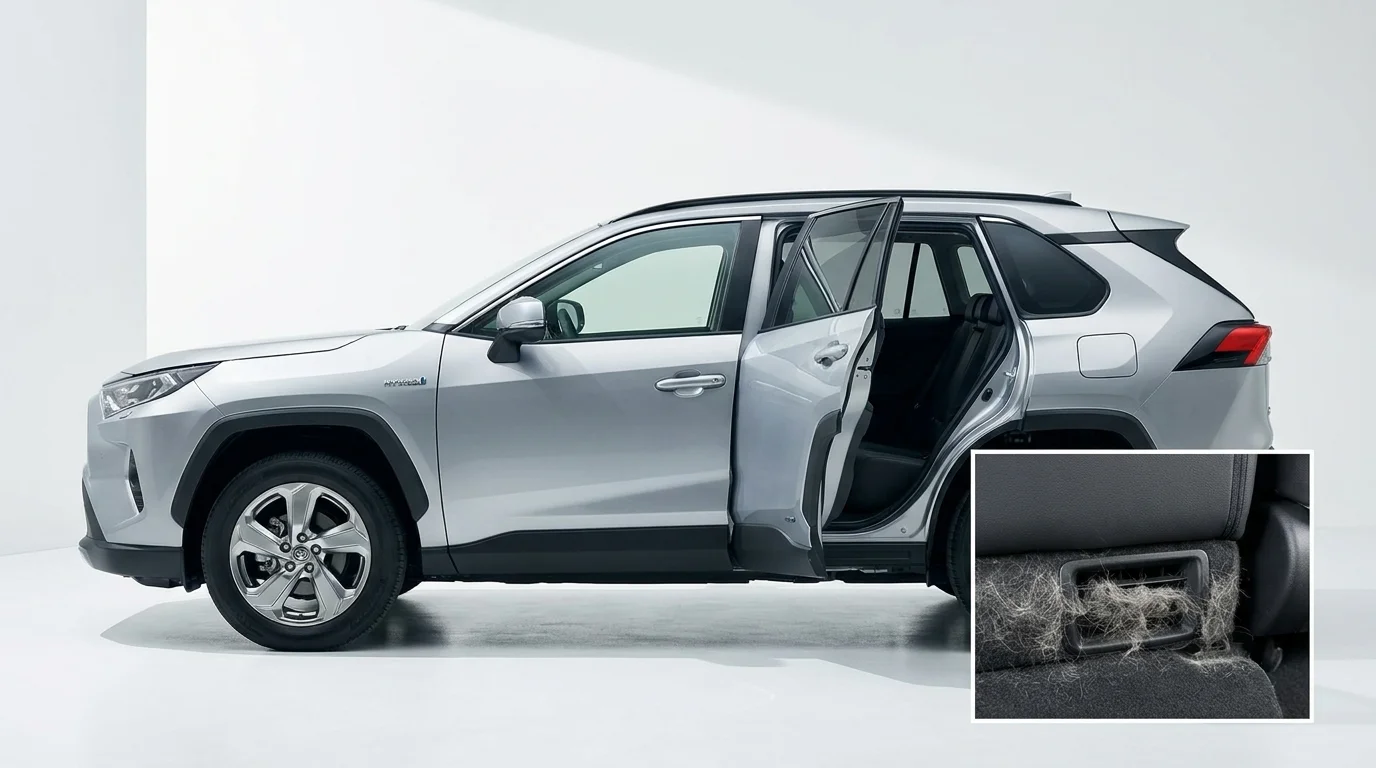
The faint scent of warm plastic and dog shampoo hangs in the air of your midsize crossover. On an eighty-degree afternoon in Ohio, you notice the gasoline engine of your Toyota RAV4 Hybrid kicking on far earlier than usual at stoplights. There is no warning light on the dashboard, nor is there any troubling rattle from under the hood. Just a subtle, high-pitched whirring sound emanating from somewhere behind your right shoulder, beneath the rear seats, struggling to find its rhythm.
You reach your hand down to the floorboards, sliding your fingers under the cushion of the rear passenger side. Instead of smooth plastic, your fingertips brush against a fuzzy, felt-like barrier. A dense mat of grey pet hair and carpet dander has formed a perfect seal over the small plastic vent designed to keep the hybrid system cool. Without realizing it, you have been forcing your battery pack to run a marathon while breathing through a wool blanket.
This silent blockage is the beginning of a slow, expensive decline. While modern crossovers are built to endure years of neglected oil changes and dirty roads, the delicate thermal balance of a hybrid powertrain is far less forgiving. The air intake grate is your battery’s only lifeline, and it is positioned exactly where dirt, pet dander, and forgotten french fries gather to rest.
The Suffocation of the Everlasting Battery
Modern dealerships often promote the idea of zero-maintenance hybrid components, leaving buyers to believe that the battery system is a sealed, self-preserving vault. In reality, the nickel-metal hydride or lithium-ion packs in your vehicle behave exactly like a hard-working athlete. They require constant, cool cabin air to maintain their optimal operating temperature. The lifetime filter myth suggests you never have to touch these vents, yet ignoring them leads to a quiet phenomenon known as thermal throttling.
When the intake grate under the rear seat is clogged, the battery management system detects a rapid rise in operating temperatures. To prevent a catastrophic meltdown, the onboard computer quietly reduces the amount of electrical assist delivered to your wheels. Your gas engine is forced to labor harder, your fuel economy plummets by three to five miles per gallon, and the battery cells degrade at an accelerated pace—all without ever triggering a single check-engine light.
- Kia EV9 Light trims completely match the costly GT line suspension
- 2027 AMG GLS 63 features abandon signature twin turbos for hybrid weight
- Garmin Dash Cam hardware codes instantly bypass standard collision claim denials
- Volvo S90 depreciation hands buyers flawless Scandinavian luxury under twenty thousand
- GM Super Cruise phantom braking targets specific metallic highway overpasses
A Hidden Word from the Service Bay
Marcus Vance, a forty-seven-year-old independent hybrid specialist based in Chicago, spends his days diagnosing older crossovers that have mysteriously lost their fuel-sipping efficiency. “Owners come in convinced their hybrid pack is dying and that they need to spend thousands of dollars on a replacement,” Marcus explains, holding up a clogged plastic bezel coated in golden retriever fur. “Nine times out of ten, the battery modules are perfectly fine. They are simply suffocating because the owners did not know this little five-dollar mesh screen existed under their passenger seat.”
Tailoring Your Airflow Defense: Lifestyles and Dust Loads
For the Multi-Pet Household
If you regularly travel with shedding companions, your hybrid system requires immediate, monthly attention. Loose fur floats along the floorboards and is vacuumed directly toward the intake grate whenever the cooling fan runs. Checking this vent weekly prevents pet hair from weaving itself into the delicate mesh fibers, keeping your cooling passages open and your hybrid battery running cool.
For the Dusty Commuter
Drivers who frequent rural gravel roads or live in arid regions face a different enemy: fine, powdery silt. This dust bypasses the coarse outer plastic grate and settles directly onto the internal cooling fan blades. Over time, this microscopic grit acts like fine sandpaper, slowing down the fan and causing silent thermal buildup during long summer drives.
For the Clean-Cabin Minimalist
Even if you rarely carry passengers or pets, domestic dust and clothing fibers naturally settle on the rear floorboards. Over fifty thousand miles, this debris forms a thin, grey membrane over the filter mesh. A quick inspect-and-wipe schedule during your routine oil changes is all it takes to guarantee unrestricted airflow for another decade of driving.
Mindful Cleansing: Your Hybrid Vent Protocol
Keeping your hybrid system breathing freely does not require a trip to the dealership or a toolbox full of specialized instruments. It is a simple, ten-minute act of preventive care that protects your vehicle’s long-term resale value and operational health.
- Locate the small, rectangular plastic grille located on the vertical plastic trim beneath the rear seat cushion on the passenger side.
- Use a soft-bristle nylon brush to gently sweep away loose surface debris, brushing downward to avoid pushing dirt deeper into the grate.
- Run a vacuum crevice tool along the slats to extract any embedded pet hair or dust bunny remnants.
- For deeper cleaning, gently pop off the plastic outer bezel using a non-marring trim tool to wash the internal mesh screen under warm tap water.
- Allow the screen to dry completely before snapping it back into place, ensuring no moisture enters the battery compartment.
Your Tactical Toolkit: Keep a soft-bristle brush, a high-power handheld vacuum, a plastic trim removal tool, and a replacement OEM mesh filter element (Part No. G92DH-42010) in your garage cabinets for seasonal maintenance.
True Longevity Lies in the Micro-Habits
We often look for grand, expensive solutions to maintain our vehicles, assuming that durability is bought at the service counter. Yet, the real secret to keeping a hybrid crossover on the road past the two-hundred-thousand-mile mark is found in these tiny, overlooked details. By understanding the physical needs of your vehicle’s battery, you preserve its efficiency and protect your wallet from premature repairs. A clean intake vent is a quiet promise of reliability, ensuring your crossover continues to run as quietly and efficiently as the day you brought it home.
“A hybrid battery is only as durable as its cooling fan’s access to clean, cool cabin air.” — Marcus Vance
| Key Point | Detail | Added Value for the Reader |
|---|---|---|
| Identify the Grate | Under-seat plastic air intake bezel | Prevents premature battery cell degradation and drop in fuel economy. |
| Clean Frequency | Every 5,000 miles or monthly with pets | Saves thousands on battery diagnostics and replacement costs. |
| Part Replacement | Replace mesh filter (G92DH-42010) if damaged | Restores factory-spec airflow without expensive dealership labor fees. |
Frequently Asked Questions
Will cleaning my own hybrid battery filter void my vehicle’s manufacturer warranty?
No, cleaning or replacing the external mesh filter screen is considered user-level maintenance and will not void your warranty. In fact, keeping the air pathways clear actively prevents heat-related damage that might not be covered under warranty if neglect is proven.How do I know if my hybrid battery is already experiencing thermal throttling?
If you notice your gas engine running continuously, your fuel economy dropping suddenly, or the hybrid battery charge indicator on your dashboard fluctuating wildly without a clear cause, your cooling system is likely restricted and forcing the battery to limit its performance.Can I run my hybrid crossover without the plastic mesh filter installed?
No, running the system without the mesh filter allows large debris, pet hair, and dust to settle directly onto the internal cooling fan blades and battery modules, which requires a highly expensive, professional teardown to clean.Why doesn’t the dealership clean this filter during standard scheduled maintenance?
Many standard maintenance schedules only focus on engine oil, cabin air filters, and tire rotations, often classifying the hybrid battery cooling path as a lifetime component that only gets inspected when a diagnostic trouble code is triggered.Are aftermarket high-flow hybrid filters safe to use on my vehicle?
It is highly recommended to stick with OEM Toyota replacement filters, as aftermarket units may use thicker foam or different mesh densities that restrict air volume, inadvertently causing the exact thermal throttling you are trying to prevent.