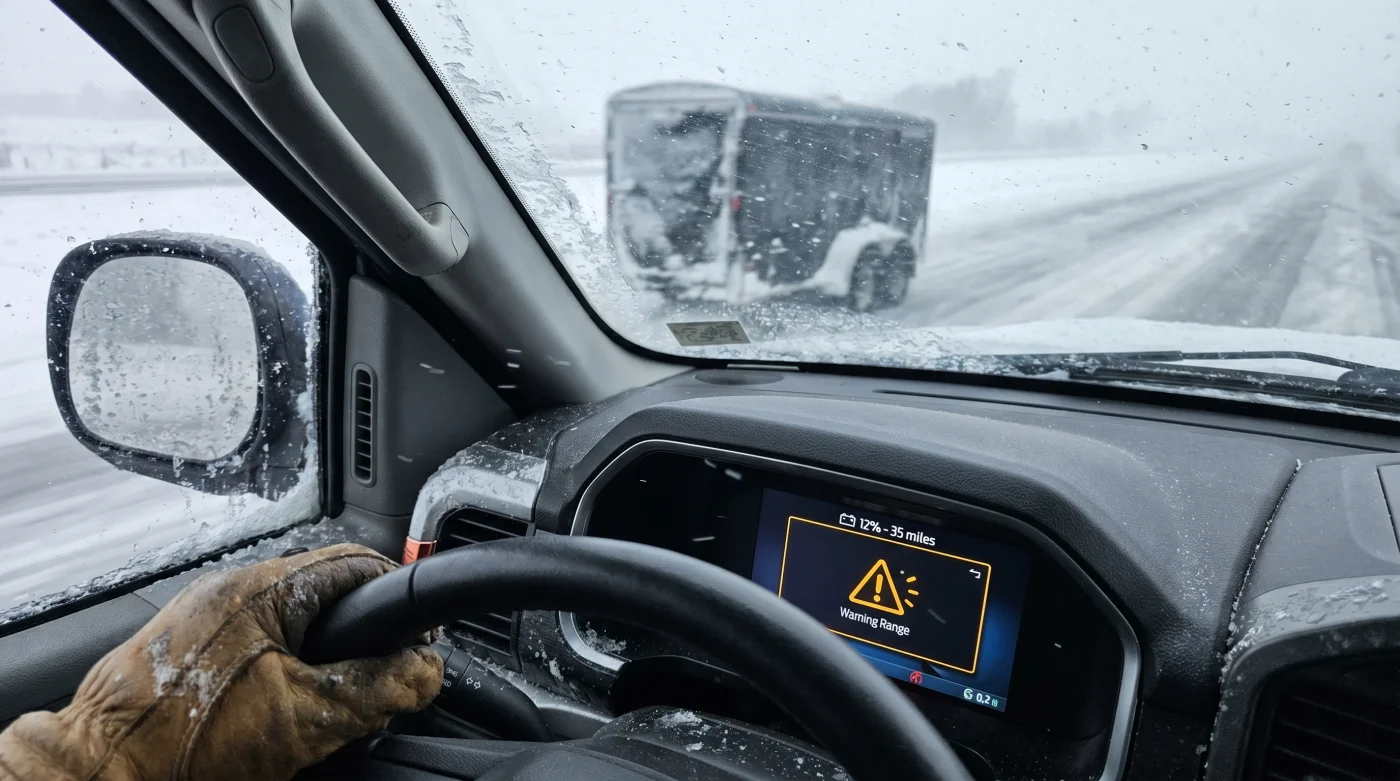
The air in northern Minnesota doesn’t just feel cold; it feels heavy, like a wet wool blanket pressed against your chest. You climb into the cab of your Ford F-150 Lightning, the door seal giving a sharp, icy crack as it breaks free from the frame. Inside, the screen glows with a crisp, digital promise of 230 miles. But as you hitch up the 5,000-pound dual-axle trailer, the air suspension hisses, and the heater begins to fight the 10-degree frost creeping across the windshield.
There is a specific silence to an electric truck in the winter, a lack of the rhythmic vibration you’d expect from a PowerStroke diesel. You pull onto the interstate, the tires crunching over packed salt and grit. By the time you hit sixty-five miles per hour, that 230-mile promise starts to dissolve. The battery isn’t just powering the wheels; it’s fighting a war on three fronts: aerodynamic drag, the mass behind you, and a chemical slowdown that turns electricity into a scarce resource.
You realize quickly that the ‘full tank’ you started with is behaving more like a leaky bucket. The estimated range indicator—the ‘GOM’ or Guess-O-Meter—begins to tumble in ten-mile chunks while you’ve only traveled three. It’s a visceral moment of loss aversion; you aren’t just driving, you are watching your freedom evaporate in real-time.
The Chemical Tax: Why Electrons Hate the Frost
Think of your battery pack not as a fuel tank, but as a living organism. When the mercury drops below zero, the liquid electrolyte inside the cells becomes sluggish, like pouring cold maple syrup. It struggles to move ions back and forth. When you demand high power to pull 5,000 pounds against a headwind, the battery has to spend a massive portion of its energy just to keep itself warm enough to function.
- Gasoline shelf life searches surge as drivers hoard fuel during unexpected regional shortages
- Ford Maverick Lobo street truck debut sparks an immediate factory allocation shortage
- Gasoline market shifts trigger a sudden surge in premium high-octane fuel pricing nationwide
- Ford Maverick hybrid inventory vanishes overnight as dealership markups surge past ten thousand dollars
- Subaru Forester symmetrical all-wheel drive maintenance proves significantly cheaper if differential fluid flushes occur early
This isn’t a mechanical failure; it’s a fundamental shift in the system’s logic. In a traditional gas truck, waste heat from the engine is free energy used to warm the cabin. In your Lightning, every degree of cabin heat is a mile stripped from your journey. You are no longer just a driver; you are a thermal manager, balancing the comfort of your toes against the distance to the next high-speed charger.
Elias, a 52-year-old landscape architect from Bozeman, found this out during a late-October cold snap. He was hauling a load of stone pavers—roughly 4,800 pounds—to a job site 90 miles away. He started with an 85% charge, a figure that would usually be overkill. Within 40 miles of highway driving at 70 mph, his remaining range had plummeted to 30%. He had to pull into a grocery store parking lot to hunt for a Level 3 charger, his schedule for the day ruined by a reality the glossy brochures didn’t emphasize.
The Three Profiles of Winter Hauling
Not every Lightning owner faces the same cliff. The impact of sub-zero towing depends heavily on your ‘load profile’ and how you treat the truck before the tires even move.
The Pre-Conditioned Purist: This driver leaves the truck plugged into a Level 2 home charger until the very second they depart. They use the FordPass app to ‘schedule’ their departure, allowing the house’s electricity to warm the battery and the cabin. By starting with a ‘warm heart’, they can recover about 10-15% of the range otherwise lost to thermal management.
The High-Speed Commuter: Aerodynamics are the silent killer of EV range, and towing doubles the penalty. If you insist on keeping pace with traffic at 75 mph in sub-zero temps, your range will drop by as much as 70 percent compared to unladen summer driving. The trailer acts like a parachute, and the cold air is denser, requiring more force to punch through.
The Rural Workhorse: For those moving heavy loads at 45-55 mph on backroads, the news is better. The lower speeds significantly reduce air resistance. While the cold still bites, the ‘drain rate’ stabilizes. These users find the Lightning still serves as a viable tool, provided the round trip stays within a 70-80 mile radius.
Navigating the 5,000-Pound Reality
To survive a winter tow without a tow-truck intervention, you must adopt a minimalist mindset. It’s about surgical precision rather than brute force. If you are pulling a 5,000-pound trailer in 0-degree weather, you are effectively driving a vehicle with a 80-90 mile total range.
- Limit top speed to 62 mph. The difference in consumption between 62 and 75 is the difference between making it home and calling for a flatbed.
- Use the seat heaters. They are significantly more efficient than the cabin’s forced-air heater. Think of it as heating the person, not the room.
- Route for chargers, not distance. Use apps that account for elevation and temperature. A ‘short’ route over a mountain pass is a range-killer.
- Inflate to the max. Cold air shrinks the pressure in your tires and the trailer’s tires. Low pressure adds rolling resistance you cannot afford.
The tactical toolkit for this environment is small: a heavy parka (so you can keep the cabin at 62 degrees), a high-quality tire pressure gauge, and a deep understanding of your route’s charging infrastructure. Efficiency is your only currency in the sub-zero highway lane.
The Reality of the Do-It-All Machine
Mastering the cold-weather tow isn’t about proving the EV skeptics wrong; it’s about aligning your expectations with the current state of battery chemistry. We’ve been conditioned by a century of internal combustion to believe that ‘more work’ just means ‘more fuel’, and that fuel is available on every corner. The Lightning changes that contract. It asks you to be more mindful, more prepared, and more aware of the environment around you.
There is a quiet satisfaction in navigating a blizzard with a 5,000-pound load, knowing exactly how much energy you have left because you’ve respected the physics of the frost. It forces a slower, more intentional pace of life. While the range drop is a stark reality, the clarity it provides about your vehicle’s true capabilities is the most valuable tool in your shed. You aren’t losing range; you are gaining a deeper expertise in the future of transport.