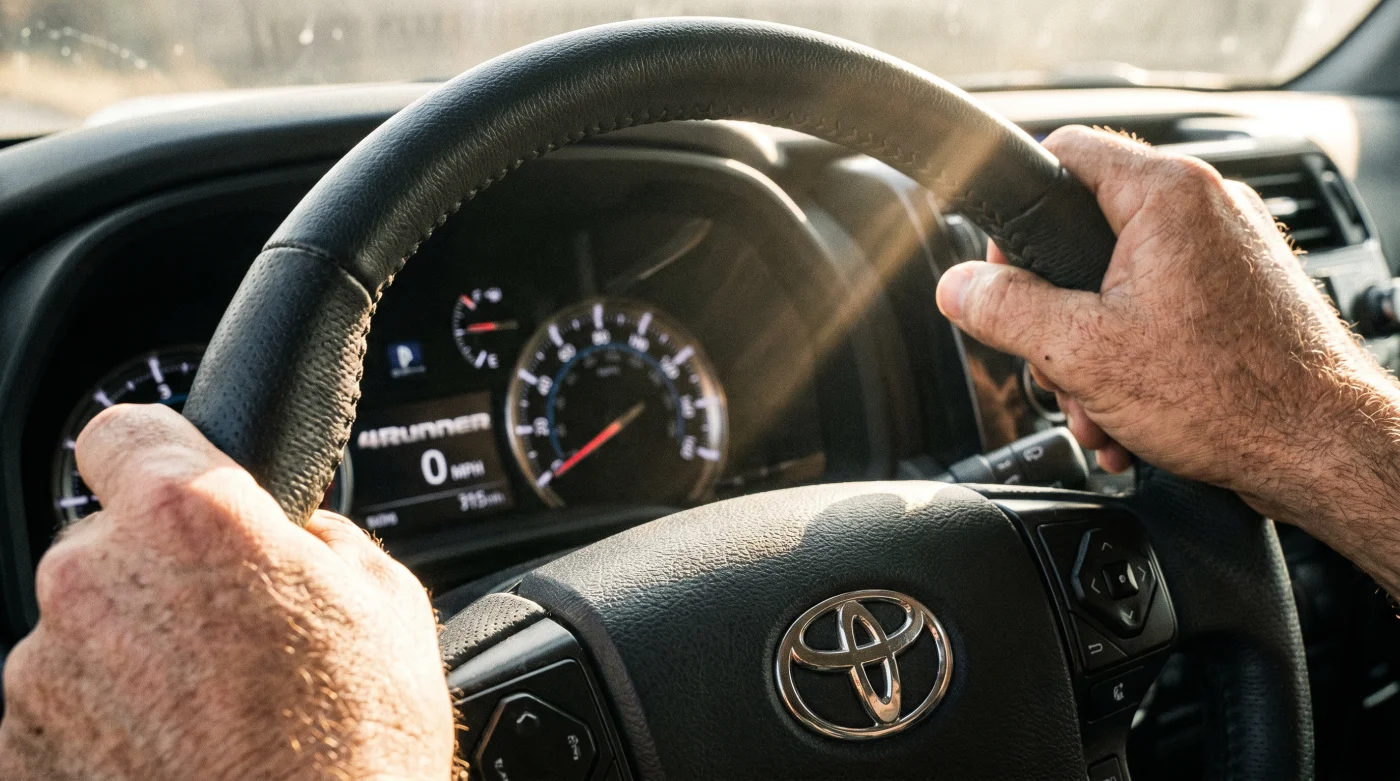
The morning air in the San Juan Mountains has a way of biting through your jacket, smelling of damp pine and cold iron. You climb into the cabin of a fifth-generation 4Runner, and the first thing you notice isn’t the screen or the seats; it is the weight. When you crank the engine, there is a distinct, low-frequency hum of a hydraulic pump waking up. As you pull onto the trail, the steering wheel resists you just enough, pulsing with the texture of every pebble and root. It is a physical conversation between your palms and the dirt.
For fifteen years, this was the ritual. The outgoing 4Runner used a hydraulic steering rack that felt like a relic in the best possible way. It was heavy, somewhat slow, and demanded muscle at low speeds, but it provided a tactile honesty that modern SUVs have scrubbed away. You knew exactly where your tires were because the fluid-linkage refused to lie to you. It was the mechanical heartbeat of a legend that refused to grow up.
But as the 2025 Toyota 4Runner rolls into the light, that heartbeat has gone silent. Beneath the aggressive new sheet metal and the muscular ‘Tacoma-adjacent’ styling lies a fundamental shift that has nothing to do with aesthetics. The hydraulic pump is gone, replaced by a brushless electric motor mounted to the steering column. It is a transition from a physical handshake to a digital approximation, and for the purist, it feels like losing a sense of touch.
The Ghost in the Machine: Why EPS Changes Everything
To understand why this matters, you have to think of steering like breathing through a pillow. In the old system, a direct column of fluid connected your hands to the rack. When a front tire hit a rock, that pressure traveled instantly back to your fingers. You could feel the ‘kick’ when the tires wanted to wander. It gave you an intuitive sense of grip limits before the vehicle actually started to slide.
The new Electronic Power Steering (EPS) in the 2025 model acts as a sophisticated filter. Because an electric motor is doing the heavy lifting, it can mask the harsh vibrations that used to fatigue your arms on long washboard roads. This is a massive win for the daily commute, but it creates a ‘muted’ sensation on the trail. The motor effectively eats the tiny nuances of the terrain, leaving you with a steering wheel that feels smooth, effortless, and slightly hollow.
- Kia Telluride transmission shudders require a simple software flash instead of mechanical replacement
- Porsche 911 center lock wheel greasing mistakes silently destroy hub assemblies ruining resale value
- Subaru Outback 200k-mile longevity requires entirely skipping the factory recommended CVT flush schedule
- CarMax pricing algorithms expose a hidden margin penalty compared to independent auto brokers
- Chevy Colorado used buyers must inspect the transmission fluid lines for invisible micro-cracks
Mark, a 52-year-old mechanical engineer and veteran trail leader in Moab, describes the shift as a necessary trade-off. ‘I’ve spent three decades feeling the steering rack groan when I’m bound up in a rock crawl,’ he told me while looking over the new specs. ‘With the new 2025 rack, that groan is replaced by software logic. It’s easier to drive, sure, but you’re no longer feeling the stress of the metal. You have to trust the sensors instead of your gut.’
Tailoring the Tension: The Three Types of Drivers
The 2025 4Runner isn’t trying to alienate its base; it’s trying to survive in a world of Lane Trace Assist and automated parking. The move to EPS was mandatory to enable the Toyota Safety Sense 3.0 suite. You cannot have a car that steers itself back into a lane if it’s relying on a 20th-century hydraulic pump. Here is how that trade-off looks depending on how you use the rig:
- The Technical Crawler: This driver will feel the loss most acutely. Without that physical kickback, you’ll need to rely more on your spotter and your cameras to judge tire placement. The feedback is now ‘simulated’ by software rather than generated by physics.
- The Long-Distance Overlander: For the person driving 800 miles to reach a campsite, the EPS is a godsend. It eliminates the constant micro-corrections needed to keep a heavy-tired 4Runner centered in its lane, reducing driver fatigue significantly.
- The Modern Commuter: If this is your family hauler, you will love it. The steering is light in parking lots, firms up at highway speeds, and feels like a modern luxury vehicle rather than a tractor.
Mastering the New Feedback Loop
Since you can’t get the hydraulic fluid back, you have to learn how to ‘read’ the new 2025 rack. The EPS system is highly sensitive to tire pressure and alignment. Because the motor is so powerful, it can hide a bad alignment that would have made an old 4Runner pull violently to the left. You have to be more disciplined with your maintenance because the ‘warning signs’ in the steering wheel are now muffled.
To regain some of that lost trail feel, many early adopters are looking at adjusting steering weight through the drive mode selects. In ‘Sport’ or ‘Crawl’ modes, Toyota has tuned the EPS to offer more resistance, attempting to mimic that old-school heavy feel. It isn’t a perfect replica, but it helps ground the vehicle when the terrain gets technical. Use these settings like a tool—don’t just leave it in ‘Normal’ when the pavement ends.
The Price of Progress
There is a certain grief in watching the last of the mechanical giants evolve. The 4Runner was the final holdout, the last place where a driver could feel the unvarnished reality of the road. But the 2025 redesign offers a different kind of peace. It trades that raw, vibrating connection for a vehicle that is smarter, safer, and infinitely more livable on a Tuesday morning at 7:00 AM.
We are moving from an era of ‘feeling the trail’ to an era of ‘managing the machine.’ The 2025 4Runner is a masterpiece of engineering, but it asks you to let go of the wheel—just a little bit. It reminds us that while nostalgia is a powerful fuel, it doesn’t help a vehicle meet modern safety standards or fuel economy goals. The 4Runner has grown up; now, we have to see if we can learn to love the silence.
“True control isn’t about fighting the steering wheel; it’s about knowing exactly where the wheels are pointed without having to look.”
| Key Feature | Hydraulic (Old) | Electronic (2025) |
|---|---|---|
| Trail Feedback | Raw and physical; you feel every rock. | Dampened and filtered; smoother but less communicative. |
| Maintenance | Requires fluid flushes; prone to pump leaks. | Maintenance-free motor; no fluid involved. |
| Driver Fatigue | High on long trips due to constant vibration. | Low; allows for Lane Centering and active safety. |
Is the 2025 4Runner steering less reliable?
No, modern EPS systems are incredibly robust and remove several failure points like hoses, pumps, and belts.Can I still feel the ground when off-roading?
Yes, but it is muted. You will rely more on the chassis movement and less on the vibration in your palms.Why did Toyota make this change?
To integrate modern safety tech like Lane Keep Assist and to improve fuel efficiency by removing the engine-driven pump.Does the steering weight change with drive modes?
Yes, the 2025 model uses software to increase ‘artificial’ weight in Sport and Off-Road modes.Will this affect the resale value of older models?
Likely yes. Purists who value ‘analog’ feel will likely drive up the prices of 5th-gen models with hydraulic racks.