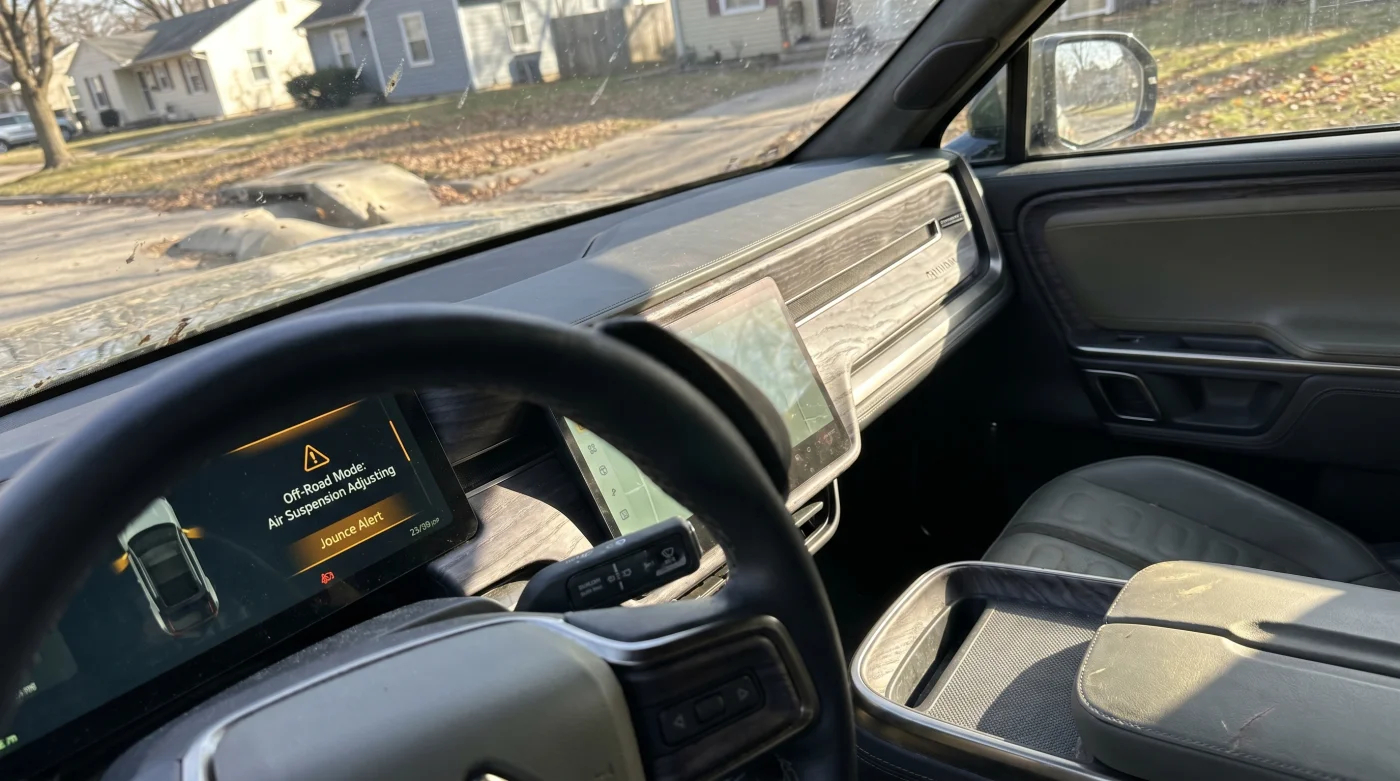
You are gliding through your neighborhood at seven in the morning, the silent hum of your Rivian R1S blending into the suburban stillness. The cabin feels like a high-end Scandinavian living room, all crisp lines and recycled wood. You approach a standard asphalt speed bump, the kind you’ve rolled over a thousand times in your old SUV. You expect the air suspension to swallow the obstacle whole, offering nothing more than a distant, muted thud. Instead, as the front tires clear the crest, the entire 7,000-pound machine kicks back with a violent, unrefined secondary shudder that rattles the coffee in your cupholder.
It feels less like a luxury vehicle and more like a stiff-legged heavy-duty truck. There is a specific mechanical dissonance here: the silence of the electric motor promises a cloud-like experience, but the chassis is fighting the pavement. For many new owners, this is the moment the honeymoon ends and the reality of ‘off-road geometry’ sets in. You realize that while your vehicle can climb a 45-degree rock face in Moab, it struggles to navigate a school zone without making your passengers feel like they are trailing a bucking horse.
The sensation isn’t just a ‘firm ride.’ It is a specific damping anomaly where the vehicle’s brain fails to catch its own weight. When the air springs compress over a bump, the rebound is so aggressive that the R1S overshoots its resting position, leading to a series of micro-oscillations. It feels like the car is breathing through a lead pillow—heavy, constrained, and slightly panicked by sudden changes in elevation. This isn’t a defect in the hardware; it is a philosophy of physics that prioritizes high-speed stability over low-speed grace.
The Paradox of the Heavyweight Athlete
To understand why your $90,000 EV feels jittery on a suburban street, you have to look at the ‘Off-Road Anchor’ metaphor. Most luxury SUVs are tuned for the 99% of time they spend on pavement. Rivian, however, built a mountain goat that happens to look like a family hauler. The suspension is designed to prevent the vehicle from bottoming out during high-speed desert runs or technical crawling. This requires a damping algorithm that is hyper-reactive to sudden compression.
The flaw lies in the ‘Low-Speed Rebound’ logic. When you hit a speed bump at 15 mph, the sensors detect a massive input. The software reacts by stiffening the dampers instantly to control the body’s mass. But because the bump is over so quickly, the system is still ‘holding its breath’ when it should be relaxing. The result is a ride that feels unnecessarily brittle and nervous in the very environments where you want it to be the most invisible.
- Audi Q9 search volume spikes as leaked dimensions threaten the BMW X7
- Malcolm Stewart replica Husqvarna gear debut sparks instant inventory shortages across motocross dealerships nationwide
- Ram 2500 tire speed recall drives a sudden commercial fleet shift toward Ford competitors
- Kia Carnival Hybrid massive demand wipes out nationwide stock overnight as dealer markups surge
- Lexus GX460 decade testing proves why naturally aspirated V8 engines completely eliminate turbo maintenance
The Seattle Software Engineer’s Secret
Elias, a 42-year-old software engineer from Seattle, spent years driving German luxury crossovers before taking delivery of his R1S. He expected the air suspension to mimic the buttery float of his old Mercedes. ‘The first time I took it through my kids’ school parking lot, I thought I had left the shipping blocks in the springs,’ Elias shared during a recent owner gathering. He discovered that the R1S doesn’t just ‘hit’ bumps; it reacts to them emotionally. After weeks of tinkering, Elias found that the vehicle’s ‘All-Purpose’ mode was actually the culprit, as its variable damping was too indecisive for the repetitive frequency of neighborhood traffic calming measures.
Navigating the Adjustment Layers
Your experience with the R1S ride quality depends heavily on how you interact with the drive modes. The truck is essentially three different vehicles trapped in one body, and the ‘Default’ setting is rarely the most comfortable. You have to manually override the logic to find the sweetness in the chassis.
- For the Daily Commuter: Switch to ‘All-Purpose’ but manually set the ride height to ‘Standard.’ If you go too low, you lose the air volume in the bags, making the ride even harsher.
- For the Motion-Sickness Prone: Surprisingly, setting the dampers to ‘Firm’ can sometimes feel better than ‘Soft.’ In ‘Soft’ mode, the R1S wallows and bounces longer after the bump, which is what actually triggers nausea.
- The Tire Pressure Factor: Rivian recommends a staggering 48 PSI for the 21-inch wheels. Dropping this to 44 PSI (while staying within safe margins) allows the sidewalls to act as a primary filter for those sharp neighborhood jolts.
The Mindful Approach to the Rebound
Improving the ride quality is a series of minimalist actions. You cannot rewrite the code, but you can change the physical inputs the sensors receive. Mastering the R1S in the suburbs requires a tactical toolkit of speed and angle. If you approach a speed bump dead-on, you trigger the maximum rebound response from the computer.
Instead, try taking the bump at a slight diagonal. This staggers the input to the suspension, preventing the ‘double-kick’ sensation where both front wheels hit the damping wall simultaneously. You are essentially tricking the algorithm into thinking the obstacle is smaller than it is. Additionally, avoid braking right before the bump. This loads the front suspension, leaving no room for the air bags to travel, which guarantees a bone-jarring impact.
The Bigger Picture: A Trade-off for Capability
At the end of the day, the R1S ride quality is a reflection of its ambition. We are living in an era where we expect vehicles to be masters of every domain, from the drag strip to the Rubicon Trail. But physics is a stubborn bookkeeper. To give you the 14 inches of ground clearance and the 800-horsepower stability you crave, Rivian had to sacrifice the pillowy gait of a traditional luxury car. Mastering this detail doesn’t mean the car is broken; it means you are learning the language of a specialized tool. When you stop fighting the suspension and start working with its rhythmic quirks, the R1S becomes a much more predictable companion for the long haul.
“The most advanced suspension in the world still can’t hide 7,000 pounds of mass from a four-inch piece of asphalt if the software is expecting a boulder.”
| Key Point | Suburban Reality | Added Value for the Reader |
|---|---|---|
| Damping Logic | Aggressive low-speed rebound causes ‘kicking’. | Manual ‘Firm’ settings often reduce post-bump wallow. |
| Ride Height | ‘Low’ settings reduce air cushion volume. | Keeping height at ‘Standard’ improves vertical compliance. |
| Tire Pressure | High PSI (48) makes the rubber feel like rock. | A slight reduction (to 44-45 PSI) softens the initial impact. |
Is the R1S ride quality objectively ‘bad’? No, it is ‘specialized.’ It feels harsh compared to a Range Rover because it lacks the same level of low-frequency damping refinement.
Can a software update fix the speed bump bounce? Yes, Rivian frequently adjusts damping maps via Over-The-Air (OTA) updates to smooth out these specific ‘rebound’ events.
Do the 20-inch All-Terrain tires ride better than the 22s? Absolutely. The extra sidewall on the 20-inch wheels acts as a natural shock absorber that no software can replicate.
Why does the car feel ‘nervous’ at 25 mph? The system is constantly calculating for high-speed stability, making it over-sensitive to small road imperfections at neighborhood speeds.
Should I use ‘Conserve’ mode in the city? Avoid it for comfort. ‘Conserve’ lowers the car and stiffens the front, making the ride significantly more brittle on uneven pavement.