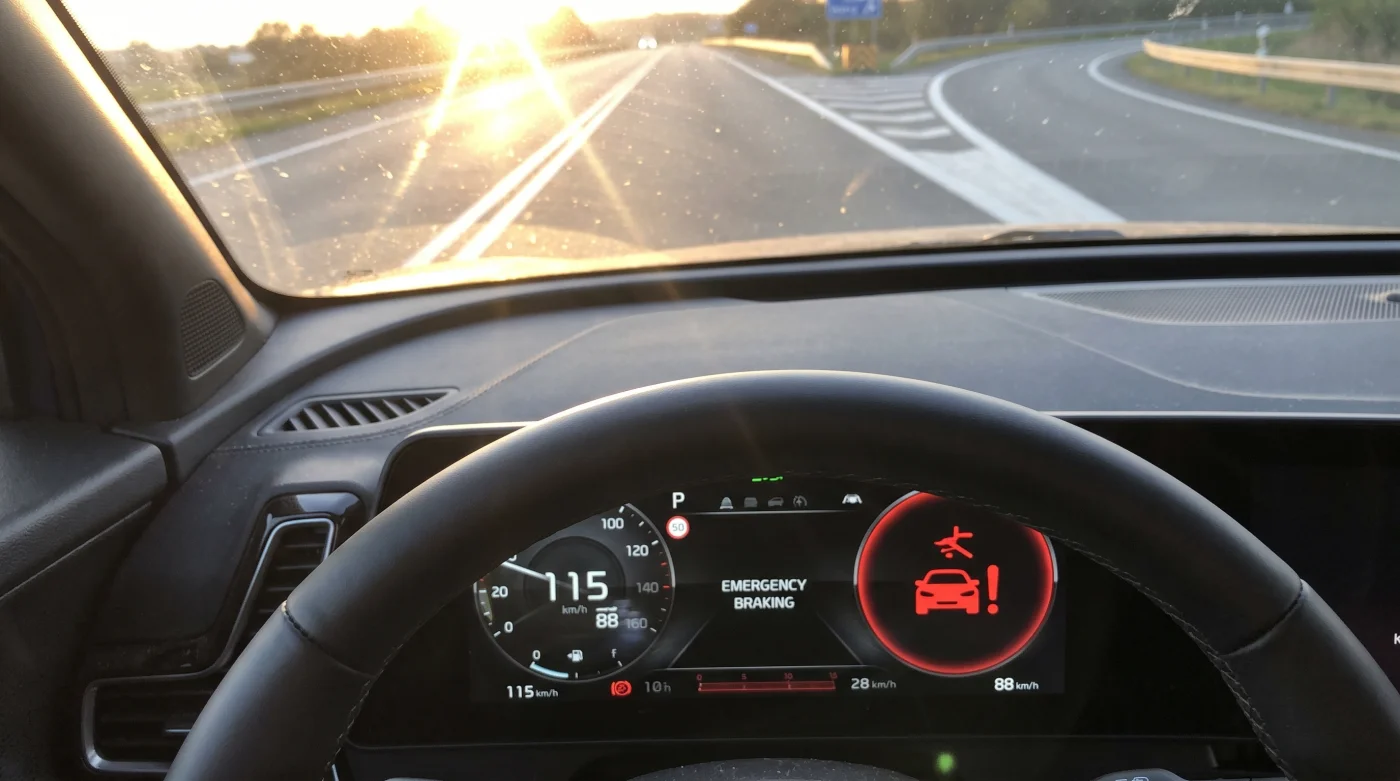
The morning commute on the 405 feels like a soft, rhythmic hum. You lean back into the perforated leather of your Kia EV6, the steering wheel performing its microscopic dances under the guidance of Highway Driving Assist. The cabin is a sanctuary of silence, save for the faint whir of the electric motors. The sun hangs low in the sky, casting long, amber shadows that stretch across the asphalt like spilled ink. It is the kind of drive that lulls you into a state of quiet confidence, a belief that the machine sees the world more clearly than you ever could.
Then, without a whisper of warning, the peace shatters. As you approach the tapering lines of a highway exit, the **seatbelt yanks your chest** and the nose of the car dives. There is no vehicle ahead of you, no debris in the path, and no siren blaring. Your heart hammers against your ribs as the speedometer drops twenty miles per hour in a heartbeat. It feels as though the car has slammed into an invisible wall, a momentary mechanical panic that leaves you bracing for a rear-end collision that hasn’t happened yet.
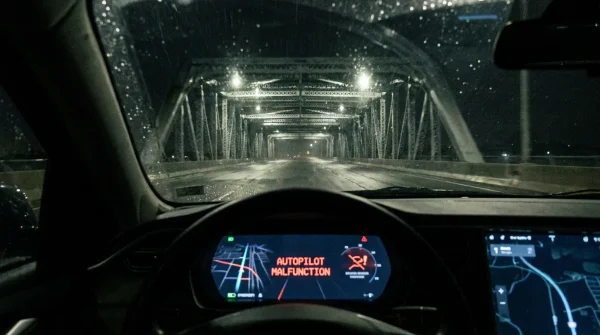
This is the ghost in the code. It isn’t a mechanical failure in the traditional sense; there are no grinding gears or leaking fluids. Instead, it is a failure of perception. The car’s optical systems, usually so adept at tracking the world, have just experienced a digital hallucination. This violent deceleration—known among enthusiasts as phantom braking—is becoming a signature glitch for Kia’s otherwise stellar ADAS suite, specifically when the **environment creates a perfect** storm of visual noise.
The Squinting Eye Metaphor
To understand why your Kia is suddenly terrified of an empty road, you have to imagine the car is a toddler staring directly into a flashlight. The Highway Driving Assist system relies on a marriage between radar and a high-mounted optical camera. When you are cruising toward an exit ramp where the lane markings widen into double-white lines, and the sun is at a specific low angle, the camera starts **breathing through a pillow** of overexposure. The high-gloss paint of those lane markings acts like a mirror, bouncing harsh solar rays directly into the lens.
In that millisecond, the software loses its ability to distinguish between a flat line on the ground and a physical barrier. The sudden flare of white light, combined with the geometric widening of the lane, tricks the processor into thinking a large, stationary object has appeared in your path. The car isn’t being cautious; it is reacting to a mirage. It is a moment where the digital brain decides that the **safest path is immediate** stillness, regardless of the sixty-mile-per-hour reality of the freeway behind you.
- Used EV tax credit loopholes allow buyers to instantly deduct four thousand dollars
- Kia EV9 base models deliver the exact luxury acoustic insulation as premium European SUVs
- Rivian R1S owners expose a harsh ride quality reality over suburban speed bumps
- Audi Q9 search volume spikes as leaked dimensions threaten the BMW X7
- Malcolm Stewart replica Husqvarna gear debut sparks instant inventory shortages across motocross dealerships nationwide
Mark, a 52-year-old optical engineer from Irvine, experienced this four times in a single week. Driving a Kia Telluride, he noticed the braking always occurred at the same three exit ramps between 4:30 PM and 5:15 PM. Being a man who lives by the physics of light, he realized his car wasn’t broken—it was simply blinded. He began recording the incidents, noting that the ‘V’ shape of the exit gore, when hit by the afternoon sun, created a high-contrast ‘wall’ that the software couldn’t parse. This is a secret shared among those who push these systems to their limits: the camera is only as good as the light it consumes.
The Anatomy of the Optical Glitch
The system isn’t failing because it is primitive; it is failing because it is too literal. There are three specific layers to this anomaly that every Kia owner should recognize before they trust the HDA system on a long trek through the desert or down a coastal highway. First, there is the **Geometry of the Gore**. The area where the highway splits to form an exit is often painted with thick, white ‘V’ patterns. These patterns are designed to be highly visible to humans, but to a camera, they represent a massive shift in the expected ‘tunnel’ of the lane.
Second, we must account for the Solar Interference. When the sun is between 15 and 25 degrees above the horizon, the reflection off the glass-beaded road paint is at its peak. This creates a ‘flare’ effect that washes out the depth perception of the front-facing camera. The suspension might be smooth, but the **digital brain makes the** pedal tremble like a nervous hand when it can’t find the horizon line through the glare.
Finally, there is the software’s ‘Safety Bias.’ Kia has tuned their emergency braking to be hyper-reactive. In the world of autonomous programming, a ‘false positive’ (braking for nothing) is considered less dangerous by lawyers than a ‘false negative’ (not braking for a wall). However, for the driver being tailgated by a semi-truck, that false positive feels like a life-threatening error. The car is choosing to **protect you from a** shadow while ignoring the very real kinetic energy of the traffic surrounding you.
Mindful Application: Managing the Machine
You do not need to disable your safety features entirely, but you must learn to drive with a ‘verification’ mindset. Mastering this system requires a series of minimalist actions that keep the car in check when you know a problematic exit is approaching. It is about moving from a passive passenger to an active supervisor of the AI.
- **Maintain Throttle Overlap:** When approaching a known ‘glitch zone’ or an exit ramp during the golden hour, keep your right foot lightly resting on the accelerator. If the car begins to phantom brake, a slight pressure on the gas will override the automatic system and maintain your speed.
- **Adjust Following Distance:** Use the steering wheel controls to set the HDA following distance to its maximum (Level 4). This gives the software more time to process visual data and often reduces the ‘violence’ of its reactions.
- **Clean the Optical Bay:** Ensure the top-center of your windshield, where the camera is housed, is free of salt spray, streaks, or film. Even a tiny smudge can amplify the ‘flare’ effect of the sun.
- **Lane Positioning:** Try to stay in the center-left of your lane when passing an exit ramp. Getting too close to the right-side ‘V’ markings increases the likelihood of the camera misinterpreting the widening lines as an obstacle.
The Tactical Toolkit for this drive includes more than just software. A pair of high-quality polarized sunglasses will help you see the lines more clearly, but remember that the car doesn’t have your ‘polarized’ filter. You must see **what the car sees**—a world of harsh reflections and confusing geometries. If the road ahead looks like a sheet of shimmering silver, assume the HDA is about to blink.
The Bigger Picture
True mastery of a modern vehicle isn’t about knowing which buttons to press; it is about understanding the limitations of the silicon soul under the hood. As we move closer to full autonomy, these ‘anomalies’ serve as a necessary reminder that we are still the ultimate failsafe. The Kia HDA system is a magnificent tool that reduces fatigue and adds a layer of security to mundane trips, but it is not a replacement for human intuition. It cannot feel the ‘wrongness’ of a shadow or the context of a sunset.
When you learn to predict the phantom brake, you regain your peace of mind. You no longer drive with the flinch of someone waiting for a jump-scare. Instead, you navigate the highway with a professional’s grace, knowing exactly when to let the machine lead and when to gently take the reins. Improving your quality of life on the road comes from this balance—respecting the technology enough to use it, but **trusting yourself enough** to know when it is lying to you. The road is a complex, shifting landscape, and while the sensors are fast, your ability to read the light will always be the superior safety feature.
“Modern autonomy is a conversation between human intent and machine logic; the moment you stop talking, the machine starts guessing.”
| Key Point | Detail | Added Value for the Reader |
|---|---|---|
| Solar Flare Effect | Low-angle sun reflects off high-viz white lines into the camera. | Knowing ‘when’ (golden hour) prevents surprise incidents. |
| Gore Geometry | The ‘V’ shape at exit ramps confuses depth-sensing logic. | Identifies ‘where’ the car is most likely to fail. |
| Manual Override | Throttle pressure negates the emergency braking command. | Provides a physical solution to regain control instantly. |
Frequently Asked Questions
Is phantom braking covered under Kia’s warranty? While hardware checks are covered, phantom braking is often classified as a ‘behavioral limitation’ of current software, making it hard to claim as a defect.
Does this happen in rainy or overcast weather? It is less frequent because the ‘flare’ effect is absent, though heavy rain can trigger different sensor-blindness warnings.
Can I turn off the braking part but keep lane centering? Yes, in the vehicle settings, you can often set the Forward Collision-Avoidance Assist to ‘Warning Only’ to prevent active braking.
Which Kia models are most affected? Models using the HDA 1.5 and 2.0 suites, including the EV6, Telluride, and late-model Sorentos, have shown similar patterns.
Will a software update fix this? Kia frequently pushes OTA (Over-The-Air) updates to refine camera logic, but the physical reality of light reflection remains a challenge for all optical-based systems.