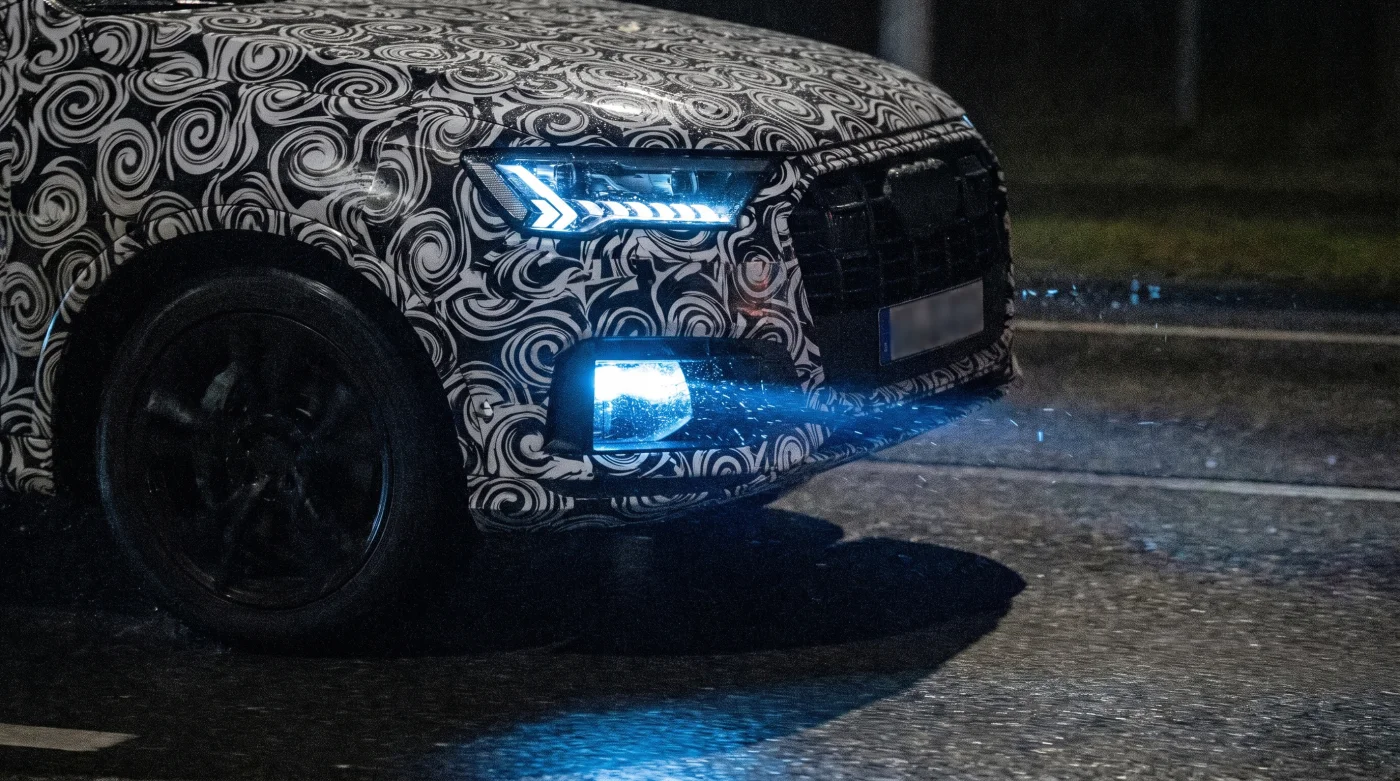
The desert air outside Las Vegas carries a sharp, metallic chill after midnight, the kind that makes the plastic on a dashboard groan as it settles. You sit in the cabin of a prototype, the silence only broken by the distant, rhythmic thrum of tires on expansion joints. For decades, an Audi at night was a lighthouse—a high-set, aggressive stare that carved a white tunnel through the darkness, reaching out to the horizon with the confidence of a predator. But as you flick the high beams on this new Q9 silhouette, something feels fundamentally different. The world hasn’t opened up; it has merely been partitioned.
The light doesn’t bloom from the top of the grille anymore. Instead, the primary illumination sits tucked into the mid-fascia, while a thin, crystalline strip of LEDs flickers at the hood line. It is a stunning visual arrangement, a masterclass in modern aggressive styling that makes the outgoing models look like relics. But as the speedometer climbs toward seventy, a nagging sensation of claustrophobia sets in. The road ahead seems truncated, as if the darkness is pressing down harder than it used to, narrowing your window of reaction to a thin slice of asphalt.
This is the reality of the ‘split-headlight’ era, a design evolution that prioritizes a menacing face over the raw physics of photon projection. While the marketing brochures will talk about the ‘digital signatures’ and ‘matrix precision,’ they rarely mention the trade-off. By dropping the main projector units six to eight inches lower than the traditional placement, Audi has inadvertently shortened the effective reach of your vision. It is the automotive equivalent of trying to light a long hallway with a flashlight held at your knees instead of your chin; the shadows grow longer, and the ‘cutoff’ line becomes a wall you cannot climb.
The Geometry of the Lowered Beam
To understand why this matters, you have to look past the glass and into the geometry of the road. A headlight is not just a bulb; it is a projector that must work against the curvature of the earth and the undulations of the pavement. When a light source is mounted high, it can cast a shallow, long-range beam that skims the surface for hundreds of feet. When you move that source closer to the ground, the angle must become steeper to avoid blinding oncoming traffic. This creates a hard, horizontal ceiling on your vision, a sharp edge where the light simply ends, leaving the world beyond it in total ink.
Think of it as breathing through a pillow. You are still getting air, but it feels restricted, forced through a filter that wasn’t there before. On a winding backroad in the Pacific Northwest, where a deer might step out from behind a Douglas fir at any second, those lost eight inches of mounting height translate to dozens of feet of lost warning. In the pursuit of a sleek, ‘tech-forward’ aesthetic, the Q9 has adopted a stance that looks fast standing still but feels hesitant at speed.
- Honda Accord EX models hide exact premium acoustic glass found in Acura flagships
- Hertz Shelby Mustang Mach-E fleet liquidations hide a severe heavy-battery suspension sag
- Jay Leno McLaren F1 archive footage exposes a terrifying high-speed braking vulnerability
- Tesla screen-only gear selectors create a dangerous low-speed parking hazard drivers ignore
- Ram 2500 tire speed recall exposes a massive factory electronic limiter calibration error
The Midnight Confession of a Lighting Lead
Leo, a 58-year-old optics consultant who spent three decades at a major German supplier, once sat me down in a dimly lit diner in Ingolstadt. He stirred his coffee until the cream trembled into a perfect vortex. ‘The stylists are winning the war,’ he whispered, his eyes tired. ‘We spend years perfecting the clarity of a lens, only for a designer to tell us we have to hide the entire assembly in a bumper pocket so the car looks like a robot from a movie. We can give you the brightest LEDs in the world, but physics doesn’t care about fashion. If the light starts low, it stays low.’
Leo’s frustration is palpable when you drive the Q9. You can see the engineering team tried to compensate with incredible brightness—the ‘hot spot’ directly in front of the bumper is blindingly white—but that actually makes the problem worse. Your pupils constrict because of the glare on the road immediately ahead, making it even harder to see into the dim periphery. It is a classic case of ‘more light’ resulting in ‘less sight,’ a paradox that only reveals itself when you’re deep into a four-hour night stint.
Adapting to the New Horizon
This shift isn’t a dealbreaker for everyone, but it requires a change in how you interact with the vehicle. The ‘set and forget’ mentality of the old Q7 days is gone. If you are moving from an older luxury SUV into this new generation, you have to realize you are operating with a different toolkit. The way you scan the road must change; you can no longer rely on the ‘peripheral splash’ that high-mounted housings used to provide.
- Check your vertical aim: Even a half-degree of downward tilt from the factory can shave 50 feet off your sightline. Have a specialist verify the aim.
- Clean the lower housings daily: Because the lights are closer to the road, they catch 30% more road salt, grime, and film than high-mounted units.
- Leverage the Fog Overlay: Use the dedicated ‘all-weather’ light mode not just for rain, but to fill in the ‘black hole’ created by the split-beam’s narrow focus.
- Trust the Infrared: If your trim includes Night Vision, keep it active on the digital cluster. It sees what the lowered LEDs physically cannot reach.
The Urbanite vs. The Long-Haul Nomad
For the city dweller, this design is a triumph. Under the orange glow of municipal streetlights, the Q9’s split-beam setup provides a crisp, wide carpet of light that illuminates crosswalks and curbs better than almost anything on the market. In the clutter of stop-and-go traffic, the lower mounting point reduces glare into the rearview mirrors of the compact car in front of you. It is a polite, sophisticated way to navigate a metropolis, where the ‘look’ of the car is just as important as its function.
But for the driver whose life is measured in interstate miles and rural county lines, the friction is real. When you are the only soul on a highway stretched across the plains, you want the light to ‘reach out and touch’ the distance. In these moments, the Q9 feels like it is holding back a secret. You find yourself leaning forward, squinting past the sharp cutoff line, wishing for the ‘old eyes’ of the previous decade. It is a reminder that in the world of high-end automotive design, progress often involves trade-offs that don’t show up on a spec sheet.
The Cost of a Prettier Face
We are entering an era where cars are designed to be ‘seen’ as much as they are designed to ‘see.’ The Audi Q9 is a breathtaking piece of sculpture, a testament to how far LED technology has allowed designers to shrink the components of a car’s identity. However, as we move toward these more aggressive, segmented faces, we must be honest about what we are leaving behind. There is a specific kind of peace of mind that comes from a long-range, high-mounted beam—a sense of security that the darkness is being properly pushed back.
Mastering the Q9 isn’t about ignoring the flaw; it’s about understanding the new boundaries. It’s about knowing that while your car looks like the future, its vision is bound by the same ancient laws of reflection and refraction that governed the first oil lamps on a carriage. When you accept that the horizon has moved a little closer, you can adjust your pace, your focus, and your expectations. Beauty has always had a price; in this case, it’s just a few extra feet of darkness on a lonely road.
‘Optics follow the law of height; the lower the torch, the shorter the shadow, but the closer the wall.’
| Feature Metric | Split-Design Impact | The Real-World Result |
|---|---|---|
| Mounting Height | 6-8 inches lower than Q7 | Sharper beam cutoff at highway speeds. |
| Foreground Glare | Increased intensity near bumper | Pupil constriction reduces long-range night vision. |
| Dirt Accumulation | High exposure to road spray | Frequent cleaning required to maintain lumen output. |
Does the Q9 use Matrix LED technology to fix this?
While Matrix tech allows for precise ‘shading’ of other cars, it cannot overcome the physical mounting height; the beam still originates from a lower point on the chassis.Is the visibility worse than a budget SUV?
The quality of light is superior, but the ‘throw’ distance may actually be shorter than a basic truck with high-mounted halogen reflectors.Why did Audi choose this design if it has flaws?
Market trends show buyers prioritize ‘aggressive’ and ‘slender’ lighting signatures, which require moving the heavy projector units lower into the bumper.Can I adjust the headlights myself?
It is not recommended; modern Audi systems use self-leveling sensors that require software calibration to avoid blinding other drivers.Will this affect resale value?
Unlikely. Most buyers prioritize the ‘Aesthetic Refresh’ over niche technical data like beam-throw geometry.