The morning light hits the Rapid Blue curves of your Corvette C8, catching the sharp angles that look like they were carved out of a single block of ice. It’s quiet in the garage, save for the faint, metallic ‘tink-tink’ of the exhaust cooling down after a spirited run through the backroads. You run your hand along the rear fender, feeling the heat radiating from the mid-mounted V8, and for a moment, everything feels perfect. It is the peak of American engineering, a supercar for the common man that commands attention at every stoplight.
But beneath that composite skin, inside the Tremec TR-9080 dual-clutch transmission, a microscopic war is being waged. You can’t hear it, and you certainly can’t feel it through the paddle shifters yet, but tiny shards of metal are swirling through the fluid. In the world of high-performance machinery, silence isn’t always golden; sometimes, it is the sound of a looming five-figure repair bill. The C8 is a masterpiece, but it has a specific, non-negotiable hunger for maintenance that many owners are accidentally starving.
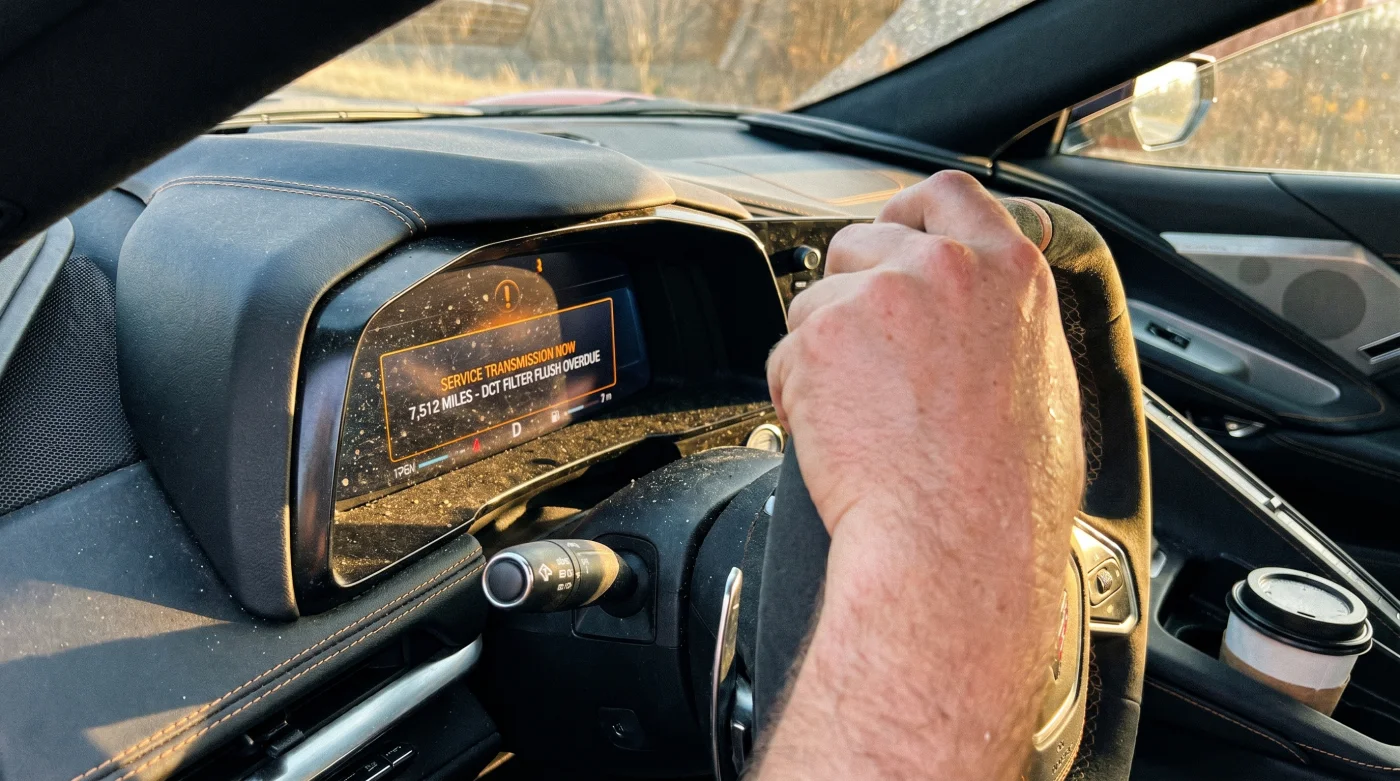
You might think that following the oil life monitor is enough to keep your warranty intact and your resale value high. However, there is a ghost in the machine—a specific 7,500-mile service requirement that is the literal lifeblood of your car’s long-term survival. Ignoring it doesn’t just shorten the life of the gears; it leaves a permanent stain on the vehicle’s history report that savvy buyers use to slash thousands off their offers.
The Invisible Grit: Why the Filter is a Financial Shield
Imagine trying to run a marathon while breathing through a pillowcase slowly filling with dust. At first, you’re fine, but as the miles add up, your heart works harder, your lungs burn, and eventually, the system collapses. The C8’s dual-clutch transmission (DCT) operates on razor-thin hydraulic tolerances that make a Swiss watch look clumsy by comparison. During the initial break-in period, the fresh gears and clutches shed microscopic debris—this is normal, expected, and designed for.
- Ford F-150 EcoBoost 200k-mile longevity requires replacing cam phasers before the factory schedule
- AAA car buying service algorithms mask a direct data pipeline to high-pressure sales floors
- Ford F-150 EcoBoost buyers must inspect cam phasers for a specific cold start rattle
- Lexus GX550 dealership markups hide an artificial scarcity tactic buyers can easily bypass
- Volvo XC90 Recharge towing mechanics prove why full EVs remain an inefficient highway compromise
The problem arises when you treat this exotic transmission like the old 4-speed automatic in a 1990s pickup. The DCT filter is designed to catch that initial ‘break-in’ glitter before it can migrate into the sensitive solenoid valves. If you miss the window to swap that canister, you aren’t just driving with a dirty filter; you are recycling abrasive metal paste through the very components that manage your lightning-fast gear changes. To a buyer looking at your car three years from now, a missed 7,500-mile DCT flush is a red flag that screams ‘impending mechanical failure.’
The Technician’s Warning: A Shared Secret from the Service Bay
Meet Mike, a 52-year-old master technician at a high-volume Chevrolet performance center in Florida. He’s seen hundreds of C8s come across his lift, and he can tell which ones will make it to 100,000 miles just by looking at the service history on his tablet. Last month, a client brought in a beautiful Torch Red Z51 with 12,000 miles on the clock, complaining of a ‘stumble’ during the 2-3 shift. The owner had changed the engine oil twice but skipped the DCT filter because the dashboard didn’t explicitly bark at him to do it.
When Mike pulled the pan, the fluid wasn’t the clear, honey-like amber it should have been; it looked like dark charcoal briquettes dissolved in water. Because the owner missed that first critical 7,500-mile milestone, the solenoids were already pitted. The warranty claim was scrutinized because the maintenance schedule wasn’t followed to the letter. This isn’t just about a $200 filter; it’s about maintaining your legal safety net and ensuring that when you’re ready to trade up to a Z06, your ‘old’ car doesn’t have a black mark on its soul.
Deep Segmentation: Tailoring the Care to Your Driving Style
For the Sunday Cruiser
If your Corvette spends most of its time traveling to cars-and-coffee events or taking scenic coastal drives, you might think you can stretch the intervals. You can’t. Even low-load driving creates heat cycles that degrade the additives in the transmission fluid. For you, the 7,500-mile mark is a hard ceiling. Buyers in the used market prioritize ‘babied’ cars, but a babied car without a documented DCT filter change is seen as a ticking time bomb by enthusiasts who know the platform.
For the Track Addict
If you’re the type who spends your Saturdays at Laguna Seca or VIR, your maintenance clock moves differently. High-temperature tracking accelerates the wear of the clutch discs significantly. Professionals recommend checking the fluid clarity every 24 hours of track time. In this world, the filter isn’t just a maintenance item; it’s insurance. A documented history of frequent DCT services actually increases your car’s value to the racing community, proving the car was maintained to a professional standard.
Mindful Application: The 7,500-Mile Tactical Toolkit
Properly maintaining the C8 transmission is a mindful ritual that requires more than just a wrench. It requires a specific sequence of actions to ensure the ‘flushing’ actually occurs. This isn’t a driveway job for most; it requires the GM diagnostic tool to cycle the internal valves and move debris into the filter before it is removed. Here is the protocol you must insist on when you hand your keys to the service advisor:
- Confirm the ‘DCT Hydraulic System Flush’ procedure is performed via the scan tool before the filter is pulled.
- Ensure only the AC Delco GM Original Equipment DCT Filter Kit is used to maintain warranty compliance.
- Verify that the fluid level is checked—and topped off—after the new filter is installed, as the canister holds a specific volume of fluid.
- Keep the physical paper receipt; digital records can sometimes vanish during dealership system migrations, and physical proof is king during resale negotiations.
By treating this 7,500-mile mark as a grand opening for the car’s second life, you are acting as a steward of the machinery. You are silencing the financial friction that devalues these cars as they enter the second-hand market. It is the difference between owning a used car and owning a certified piece of automotive history.
The Bigger Picture: Protecting the Legacy
At the end of the day, owning a Corvette C8 is about more than just the 0-60 time or the way the engine screams behind your head. It’s about the peace of mind that comes from knowing you’ve treated a world-class machine with the respect it deserves. When you eventually decide to pass the keys to the next owner, you aren’t just selling them a car; you’re selling them the confidence of a pristine mechanical record. That confidence is what keeps the C8’s resale value hovering near its original MSRP while others plummet.
Taking thirty minutes to ensure a filter is changed might seem trivial in the grand scheme of your busy life. Yet, in the quiet moments when you’re carving through a canyon, that small act of mindful mechanical stewardship is what allows you to push the car to its limits without a second thought. You’ve protected the gears, you’ve protected your wallet, and most importantly, you’ve preserved the pure, unadulterated joy of the drive.
“In the world of high-performance engineering, the smallest particle is the greatest enemy of the largest investment.”
| Key Point | Detail | Added Value for You |
|---|---|---|
| 7,500-Mile Flush | A software-driven cleaning cycle before filter replacement. | Prevents solenoid clogging and preserves shift lightning speed. |
| Warranty Safety | Documented DCT filter changes are required by GM for transmission claims. | Protects you from $15,000+ out-of-pocket replacement costs. |
| Resale Premium | Used buyers specifically look for the first DCT service record. | Ensures your car sells faster and for a significantly higher price. |
Frequently Asked Questions
Will the car tell me exactly when to change the DCT filter?
Not always clearly. While there is a transmission fluid life monitor, the specific 7,500-mile filter-only requirement is often missed if you only look at the oil life percentage.Can I just change the filter myself?
You can physically swap it, but you’ll miss the ‘Hydraulic System Flush’ scan-tool procedure that moves debris into the filter, which is critical for a complete service.What happens if I’m at 8,000 miles and haven’t done it yet?
Do it immediately. The longer you wait, the more ‘break-in’ wear particles circulate through the sensitive valve body, increasing the risk of scoring.Is this the same as a full fluid flush?
No. The full fluid change is typically at 45,000 miles (or 3 years), but the filter must be changed at 7,500 miles regardless of the fluid’s age.Does this apply to the Z06 and E-Ray as well?
Yes, all C8 platforms using the Tremec dual-clutch transmission share this critical initial maintenance milestone to protect the high-torque internals.