The morning air in a suburban parking lot has a specific, thin stillness. You hear the low, rhythmic thrum of a dozen cooling fans spinning inside tall white monoliths. There is a specific satisfaction in the heavy click of a NACS adapter mating with your CCS1 plug—a sound that promises the freedom of the most reliable charging network in America. You feel the weight of the thick, liquid-cooled cable in your hand, cold and unyielding in the dawn air, smelling faintly of ozone and damp asphalt.
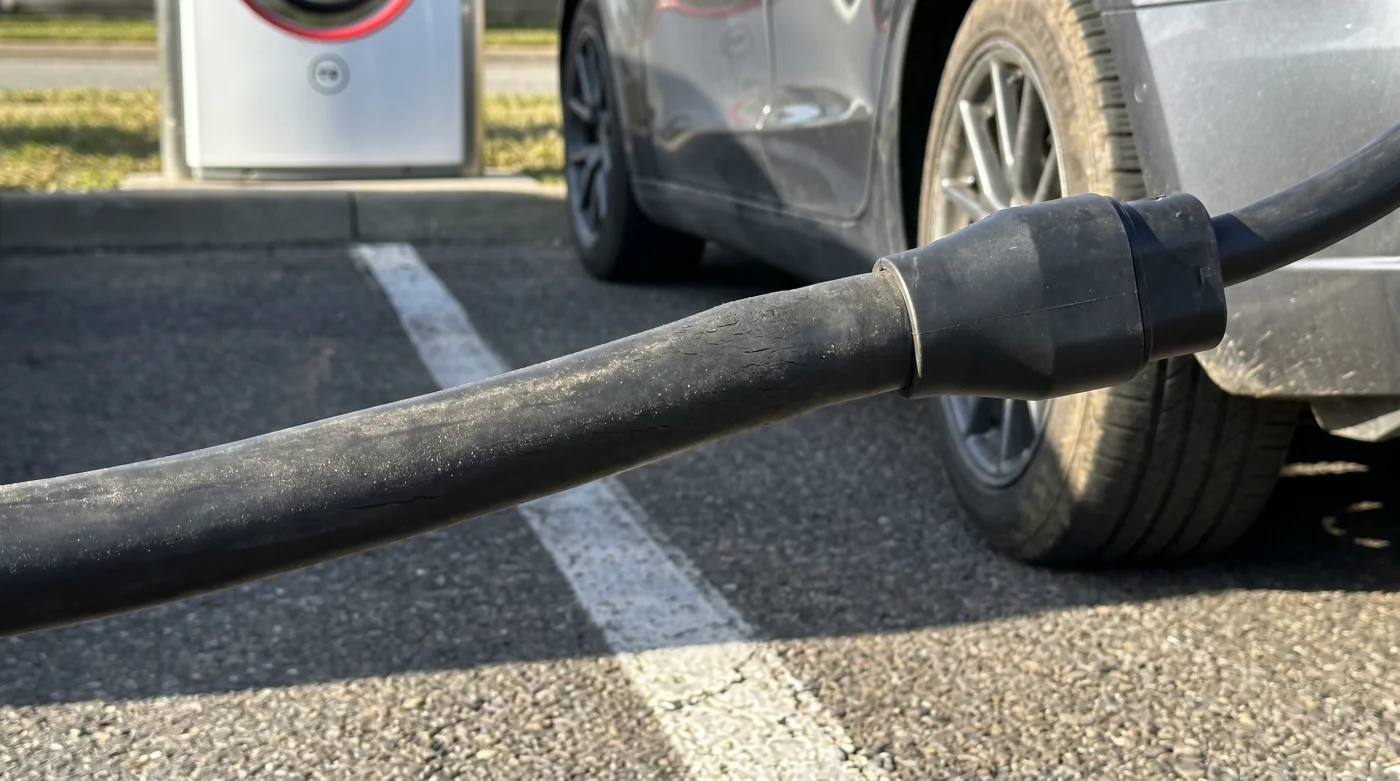
But as you pull your non-Tesla EV up to the stall, that satisfaction quickly evaporates into a cold sweat. You realize the cable isn’t just short; it is **breathing through a pillow**. It strains against your fender, a rigid rubber tether that simply was not designed for a vehicle of your width or a port located on the opposite corner. You are left staring at the dashboard, hovering awkwardly between two parking spots, feeling the silent judgment of five Tesla owners burning into the back of your neck.
The industry-wide pivot to the North American Charging Standard was supposed to be the moment the ‘range anxiety’ ghost was finally laid to rest. Instead, it has revealed a fundamental disconnect between digital protocols and physical geometry. While the electrons flow perfectly fine through the pins, the **physical reach of the hardware** creates a social and logistical nightmare that no software update can fix in the immediate future.
The Short Blanket: Why NACS is a Physical Mismatch
Imagine trying to sleep under a blanket that is six inches too short for your frame. If you pull it up to cover your shoulders, your feet freeze; if you tuck your toes, your chest is exposed. This ‘Short Blanket’ metaphor perfectly describes the current state of the NACS rollout. Tesla designed its Superchargers with a **singular vehicular blueprint** in mind: a port located at the driver-side rear. By keeping the cables extremely short, Tesla minimized energy loss and reduced the physical clutter of the station.
Now, enter the rest of the automotive world. When you take a Ford F-150 Lightning or a Rivian R1T to a V3 Supercharger, you aren’t just plugging in a car; you are trying to fit a square peg into a circle that is twenty feet away. Because the cables are often less than ten feet long, a vehicle with a front-left or rear-right port **cannot reach its designated charger** without parking in the wrong stall. You are effectively forced to become ‘that guy’—the one blocking two spots just to get a sip of power.
- Ford BlueCruise sensors misread specific highway exit shadows as emergency braking obstacles
- EV tax credit lease loopholes allow high-income buyers to bypass strict household limits
- Chevy Blazer EV interior components expose a shared plastics bin with budget crossovers
- Ford F-150 Lightning winter towing tests reveal a massive payload range penalty
- Truck accident lawyer searches surge as commercial dashcams expose fleet liability loopholes
Marcus, a 48-year-old logistics coordinator from Ohio, recently shared a story about his first experience with the adapter. He pulled his Mustang Mach-E into a busy station near Columbus, only to realize he had to park two feet over the line to make the connection. ‘I felt like a trespasser,’ he said. ‘I had the right adapter, the right app, and the right credit card, but the **concrete and the curb** were telling me I didn’t belong there.’ This shared secret among non-Tesla owners is the new friction point of the EV era.
The Geometry of Frustration: Port Locations and Rivalries
The problem isn’t just a lack of cable; it is a legacy of design philosophy. For years, manufacturers placed charging ports based on internal battery packaging and safety ratings rather than a universal curb-side standard. This has created three distinct ‘cliques’ of frustration at the charging pedestal, each requiring a different level of parking gymnastics to survive the experience.
- The Rear-Right Crowd: Vehicles like the Hyundai Ioniq 5 or the Audi e-tron often place the port on the passenger rear. To charge at a standard Tesla stall, these drivers must park in the stall to the right of the charger, effectively ‘stealing’ the spot for the next person in line.
- The Front-Left Pioneers: Ford and Rivian often opt for the driver-side front. This requires a ‘nose-in’ approach that often leaves the rear of the vehicle hanging precariously out into the driving lane, a nerve-wracking position in a busy rest stop.
- The Center-Nose Oddities: Some older models or niche EVs have ports directly in the grille. These are the lucky few, but even they struggle with the height of the pedestal and the tension of the heavy NACS cable.
This physical incompatibility creates a ‘shadow inventory’ problem. A station might show as having four open stalls on your app, but if two non-Tesla vehicles are parked incorrectly to reach the cables, those **open stalls are actually unusable**. It is a phantom shortage that triggers immediate friction between drivers during peak travel hours.
Survival Tactics for the Non-Tesla Pioneer
Navigating this transition requires more than just a piece of plastic hardware; it requires a tactical approach to parking that most drivers never had to consider. You must treat every charging stop like a game of three-dimensional chess. The goal is to minimize your footprint while ensuring the **cable does not rub** against your paint or put undue tension on your vehicle’s charging port.
Before you even put the car in park, assess the ‘End-Cap’ stalls. These are the holy grail of non-Tesla charging. By using the very last stall on either end of a row, you can often park slightly outside the painted lines without blocking a second charger. This is the **most mindful way to charge**, as it preserves the interior stalls for the Tesla owners who were there first.
- Identify the ‘Master Charger’: Check if the station uses V4 posts, which feature significantly longer cables (roughly 10 feet) designed specifically for this transition.
- Angle of Attack: If you must use a mid-row stall, pull in at a slight 15-degree angle. This small shift can provide the extra two inches of slack needed to prevent port strain.
- The Tension Test: Never force a cable to click. If you have to pull the cable taut like a bowstring, you risk damaging the internal locking pins of your expensive NACS adapter.
- The App Check: Use ‘PlugShare’ to see photos of the specific station layout before you arrive; some older V2 stations are physically impossible for wide trucks.
Beyond the Plug: The Need for Concrete-Level Solutions
This rollout has proven that infrastructure is about much more than electrical compatibility. It is about the physical world—the curbs, the paint, and the length of a rubber hose. We are currently in the ‘adapter phase,’ a messy middle ground where we are trying to patch over a decade of uncoordinated design. True parity will only arrive when the **infrastructure mirrors the diversity** of the vehicles using it.
Tesla’s move to the V4 ‘Magic Dock’ and longer-cable pedestals is the light at the end of the tunnel, but thousands of older V3 stalls will remain in service for years. For you, the driver, this means mastering the art of the ‘awkward park’ and maintaining a level of empathy for those around you. The NACS transition is a massive win for the industry, but it remains a **physical struggle for the individual**. Every time you successfully navigate a tight stall and hear that charging hum, you are a pioneer in a world that is still learning how to fit your car into its plans.
Ultimately, the peace of mind you seek comes from knowing the limits of your gear. Don’t expect the charger to move for you; instead, move your perspective to find the one stall that works. The transition is bumpy, but the ability to tap into the world’s most robust network is worth a few **clumsy parking maneuvers** on a Tuesday morning.
“Standardization is a beautiful theory until it meets the stubborn reality of a six-inch curb and a five-foot cable.”
| Vehicle Port Location | Resulting Conflict | Practical Workaround |
|---|---|---|
| Rear Right (Hyundai/Kia) | Blocks the adjacent right-hand stall | Prioritize ‘End-Cap’ stalls to keep adjacent spots open. |
| Front Left (Ford/Rivian) | Requires ‘nose-in’ parking, often straining cable | Approach at a 15-degree angle to create slack. |
| Front Right (Leaf/Niche) | Severe reach issues on older V3 units | Seek out newer V4 pedestals with 10-foot cables. |
Common Questions About NACS Adapter Hurdles
1. Why doesn’t Tesla just add cable extensions? Cable extensions cause significant heat buildup and voltage drop, which can damage the high-speed charging hardware and reduce efficiency.
2. Are all Superchargers now open to non-Tesla vehicles? No, only specific V3 and V4 stations are compatible; older V2 stations lack the necessary communication hardware to talk to your adapter.
3. Will I get fined for blocking two spots while I charge? While unlikely to result in a legal fine, it can lead to negative social interactions or ‘ICEing’ complaints; always aim for the end stalls first.
4. Does the adapter slow down my charging speed? Generally, no. Most high-quality NACS-to-CCS adapters are rated for up to 250kW, though your vehicle’s own thermal management usually dictates the actual speed.
5. Is the short cable issue permanent? New Tesla V4 stalls feature longer cables specifically for this reason, but retrofitting thousands of existing V3 stalls is a slow, expensive process.