You stand on the sun-baked asphalt of a suburban dealership, the glare glinting off the ruby-red paint of a 2019 Ford Escape. It smells like ozone and industrial carpet cleaner, that sharp, artificial scent designed to mask a history of grocery runs and family road trips. You pull up the vehicle history report on your phone, and the green checkmarks feel like a warm hug. No accidents. No lemon status. Just a single owner who seemingly babied this crossover for fifty thousand miles. You run your hand along the door edge, and the metal feels smooth, cool, and permanent.
But beneath that glossy clear coat, a silent chemical war is being waged. It is not the kind of rust that bubbles up on a fender like a bad rash. It is a structural cancer that thrives in the shadows, specifically where different metals meet and forget how to coexist. If you do not know where to look, you are not just buying a car; you are buying a ticking clock wrapped in a four-star safety rating.
The silence of the engine bay when the hood is popped often hides the most aggressive betrayal. While the rest of the world looks at the tires and the oil dipstick, the real truth of a used Escape is found in the dark crevices where the factory assembly logic fails. You have to be willing to get your hands dirty, reaching past the plastic shrouds to touch the bones of the machine.
The Galvanic Betrayal: When Metals Fight Back
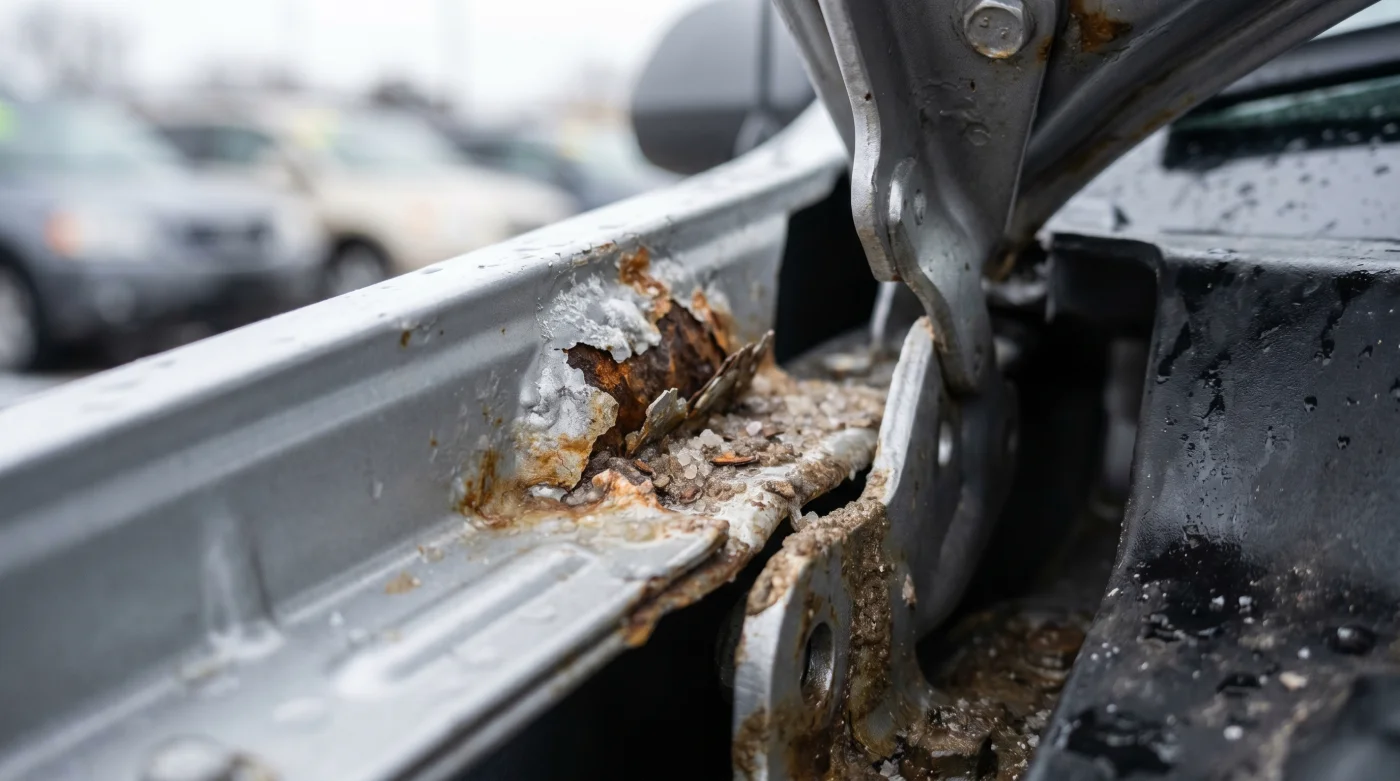
To understand why a clean history report misses this, you have to view the Ford Escape as a giant battery rather than a vehicle. This is the logic of galvanic corrosion. Ford, in an effort to shed weight and improve fuel economy, married an aluminum hood to a steel subframe and support structure. On paper, it is a brilliant engineering feat. In the real world, when salt, moisture, and road grime bridge the gap between these two materials, they create a microscopic electrical current. This current strips ions from the metal, turning structural integrity into a fine, orange powder.
Think of it like breathing through a pillow; the car is struggling to maintain its shape while the very elements it was built with are working to dissolve it. This is why the ‘Second-Hand Shield’ matters. Dealers will show you a shiny undercarriage that has been sprayed with a cheap black ‘reconditioning’ paint, but they rarely look at the precise mating point where the aluminum front-end meets the steel cab corners. This is the ‘hidden trim’ of the repair world—a flaw that costs thousands but stays invisible to a casual observer.
- Chevy Tahoe 200k-mile longevity requires entirely bypassing the factory recommended transmission flush schedule
- Honda Civic LX base models retain the most durable naturally aspirated engine without turbo lag
- Ford F-150 Lightning dealer markups artificially inflate the sticker price bypassing federal rebates
- Jeep Grand Cherokee grille redesign silently restricts engine airflow causing severe highway overheating
- Chevrolet Silverado Custom trims hide the exact towing capacity found in the High Country
The Body Shop Secret
Marcus, a 52-year-old master welder in Youngstown, Ohio, has seen this story play out a hundred times. He calls it ‘the ghost in the machine.’ Last winter, a woman brought in an Escape that looked showroom-new, but when he put it on the lift, the front cab corner assembly crumbled under the pressure of a screwdriver. ‘The computer says it is a clean car,’ Marcus told me while wiping grease from his forehead. ‘But the chemistry says it is a liability. Once that bond between aluminum and steel is breached, the structure loses its ability to manage a crash pulse. It is not just about looks; it is about surviving a hit.’
Segmenting the Risk: From Salt Belts to Sun States
Not every Ford Escape is a casualty of this metal-on-metal war. You have to categorize the vehicle based on its ‘biological’ history. The Salt-Belt Veteran is the highest risk. If the car spent its life in Michigan or New York, the calcium chloride used on winter roads acts as an accelerant for the galvanic process. For these vehicles, the cab corner inspection is non-negotiable.
Conversely, the High-Heat Nomad from Arizona or Nevada might show perfect structural integrity but suffer from ‘hood-lip’ bubbling. This is a cosmetic precursor to the structural issue. Even if you live in a dry climate, if that car was originally a fleet vehicle from a northern auction, the damage is already seeded. You are looking for the white powdery residue—the first sign that the aluminum is sacrificing itself to the steel.
The Five-Minute Forensic Audit
Checking for this hidden rot does not require a mechanic’s license, but it does require a specific set of mindful actions. You are looking for ‘tearing seams’ where the metal should be fused. Follow these steps with a flashlight and a plastic pry tool in hand:
- Open the hood and locate the precise mating point where the hood hinges meet the steel firewall.
- Feel along the inner lip of the cab corner, just behind the front wheel well liner; if the metal feels ‘crunchy’ or has the texture of dried leaves, walk away.
- Look for ‘blistering’ paint on the underside of the hood near the latch; this indicates the aluminum is already oxidizing from the inside.
- Inspect the subframe bolts; if the washer is fused to the frame with orange crust, the galvanic cycle is in full swing.
- Use your flashlight to peek behind the plastic wheel arch molding; look for ‘rust weep’—streaks of orange running down the interior paint.
Your tactical toolkit should be simple: a high-lumen flashlight, a pair of nitrile gloves, and a small magnet. Remember, the magnet will not stick to the aluminum hood, but if it fails to stick to a section of the ‘steel’ frame, you are likely touching a patch of fiberglass or body filler used to hide a hole.
The Bigger Picture: Buying Truth, Not Just Paint
In a world of digital reports and computerized diagnostics, we have forgotten that cars are still physical objects subject to the laws of chemistry. Mastering the art of the under-the-hood inspection provides a level of peace of mind that no ‘Certified Pre-Owned’ sticker can match. It is about reclaiming your agency as a buyer. When you find that hidden spot of corrosion, you are not just finding a flaw; you are seeing the car for what it truly is.
This level of scrutiny might feel obsessive, but it ensures that the vehicle you trust to carry your family is actually capable of protecting them. Realizing that a ‘clean’ car can be structurally compromised is a heavy perspective shift, but it is one that saves you from a five-figure mistake. A car is more than its MSRP or its infotainment screen; it is a structural promise. Make sure the one you buy can keep it.
“The most expensive car you will ever buy is a cheap one with a hidden history written in oxidized metal.”
| Inspection Zone | The Silent Indicator | Value for the Buyer |
|---|---|---|
| Hood-to-Frame Mating Point | White powdery oxidation or ‘salt’ crystals | Detects early-stage galvanic corrosion before failure. |
| Inner Cab Corner | Textural ‘crunch’ or bubbling under the paint | Prevents buying a car with compromised crash safety. |
| Wheel Arch Moldings | Orange streaks or ‘weeping’ rust lines | Identifies hidden rot that ‘reconditioned’ paint fails to hide. |
Is a Ford Escape safe if it has minor hood bubbling?
Cosmetic bubbling on the aluminum hood is common and doesn’t always mean structural rot, but it is a red flag that the galvanic process has begun; you must check the steel subframe immediately.Why doesn’t Carfax show this structural rust?
Vehicle history reports only track documented events like accidents or title transfers; they cannot ‘see’ environmental damage or slow-moving chemical reactions in the metal.Can I fix this rust once it starts?
Galvanic rust is notoriously difficult to stop because it is a molecular reaction; while you can slow it with oil-based undercoating, true structural rot usually requires expensive panel replacement.Does this affect the 2020 and newer models?
While Ford improved the sealing processes in later generations, the mix of aluminum and steel still requires a watchful eye, especially in high-salt environments.Will a pre-purchase inspection (PPI) catch this?
Only if the mechanic is specifically looking for galvanic issues; many standard inspections focus on the engine and suspension rather than structural metal interfaces.