The sun barely clears the neighbor’s roofline when you climb into the saddle, the scent of cold vinyl and coffee filling the cabin. You thumb the starter, and the 2.7-liter V6 settles into its rhythmic, mechanical hum. There is a specific pride in seeing that massive hood bulge from the driver’s seat, a visual promise that you can conquer anything from a rock crawl in Moab to a flooded creek bed. But as you crank the wheel to back out of your suburban driveway, a sharp, metallic tink echoes through the floorboards. It is a tiny sound, almost imperceptible over the tire noise, yet it feels like a fracture in the dream.
After 40,000 miles, the Sasquatch package—the very thing that gives this truck its predatory stance—starts to feel less like armor and more like a weighted vest. On the highway, the steering wheel no longer snaps back to center with authority. Instead, it wanders like a tired horse, requiring constant micro-corrections just to stay between the painted lines. You aren’t traversing the Rubicon Trail; you are driving to the grocery store, yet the steering rack is behaving as if it has spent a decade jumping sand dunes.
The reality of a heavy-duty off-roader in a low-impact world is a study in unintended consequences. Those 35-inch Goodyear Territory tires, while magnificent to look at, weigh nearly 70 pounds apiece. Every time you hit a manhole cover or a sunken utility patch at 45 miles per hour, that mass sends a shockwave straight up the tie rods. It is a slow-motion demolition of the steering’s internal geometry, happening one pothole at a time in the most mundane environments imaginable.
The Pendulum of Unsprung Weight
To understand why a rugged truck fails on smooth pavement, you have to visualize the steering rack as a delicate clockwork mechanism being hammered by a sledgehammer. We often think of “wear and tear” as a product of extreme heat or mud, but the real killer is moment of inertia. When you turn a 35-inch tire on high-friction asphalt, the steering rack has to fight against the massive surface area of the rubber. The Sasquatch rack, while beefed up from the base model, still relies on inner tie rod ends that are essentially the sacrificial lambs of the front end.
- GM vehicle safety recall 2026 exposes a massive software flaw during early autonomous testing
- New Honda design concepts reintroduce physical interior dials after digital touchscreens caused tactile blindness
- Honda CR-V parasitic battery drains require a simple relay replacement instead of expensive alternators
- Chevrolet Silverado transmission thermal bypass neglect silently destroys torque converters ruining truck resale value
- Jeep Wrangler 200k-mile longevity requires replacing the oil cooler housing before factory schedule warnings
Think of it as breathing through a pillow. The power steering motor is working overtime to push those wide contact patches across the pavement, and the inner tie rods absorb the brunt of that resistance. In a suburban setting, where you are constantly performing low-speed maneuvers, parallel parking, and three-point turns, the steering rack experiences higher torque loads than it often does on a slippery, muddy trail. On dirt, the tires can slide; on asphalt, they grip, and that grip pulls the rack apart from the inside out.
Elias, a 52-year-old master technician at a high-volume Ford dealership in northern Virginia, has become the local whisperer for these issues. “I see three Sasquatches a week with the same ‘mysterious’ front-end clunk,” he told me while wiping grease from a pair of worn-out boots. He explained that the factory grease in the inner ball joints often thins out prematurely under the heat of constant suburban friction. “People think they’re safe because they don’t go off-road, but the street is actually harder on the rack because there’s no ‘give’ in the surface. The truck is essentially fighting itself every time you pull into a Starbucks parking lot.”
Living with the Beast: A Usage Breakdown
Not every Bronco owner experiences this degradation at the same rate. The way you interact with the steering wheel during the first five minutes of your commute dictates whether your rack will survive to 100,000 miles or fail before the factory warranty expires. The stress is cumulative, but certain environments act as catalysts for the decay.
For the Suburban Commuter, the danger lies in the “dry steer.” This is the act of turning the wheels while the vehicle is completely stationary. With the Sasquatch’s wide tires, dry steering creates astronomical levels of pressure on the internal rack gears. If you find yourself frequently navigating tight parking garages or cul-de-sacs, your inner tie rods are likely weeping grease as you read this. This group often sees failure symptoms—like a loose “dead spot” in the center of the steering—as early as 25,000 miles.
The Weekend Explorer, paradoxically, might have a healthier steering system. By taking the truck onto gravel or dirt once a month, they allow the steering components to move through their full range of motion on a surface with low resistance. This helps distribute the internal lubricant and relieves the lateral tension that builds up during a week of highway driving. However, if that weekend includes “whoops” or high-speed washboards, the sheer vibration can accelerate the backing-out of the rack’s mounting bolts.
The 40,000-Mile Health Check
If your Bronco has crossed the 30,000-mile mark, you need to perform a mindful inspection. You don’t need a degree in mechanical engineering, but you do need to develop an ear for the machine. The goal is to catch play in the system before a tie rod snaps or the rack housing cracks, which can turn a routine drive into a dangerous loss of control.
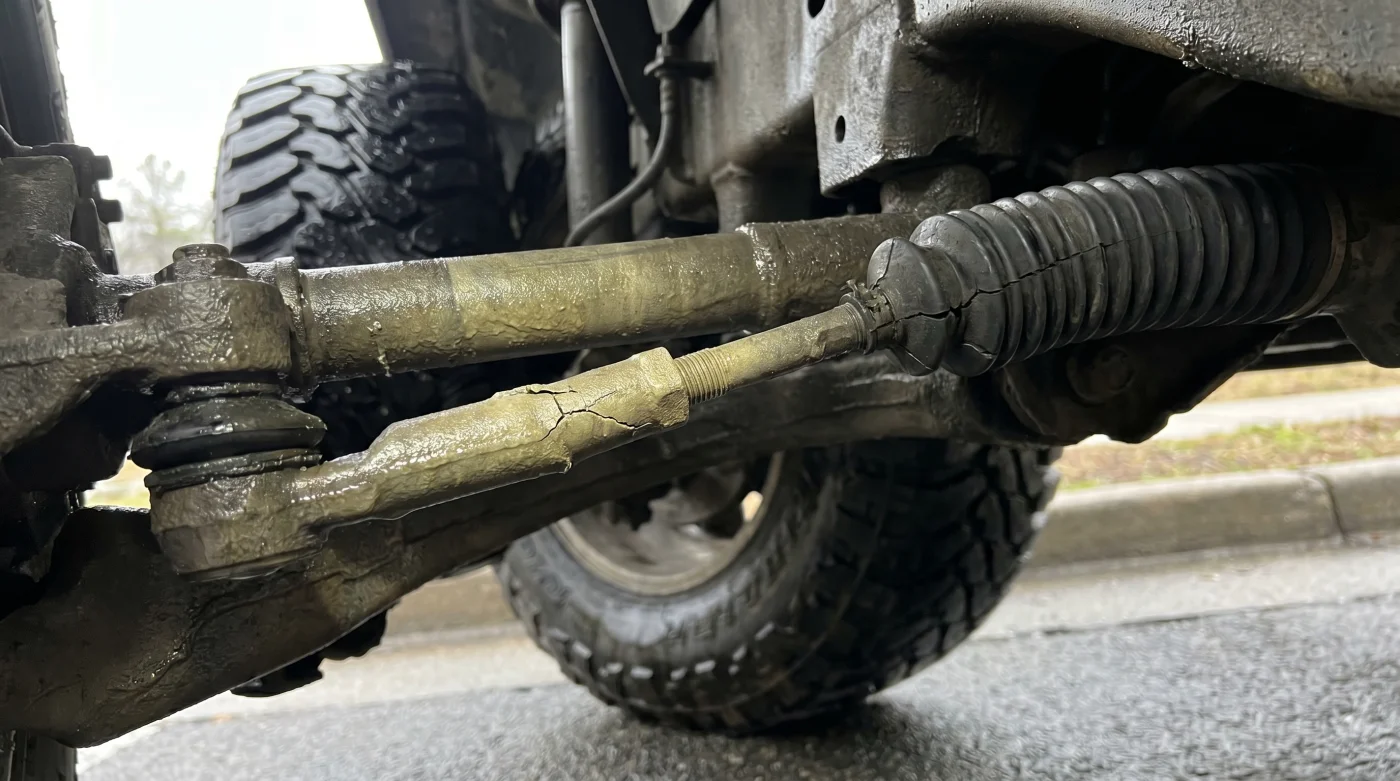
- The 9-and-3 Test: With the front wheels off the ground, grab a tire at the 9 o’clock and 3 o’clock positions and shake it firmly. Any clicking or movement indicates a failing inner tie rod.
- The Boot Squeeze: Locate the rubber dust boots on the steering rack. If they feel “crunchy” or if you see fluid seeping from the clamps, the internal seals are compromised.
- The Harmonic Listen: Have a friend turn the wheel lock-to-lock while you stand near the front wheel well. Listen for a low-frequency groan or a repetitive popping sound.
To mitigate the wear, practice the “rolling turn.” Never move the steering wheel unless the truck is at least slowly rolling forward. This reduces the frictional load on the rack by nearly 40 percent. Additionally, consider upgrading to heavy-duty aftermarket tie rod sleeves. These simple steel tubes slide over the existing rods and prevent them from bending under the weight of those 35-inch tires during sudden impacts with potholes.
Reclaiming Your Connection to the Road
Owning a Sasquatch-equipped Bronco is a commitment to a specific lifestyle, one that values capability above all else. But that capability comes with a hidden tax that the brochures don’t mention. Realizing that your truck is vulnerable to the street isn’t a reason to love it less; it is a reason to understand it better. When you acknowledge that the massive rubber and heavy wheels are a burden on the steering, you become a more deliberate driver.
There is a peace of mind that comes from knowing exactly how your vehicle works and where its weaknesses lie. By shifting your habits—avoiding dry steering and performing regular inspections—you ensure that when you finally do leave the pavement behind, your steering is crisp and reliable. The Bronco is a masterpiece of modern engineering, but even a masterpiece needs a watchful eye to keep the suburban jungle from wearing it down to the bone.
“The biggest threat to a Sasquatch’s longevity isn’t a boulder field in the desert; it’s the high-grip friction of a suburban cul-de-sac.”
| Component | Failure Symptom | The Value Fix |
|---|---|---|
| Inner Tie Rods | Metallic clicking during turns | Upgrade to hardened steel sleeves |
| Steering Rack Seals | Fluid leaking into dust boots | Avoid ‘dry steering’ while stationary |
| Rack Mounting Bolts | Vibration in the wheel at 60mph | Torque-check bolts every 10k miles |
Is the ‘clunk’ sound covered under warranty?
Yes, if your Bronco is under 36,000 miles, Ford generally replaces the rack or tie rods, though they may claim ‘normal wear’ if there is evidence of off-road abuse.Will smaller tires save my steering rack?
Significantly. Dropping to a 33-inch tire reduces the leverage exerted on the rack components, though it changes the Sasquatch’s signature look.Can I grease the inner tie rods myself?
Modern units are often sealed, but some aftermarket replacements come with Zerk fittings, allowing you to flush out old grease periodically.How do I know if it’s the rack or just an alignment issue?
An alignment issue usually causes a constant pull, while a failing rack creates ‘slop’ or play where you can move the wheel without the truck reacting.Are aftermarket steering racks better than OEM?
Billet aluminum racks are available and much stronger, but they are expensive and can transmit more vibration into the cabin.