The air in a used car lot usually smells of cheap ozone generators and wet upholstery, but with an electric vehicle, the atmosphere is unsettlingly sterile. You stand there, smartphone in hand, watching a progress bar on a third-party app claim the battery health is a perfect ninety-two percent. The silent hum of the cooling fans kicking in feels like a reassurance, a digital pulse saying everything is fine under the hood. But as you crouch near the front wheel well, a different sensation hits you—the faint, cloying scent of warm maple syrup hanging in the still morning air.
It is a smell that shouldn’t exist in a machine without an engine, a sweetness that signals a slow-motion disaster. You look at the pristine white seats and the massive touchscreen, feeling the pull of the future, yet your instincts settle on that sugary aroma. Most buyers are mesmerized by battery cycles and software versions, ignoring the fact that these rolling computers are still, at their core, slaves to a complex web of plumbing. If the fluid isn’t moving, the battery is dying, and no software update can fix a physical breach.
The ground beneath the front bumper is dry, which is exactly why this inspection is so deceptive. Unlike an internal combustion engine that leaves a greasy puddle of oil as a calling card, an EV leak often stays hidden behind aerodynamic shields and plastic cladding. It evaporates against the heat of the inverter or crystallizes into a hard, colorful crust before it ever hits your driveway. You are looking for a ghost in the machine, and finding it requires moving past the screen and getting your hands dirty on the chassis.
The Battery Health Mirage and the Plumbing Reality
We have been conditioned to believe that the ‘Health’ percentage on a dashboard is the final word on an EV’s longevity. This is the great digital deception of the second-hand market. Think of that percentage like a fitness tracker on a person’s wrist; it can tell you the heart rate is steady, but it won’t show you the arterial blockage that’s about to cause a stroke. In an electric vehicle, the ‘arteries’ are the high-voltage coolant lines that snake from the radiator assembly to the battery pack and the power electronics.
- Chevy Equinox 200k-mile survival demands ignoring the factory scheduled transmission fluid flush completely
- Electric car base trims secretly utilize software locked batteries identical to expensive extended range models
- Rivian R2 pricing structures mask a severe destination charge penalty destroying base model value
- Toyota compact pickup truck news exposes a retro grille restricting essential radiator cooling airflow
- Chevy Colorado Work Truck trims hide the exact towing suspension required for heavy payload stability
These lines carry a specialized, low-conductivity fluid designed to keep the cells at a stable temperature during the violence of DC fast charging. When a line fails, the car doesn’t just ‘run hot’—the electronics can suffer a catastrophic short-circuit or the battery cells can experience localized thermal runaway. Understanding the system means realizing that the hardware holding the fluid is just as critical as the chemistry inside the cells. If the cooling loop is compromised, the battery’s software-reported health is a ticking clock, not a guarantee.
Bill Vance, a 62-year-old retired fleet mechanic from Phoenix, spends his weekends helping buyers vet used EVs. He calls the cooling system the ‘Vulnerable Vein.’ Last month, Bill walked away from a ‘mint’ 2021 crossover because he found a pea-sized accumulation of dried blue crystals near the rear motor housing. ‘The buyer thought I was crazy,’ Bill says. ‘The car only had twelve thousand miles. But that crust meant a seal was breathing, and within a year, that owner would have been looking at a fifteen-thousand-dollar bill for a pack replacement because of fluid intrusion. The app said the battery was perfect; the physical reality said it was a paperweight.’
Identifying the High-Voltage Junction and the White Glove Test
To find the most frequent point of failure, you must look where the flexible rubber hoses transition into the rigid aluminum inlets of the battery pack. On the most popular American EV platforms, this junction is typically located behind the front subframe, often shielded by a plastic ‘aero-plate.’ You cannot see it by merely popping the trunk or looking under the hood; you must bring a set of ramps or at least be willing to slide a camera-phone under the leading edge of the battery tray.
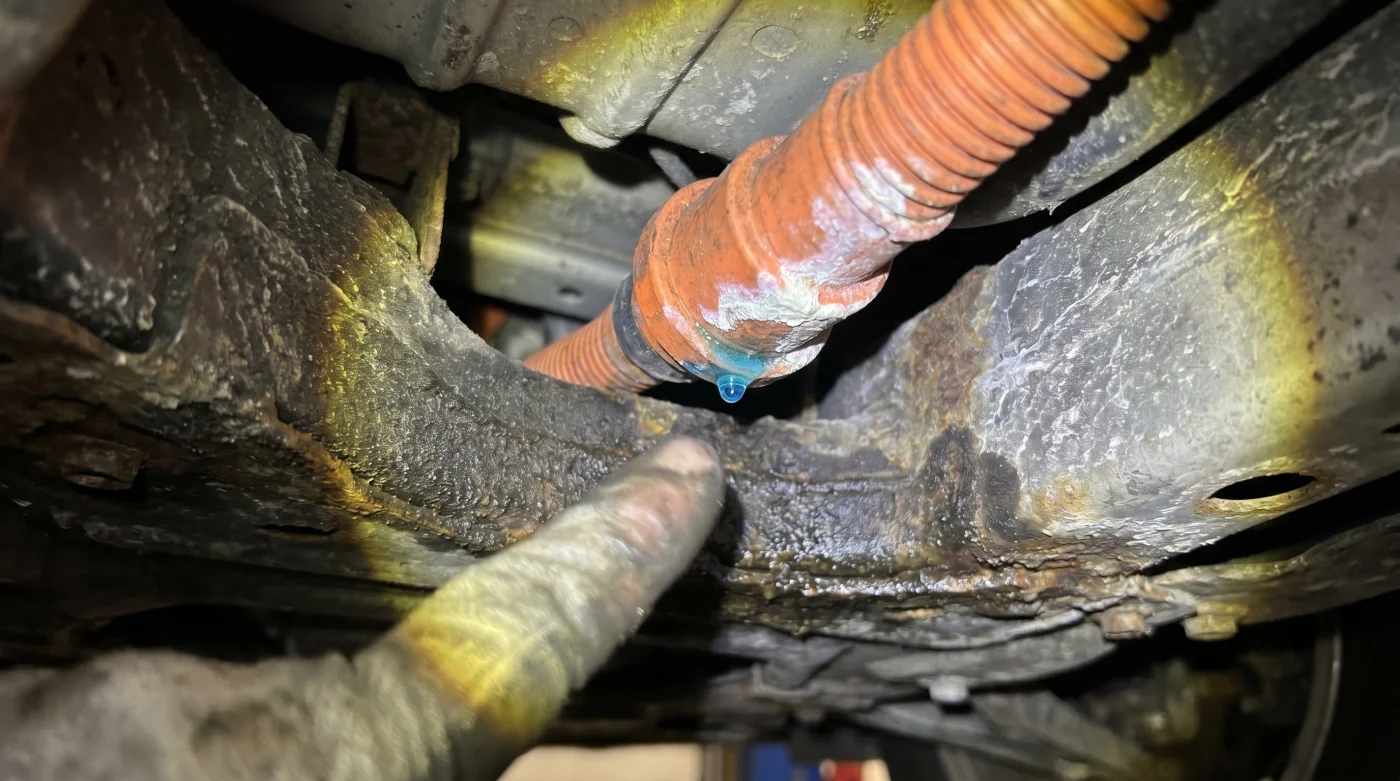
For owners of Tesla Model 3 and Model Y units, the area of interest is the manifold located near the front-left of the battery pack. In Hyundai and Kia e-GMP vehicles, you are looking for the lines that feed into the ‘Integrated Power Assembly’ under the front trunk. You are searching for ‘Crusting’—a phenomenon where the coolant dries into a chalky, colorful residue. Depending on the brand, this will be vibrant blue, neon orange, or a pale violet. If you see any evidence of this ‘candy-like’ substance around the hose clamps, the vehicle is a liability.
Tactical Inspection for Different Driver Profiles
Not all EV cooling systems are stressed in the same way, and your inspection should reflect how the previous owner lived with the car. The failure points shift based on geography and driving habits, making a targeted physical check much more effective than a generic walkaround.
- For the ‘Salt Belt’ Commuter: If the car lived in the Northeast or Midwest, focus on the aluminum-to-rubber transition points. Road salt gets trapped under the plastic shields and creates galvanic corrosion where the metal pipe meets the rubber hose. Look for ‘pitting’ on the metal.
- For the Desert Dweller: In states like Arizona or Nevada, heat is the enemy. The rubber hoses become brittle and lose their elasticity. Squeeze the lines gently (while the car is off and cool). They should feel like a firm garden hose; if they feel like a dry twig or a soft marshmallow, the rubber is failing.
- For the Fast-Charge Enthusiast: Cars that were exclusively DC fast-charged have cooling systems that cycled through extreme temperature swings daily. Check the ‘O-rings’ at the quick-connect fittings. These are the most likely spots for a ‘breathing’ leak that only occurs when the system is under high pressure.
The tactical toolkit for this job is minimal but non-negotiable. You need a high-lumen LED flashlight to cut through the shadows of the underbody and a small telescopic mirror to see the top side of the battery manifold. A pair of nitrile gloves is helpful for the ‘swipe test’—reach into the areas where the lines enter the chassis and wipe your finger across the bottom of the fitting. Any moisture, even if it doesn’t drip, is a sign of a failing seal.
The Peace of Mind in Physical Proof
Mastering this specific inspection point does more than just save you from a bad investment; it changes your relationship with the technology. When you can verify the integrity of the thermal management system, you are no longer at the mercy of a seller’s word or a computer’s optimistic algorithm. You are seeing the car for what it truly is: a mechanical system that requires physical vigilance. There is a profound peace of mind that comes from knowing the ‘veins’ of your vehicle are clear and dry.
Ultimately, the transition to electric mobility doesn’t mean we stop being mechanics; it just means we change what we are looking for. By prioritizing the high-voltage coolant lines over the dashboard apps, you protect your finances and your safety. You ensure that your silent, futuristic drive stays that way, free from the hidden failures that turn a dream car into a driveway ornament. True authority in the used market isn’t about reading the screen—it’s about knowing exactly where the cracks in the armor appear.
“A battery is only as healthy as the fluid that keeps it from cooking itself; never trust a screen when a hose can tell you the truth.”
| Key Point | Detail | Added Value for the Reader |
|---|---|---|
| Coolant Crusting | Dried blue, orange, or purple residue at hose junctions. | Early warning sign of seal failure before the battery dies. |
| Thermal Manifold | The physical junction where hoses enter the battery pack. | The most common leak point that dashboard apps cannot detect. |
| ‘Sweet’ Aroma | The smell of ethylene glycol near the wheel wells. | A sensory cue that saves you from a $15,000 pack replacement. |
Does a battery health app show coolant leaks?
No. Most apps only report the internal resistance and voltage of the cells, not the physical integrity of the external cooling loops.Is coolant crusting always a dealbreaker?
It signals that a seal has failed. While the hose is cheap to replace, you must ensure no fluid has entered the battery casing itself.Why is EV coolant colored so vibrantly?
Manufacturers use bright dyes (blue, orange, violet) specifically to make slow, evaporating leaks visible to technicians during inspections.Can I replace these lines myself?
It is risky. These lines are often adjacent to high-voltage orange cables. Physical inspection is safe, but repairs should be handled by a certified EV tech.How often do these lines fail?
They are generally durable for 100,000 miles, but road debris or salt corrosion can cause premature failure in as little as three years.