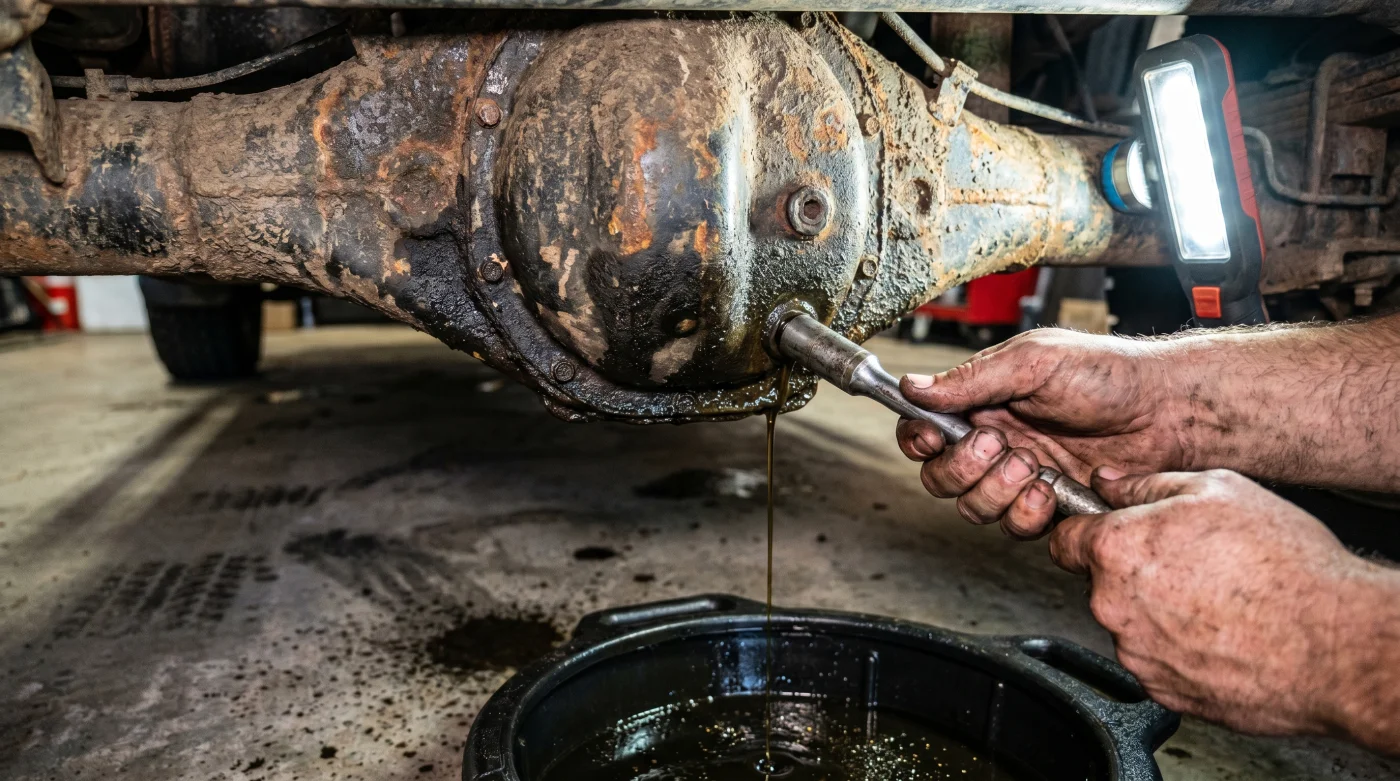
You know the smell of a hot garage on a Saturday afternoon. The scent of cooling metal, old rubber, and the faint, sweet tang of synthetic oil clinging to your hands. You just pulled the drain plug on your Tacoma, watching the dark liquid flow into the pan. You wipe a smear of grease from your forehead, feeling a quiet satisfaction.
You do this every five thousand miles, right on the dot. You follow the manual like it is a sacred text. You swap the filters, rotate the tires, and check the brake pads. You believe this rhythm of maintenance is the armor that will carry your truck past the two hundred thousand mile mark.
But while you are focused on the heartbeat under the hood, something else is slowly suffocating beneath the bed. There is a blind spot in the standard service routine, a heavy cast-iron housing hanging between the rear wheels that rarely gets a second glance. The truth is, clean engine oil will not save you from a catastrophic driveline failure.
We treat engines like royalty and axles like afterthoughts. This silent, grinding neglect is what actually sends legendary trucks to the scrapyard years before their time. The myth of the indestructible powertrain relies on a fluid most people never even check.
The Hidden Armor: A Shift in Driveline Perspective
Think of your powertrain like a marathon runner. The engine provides the lung capacity, but the differentials are the joints absorbing every impact. If the cartilage wears down, the lungs do not matter anymore. You are sidelined. For years, service desks have perpetuated a subtle omission, allowing owners to believe that if the dash lights remain dark and the engine idles smoothly, all is well.
Yet inside that pumpkin-shaped housing on your rear axle, a thick, honey-like gear oil is breaking down. It battles sheer mechanical friction daily every time you press the accelerator. When this fluid shears, it loses its viscosity. It turns from a protective liquid bearing into a gritty, metallic sludge that acts more like liquid sandpaper than a lubricant. The difference between a truck that drives forever and one that whines itself to death is simply knowing where to look.
The Arizona Gear Graveyard
Sam is a sixty-one-year-old independent Toyota specialist working out of a dust-covered cinderblock shop in Mesa, Arizona. His hands are permanently stained a faint shade of grey, and he speaks with a quiet, deliberate cadence. If you ask him about the longevity of a Tacoma, he will not point to the engine block. Instead, he will walk you over to a rusted metal drum sitting in the corner of his bay.
- The Silent F-150 Lightning Flaw The Rivian R1T Avoids Entirely
- The 10-Second Dipstick Test That Exposes A Failing CR-V Transmission
- The Hidden Cladding Purpose In The New Subaru Outback Design
- Dealerships Are Hiding This Palisade Trim Because It Costs Them Money
- Why Skipping The Sasquatch Package Makes The Base Bronco A Better Off-Roader
Inside that drum is a tangled heap of chewed-up ring gears and scorched pinion bearings. He calls it the graveyard of good intentions. Sam explains that nine out of ten trucks he sees with major mechanical failures have perfectly healthy engines. They die because the owners ignored the gear oil until the rear end locked up at highway speeds. ‘People change their engine oil because they can check it with a dipstick,’ he says, wiping down a wrench. ‘The differential hides its damage behind heavy steel. By the time you hear it howling, you are already paying for a rebuild.’
Stress Signatures: How You Drive Dictates How It Degrades
Not all fluid degradation happens at the same pace. The way you use your truck dictates the specific wear pattern on your differential fluid. Understanding your category is the first step toward reclaiming your truck’s true lifespan.
For the Highway Commuter: You might think gentle highway miles are a free pass. They are not. Extended periods of high-speed cruising generate a massive amount of sustained thermal load baking the fluid over time. The constant rotation vaporizes its protective additives. Your gear oil might look relatively clean, but it loses its ability to coat the metal under pressure.
For the Weekend Hauler: The moment you attach a trailer or load the bed with heavy cargo, the pressure on your ring and pinion gears multiplies exponentially. This literal heavy lifting forces the gear teeth together with immense torque, squeezing the fluid to its breaking point. If your fluid is old, the metal-on-metal contact creates microscopic shavings that float in the bath, accelerating the wear.
For the Off-Road Explorer: Water is your absolute worst enemy. Fording a stream or hitting a deep mud puddle submerges the hot axle housing. The sudden cooling creates a vacuum, sucking water past the breather valve. A clogged valve forces the differential to operate like it is breathing through a pillow, blowing out seals and drawing in moisture. Water and gear oil create a toxic, milky emulsion that offers zero lubrication.
The Mindful Fluid Refresh
Taking control of this critical maintenance is a grounded, surprisingly peaceful task. It requires only a handful of tools and a bit of quiet focus under the truck. You are simply draining out the old stress and pouring in fresh resilience.
First, you must always loosen the fill plug before you touch the drain plug. This is a vital rule of thumb. If you drain the fluid first and then discover the upper plug is seized, you are left with an un-drivable truck. A twenty-four millimeter socket and a long breaker bar will usually crack it loose with a satisfying snap.
The Tactical Toolkit:
- A sturdy drain pan with a wide catch area.
- A 24mm six-point socket and a 10mm hex bit.
- Three quarts of premium 75W-90 synthetic gear oil.
- A simple fluid transfer pump to push the new oil upward.
- Fresh crush washers for both the drain and fill plugs.
Once the drain plug is removed, let the thick fluid fall. The surface should tremble slightly as the heavy oil hits the catch pan, a sign of its sheer weight. Wipe the magnetic tip of the drain plug carefully; you will see a fine grey paste of metal shavings. This is normal wear, but cleaning it ensures the magnet can catch future debris. When the dripping stops, replace the lower plug with a new washer. Pump the fresh, golden oil into the top hole until it just begins to weep over the threads. Wipe it clean, tighten it down, and breathe easily.
Hearing the Silence of the Road
Driving your truck after a fresh differential service feels different. It is not a sudden burst of horsepower or a noticeable change in steering. It is an absence of noise. You will notice the quietness of the cabin, the smooth deceleration when you lift your foot off the gas pedal, and the seamless power delivery from the rear axle.
Knowing that those heavy gears are bathed in clean, synthetic protection offers a profound sense of ownership. You have bypassed a catastrophic failure that catches so many others off guard. You are no longer just reacting to dashboard lights; you are actively nurturing the structural integrity of your vehicle. This is how a truck genuinely makes it past two hundred thousand miles, outlasting the trends and the harsh realities of the road.
Longevity is not about catching failures as they happen; it is about respecting the heavy, unseen friction that holds the machine together. — Sam, Independent Specialist
| Key Point | Detail | Added Value for the Reader |
|---|---|---|
| The Fill Plug Rule | Always remove the top fill plug before touching the lower drain plug. | Prevents the nightmare scenario of an empty axle you cannot refill. |
| The Magnetic Catch | The drain plug has a magnet that collects microscopic metal wear. | Cleaning this acts as a diagnostic tool to assess the health of your gears. |
| Water Emulsion | Submerging a hot axle pulls water through the breather valve. | Empowers off-road drivers to change fluid immediately after water crossings. |
Frequently Asked Questions
How often should I actually change my differential fluid? If you commute, aim for every 30,000 miles. If you tow heavily or drive off-road frequently, drop that interval to every 15,000 miles to maintain optimal lubrication.
Can I use any brand of gear oil? Stick to a high-quality 75W-90 synthetic gear oil. The specific brand matters less than ensuring it meets the GL-5 specification required for heavy hypoid gears.
What does a failing differential sound like? It usually starts as a low-pitched hum or whine from the rear of the truck that gets louder as you accelerate or decelerate. By the time you hear it, irreversible wear has occurred.
Do I need to service the front differential as well? Yes. Even if you rarely use four-wheel drive, the fluid in the front differential degrades from thermal cycling and age. Change it on the same schedule as the rear.
Is the transfer case fluid the same thing? No, the transfer case often takes a different fluid, typically a specific gear oil or even automatic transmission fluid depending on the exact year. Always verify with your specific manual.